
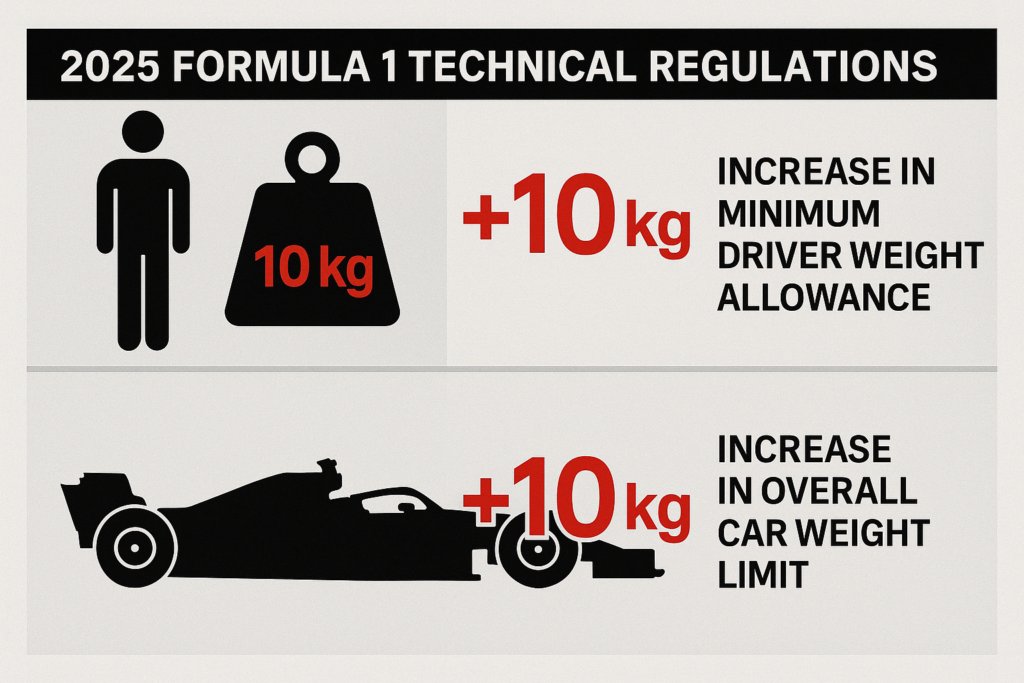
Image Credentials: Image Title: ⚖️ F1 Rebalance: Minimum Weight Rises to Prioritize Driver Well-being Source: (sora.openai) Date: December 2025. Attribution: This image was created using AI-generated imagery (sora.openai) and does not depict a real-world scene.
The 2025 Formula 1 season will see a small but significant adjustment to the Technical Regulations, specifically aimed at promoting driver health and ensuring a fairer playing field for athletes of all sizes. The FIA has confirmed an increase in both the minimum driver weight allowance and the overall car weight limit.
Driver Weight Jumps to 82kg
The most impactful change is the increase in the minimum driver weight allowance from 80 kilograms (176.4 lb) to 82 kilograms (180.8 lb).
This adjustment is a direct response to concerns regarding driver well-being, particularly for the taller or naturally heavier individuals on the grid. Since the introduction of the minimum driver weight rule in 2019, lighter drivers have been required to carry compensating ballast beneath their seat to meet the minimum threshold, mitigating any weight advantage.
However, the previous 80 kg limit often placed undue pressure on taller drivers, such as Alexander Albon or Esteban Ocon, to maintain an unhealthily low body weight to stay competitive. The $2 kg increase is intended to alleviate this pressure, allowing drivers to focus on optimal strength and fitness training rather than restrictive weight-saving measures.
Daniel Ricciardo, among others, has praised the move, noting it gives drivers more “freedom to be athletes” by removing the need to restrict strength training in favour of weight management.
Overall Car Weight Creeps Up
As a direct consequence of the driver allowance rising, the overall minimum weight limit of the car, excluding fuel, will increase from 798$ kilograms ($1,759 lb) to 800 kilograms (1,764 lb).
This minimal 2 kg increase to the car’s overall weight is solely to accommodate the additional allowance for the driver, ensuring the regulatory balance is maintained across the grid.
While this contributes to the ongoing trend of heavier F1 cars (a topic Carlos Sainz and others have voiced concern over), the FIA’s clear focus here is not performance, but equitable competition and driver safety. This change, combined with the new regulations mandating driver cooling systems in extreme heat, marks a significant step in prioritizing the athletes in the cockpit.
📐 F1’s Aerodynamic Police Tighten the Screws: The War on Flexi-Wings Continues
While the push for fairer weight distribution for drivers has been hailed as a success, the 2025 Formula 1 season has seen the governing body, the FIA, continuously reinforce one of its oldest battles: the enforcement of rigid aerodynamics. The ongoing saga of “flexi-wings” has led to new technical directives and harsher tests, particularly concerning the rear wing.
Closing the “Mini-DRS” Loophole
The primary target of the latest technical adjustments is the exploitation of aerodynamic elasticity, where teams design wings that appear rigid under static scrutineering but deflect at high speeds on the track, effectively reducing drag (a “mini-DRS” effect).
The FIA addressed this by tightening the standards in the 2025 Technical Regulations, specifically targeting the slot gap between the rear wing elements. Article 3.15.17, introduced in 2025, initially specified that when a 75 kg vertical load is applied to the rear wing mainplane extremity, the distance between the mainplane and the flap (the slot gap) must not vary by more than $2 mm.
However, analysis of on-track camera footage from the season-opening races in 2025 indicated that even this new rule was insufficient.
Load Tests Get Dramatically Tougher
Following the Australian Grand Prix, the FIA announced a swift and severe clampdown, introducing an even tougher test from the subsequent Chinese Grand Prix.
-
Initial Regulation (Art. 3.15.17): Maximum slot gap deflection of 2 mm}$ under load.
-
Chinese GP Onwards: The permitted deflection was drastically reduced. The limit was first cut to 0.75 mm for Shanghai, and then reduced further to just 0.5 mm for the following Japanese Grand Prix.
This aggressive reduction in tolerance, a four-fold increase in stringency compared to the initial 2025 rule, shows the FIA’s determination to eliminate any performance advantage gained through aerodynamic component flexibility.
Front Wing Scrutiny Follows
The clampdown is not limited to the rear of the car. Stricter static load tests on the front wings have also been introduced from the Spanish Grand Prix (Round 9) onwards. These tests reduce the permitted vertical deflection of the front wing under load, again aiming to prevent teams from using flexibility to gain an aerodynamic edge at high speed.
These moves reinforce the FIA’s policy that aerodynamic parts must remain immobile relative to the sprung part of the car, with the only allowable movement being the driver-operated DRS flap. The teams are now forced to rapidly redesign components to comply with these tighter physical parameters, ensuring the competition remains fair based on pure design rather than aero-elastic trickery.
The stricter checks on both the front and rear wings demonstrate the FIA’s proactive role in maintaining the integrity of the technical regulations throughout a season.
You can learn more about how F1 teams try to exploit flexibility and how the FIA combats it by watching this video: F1 2025 – New Flexi Wing Test EXPLAINED (CATIA).
Back to 2025 Formula One Season Portal
Explore this subject
Continue exploring related Open Chronicle Encyclopedia entries through the categories associated with this article.

Staff Writers at Open Chronicle produce trusted journalism, strategic analysis and authoritative reference content across global affairs, geopolitics, defense, science, history, technology, business, culture and sport. Their work combines accurate reporting with historical perspective and analytical depth, helping readers understand not only what is happening, but why it matters. Beyond daily news coverage, Staff Writers contribute to the Open Chronicle Encyclopedia, investigative features, original research projects and long-form reports, building a comprehensive knowledge platform designed to inform, educate and preserve reliable information for a global audience.