
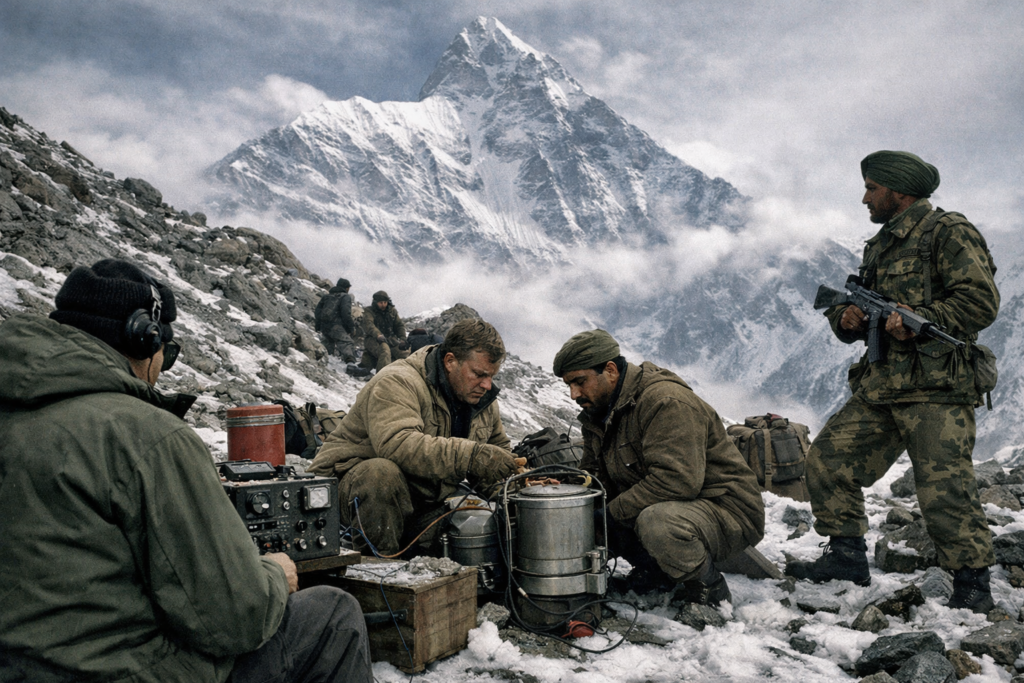
Image Credentials: Image Title: Frozen Espionage: The CIA’s Lost Nuclear Device in the Himalayas Source: (sora.openai) Date: December 2025. Attribution: This image was created using AI-generated imagery (sora.openai) and does not depict a real-world scene.
By Open Chronicle Staff
At the height of the Cold War, a high-stakes covert mission between the CIA and Indian intelligence ended in a quiet catastrophe that remains a secret concern for global security and environmental experts today: the loss of a plutonium-powered surveillance device on Nanda Devi, India’s second-highest peak.
Mission: Operation Blue Mountain
In 1965, the United States was desperate to monitor China’s burgeoning missile and nuclear program. The plan was as ambitious as it was dangerous: climbers would scale the 25,643-foot Nanda Devi to install a nuclear-powered surveillance station.
The heart of the station was a SNAP-19C generator. This device was fueled by Pu-239, a highly radioactive plutonium isotope, the same material used in the atomic bomb dropped on Nagasaki. Similar generators were later used by NASA to power the Voyager I spacecraft.
The Blizzard and the Loss
As the joint US-Indian expedition neared the summit, a violent Himalayan blizzard struck. Facing life-threatening conditions, the expedition leader made the call to retreat. The 50-pound plutonium generator and its spying equipment were secured to a rock ledge near the top.
When the team returned in the spring of 1965 to finalize the installation, the ledge was empty. An avalanche had swept the equipment away, presumably burying it deep within the glaciers below.
Decades of Cover-Ups
The loss triggered immediate panic in Washington and New Delhi. For over a decade, the mission remained a closely guarded secret. It wasn’t until 1978 that an investigative reporter revealed the story, sparking national outrage in India.
Declassified cables show that high-level officials, including President Jimmy Carter and Indian Prime Minister Morarji Desai, worked behind the scenes to contain the political fallout. Despite multiple recovery missions using metal detectors and radiation sensors, the “mountain of plutonium” was never found.
The Ganges Risk: A Warming Threat
The primary fear stems from the fact that the glaciers of Nanda Devi feed the Ganges River basin, the primary water source for hundreds of millions of people.
- Contamination Fears: While studies in the 1970s suggested the risk of leakage was low, these assessments were made decades ago.
- Climate Change: As Himalayan glaciers melt at an accelerated rate due to climate change, there is a renewed concern that the generator could be exposed or that its radioactive casing could finally breach, contaminating the headwaters of India’s most sacred river.
- Security Risks: Some experts also worry that the device could be found by non-state actors looking for radioactive material.
A Lingering Mystery
Nearly 60 years later, the US government has yet to issue a full public accounting of the incident. To the villagers living in the shadow of Nanda Devi and the environmentalists monitoring the Ganges, the missing SNAP-19C remains a “ticking time bomb” buried under the ice—a permanent reminder of the environmental costs of Cold War espionage.
References
- The New York Times. (2024). The CIA’s Nuclear Secret on an Indian Peak.
- US Department of State. Declassified Diplomatic Cables, 1978-1979.
- Ministry of External Affairs, India. Archives on the Nanda Devi Expeditions.
-
Kohli, M.S. (2003). The Himalayas: Playgrounds of the Gods – Trekking, Climbing, Adventure.