
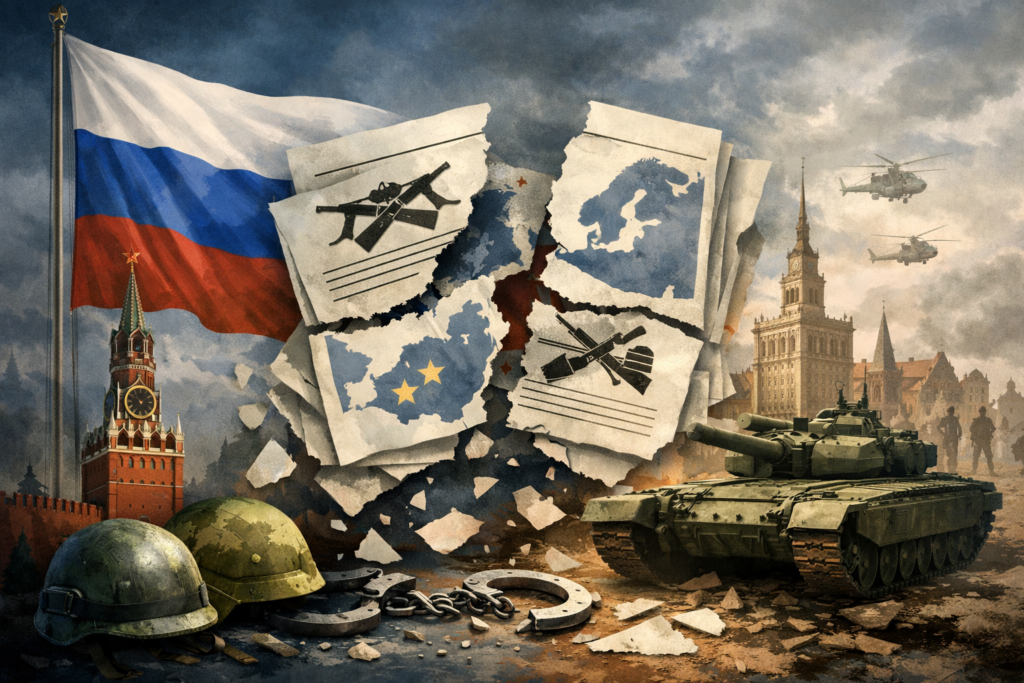
Image Credentials: Image Title: Russia Dissolves Post-Soviet Military Treaties with 11 European Nations Source: (sora.openai) Date: December 2025. Attribution: This image was created using AI-generated imagery (sora.openai) and does not depict a real-world scene.
By Open Chronicle Staff with Agencies | December 21, 2025
MOSCOW — In a definitive move to dismantle the security architecture established after the Cold War, the Russian government officially authorized the Defense Ministry on Saturday to terminate a series of bilateral military cooperation agreements with 11 European nations. The decision, formalized via a decree signed by Prime Minister Mikhail Mishustin, signals a final rupture in defense diplomacy between Moscow and key NATO members.
The targeted agreements, signed between 1992 and 2002, once served as the foundational legal framework for military-to-military transparency, joint exercises, and confidence-building measures in the wake of the Soviet Union’s collapse.
The Termination List
The decree affects ten bilateral agreements and one memorandum of understanding. The list of nations includes:
-
Northern & Western Europe: United Kingdom, Germany, Norway, Denmark, Netherlands, Belgium.
-
Central & Eastern Europe: Poland, the Czech Republic, Romania, Bulgaria, Croatia.
While many of these pacts have been functionally dormant since the 2014 annexation of Crimea and the 2022 invasion of Ukraine, the formal termination marks a “symbolic and strategic unraveling,” according to geopolitical analysts. The move follows a similar step in July 2025, when Moscow scrapped a 1996 military-technical agreement with Germany, claiming it had “lost all practical significance.”
A Pivot Toward Confrontation
The Russian Foreign Ministry justified the sweep by stating that the current “aggressive militaristic aspirations” of European capitals make post-Soviet cooperation impossible. The order follows a pattern of Russia withdrawing from international security treaties throughout 2025, including:
-
April 2025: Denunciation of the Barents Sea cooperation agreement with Norway, Sweden, and Finland.
-
September 2025: Formal suspension of the plutonium disposal agreement with the United States.
-
October 2025: Threats to officially denounce the New START (START-3) treaty unless the U.S. ceases strategic expansion.
Regional Impact: The “Hardened Bloc” Era
Experts suggest this move is less about immediate military changes and more about the “hardening of bloc politics.” By removing the legal obligations for transparency, Russia is signaling that its relations with Europe will now be viewed strictly through the lens of confrontation.
| Affected Treaty (Sample) | Signing Year | Primary Objective |
| Russia-Germany Pact | 1993 | Military contacts and personnel exchange. |
| Russia-Poland Agreement | 1993 | Regional security and defense collaboration. |
| Russia-UK Memorandum | 1997 | Joint training and maritime safety. |
| Russia-Norway Accord | 1995 | Border security and Arctic transparency. |
NATO’s Response
NATO officials, meeting earlier this month in Brussels, reiterated their commitment to a “deterrence by denial” strategy. With Russia systematically dismantling the last vestiges of the 1990s “Partnership for Peace” era, the alliance is reportedly moving toward its most ambitious defense spending targets since the 1980s, with a newly agreed-upon requirement for members to reach 5% of GDP for defense and security by 2030.