
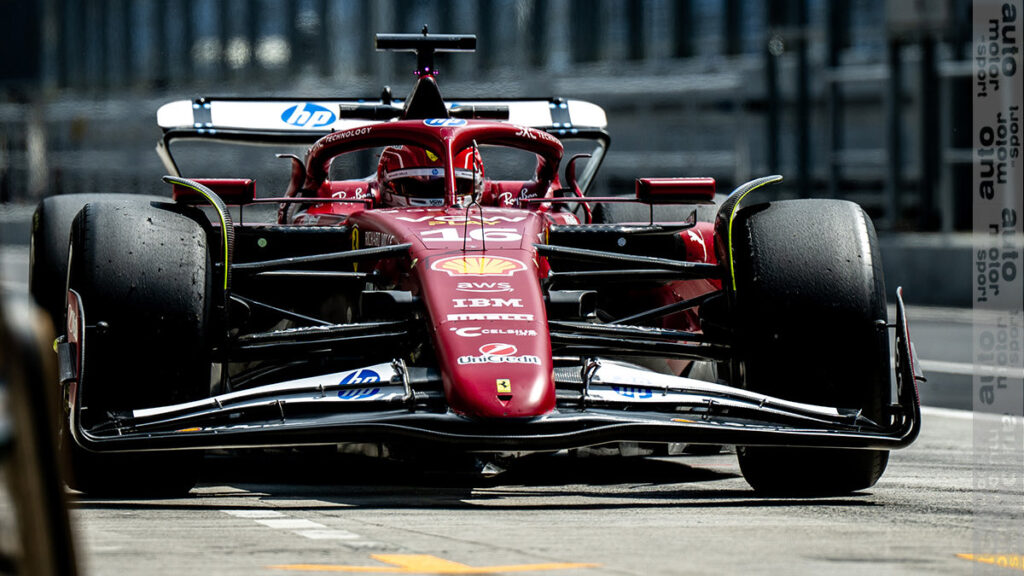
Image: from La Gazzetta Ferrari X@GazzettaFerrari
The Drag Reduction System (DRS) underwent specific technical refinements for the 2025 Formula One World Championship. These changes, mandated by the FIA, focused on the mechanical tolerances of the rear wing slot gaps and the operational modes of the actuator system. The primary intent of these adjustments was to ensure technical compliance across the grid and to standardize the aerodynamic transition between “closed” and “open” wing states.
Technical Specification Changes
Slot Gap Measurements
For the 2025 season, the FIA adjusted the permissible gap between the main plane and the flap of the rear wing when the DRS is in its deactivated (closed) state. This measurement is crucial for determining the baseline level of downforce and drag generated by the wing.
-
Closed Mode Minimum Gap: Reduced from a range of 10–15 mm (0.39–0.59 in) to 9.4–13 mm (0.37–0.51 in).
-
Open Mode Maximum Gap: The upper boundary remains unchanged at 85 mm (3.3 in).
This reduction in the minimum gap allows teams slightly more flexibility in the aerodynamic sealing of the wing elements while tightening the overall tolerance to prevent complex “flexing” designs that could circumvent the spirit of the regulations.
Mode Restrictions
The FIA introduced stricter language regarding the operational positions of the DRS flap to prevent the development of “multi-stage” or intermediate DRS deployments. The 2025 regulations specify:
-
Two-Position Limit: There must only be two distinct positions for the DRS flap—fully closed or fully open.
-
Return Consistency: Upon deactivation (ending the application of DRS), the wing must return exactly to the initial “closed” mode as defined in the technical drawings. This prevents systems that might attempt to leave the wing in a slightly different orientation to gain a post-DRS aerodynamic advantage.
Aerodynamic Impact
By shrinking the minimum gap in the closed position, the FIA has slightly altered the airflow characteristics through the rear wing assembly. While a smaller gap can lead to a cleaner flow over the wing, it also requires higher precision in manufacturing and assembly to ensure the wing remains within the tighter 9.4–13 mm window.
The requirement for exactly two positions eliminates the possibility of teams using “staged” DRS activation to manage rear-end stability during the transition phase of high-speed corners.
Summary Table: DRS Parameters
| Parameter | 2024 Regulation | 2025 Regulation | Status |
| Minimum Gap (Closed) | 10–15 mm | 9.4–13 mm | Reduced |
| Maximum Gap (Open) | 85 mm | 85 mm | Unchanged |
| Operational Modes | Two (Standard) | Two (Strictly Enforced) | Clarified |
| Reset Requirement | General | Exact defined return | New Strictness |
Back to 2025 Formula One Season Portal
Explore this subject
Continue exploring related Open Chronicle Encyclopedia entries through the categories associated with this article.

Staff Writers at Open Chronicle produce trusted journalism, strategic analysis and authoritative reference content across global affairs, geopolitics, defense, science, history, technology, business, culture and sport. Their work combines accurate reporting with historical perspective and analytical depth, helping readers understand not only what is happening, but why it matters. Beyond daily news coverage, Staff Writers contribute to the Open Chronicle Encyclopedia, investigative features, original research projects and long-form reports, building a comprehensive knowledge platform designed to inform, educate and preserve reliable information for a global audience.