
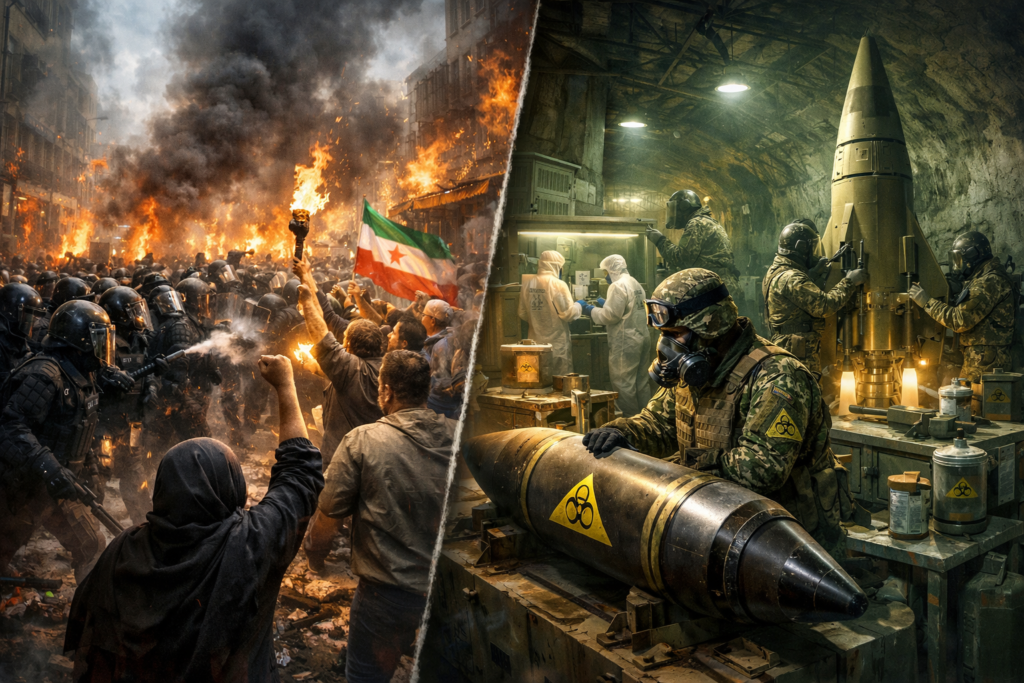
Image Credentials: Image Title: Double Crisis in Iran: Unconventional Weapons Development Amidst Economic Collapse Source: (sora.openai) Date: December 2025. Attribution: This image was created using AI-generated imagery (sora.openai) and does not depict a real-world scene.
By Open Chronicle Staff with Agencies | December 29, 2025
TEHRAN / WASHINGTON — The Islamic Republic of Iran is navigating a perilous dual crisis as 2025 draws to a close. While the streets of Tehran erupt in the most significant economic protests in years, exclusive reports suggest the Islamic Revolutionary Guard Corps (IRGC) is accelerating the development of chemical and biological warheads for its ballistic missile arsenal.
The convergence of a “shadow” unconventional weapons program and a domestic currency in freefall has placed the regime under unprecedented pressure, both from its own citizens and the international community.
The Unconventional Missile Threat
An exclusive report by Iran International indicates that the IRGC has moved beyond traditional payloads, focusing on high-tech upgrades and nonconventional warhead configurations.
-
Chemical & Biological Payloads: Sources suggest that, despite being a signatory to the Chemical Weapons Convention, Iran is actively exploring warheads capable of carrying toxic agents.
-
Infrastructure Shift: In a strategic move to reduce vulnerability to preemptive strikes, the IRGC has reportedly relocated launch assets and command-and-control systems to eastern Iran.
-
International Alarm: These developments coincide with a high-stakes meeting between Israeli Prime Minister Benjamin Netanyahu and U.S. President Donald Trump. The duo is expected to address Iran’s missile program as a top-tier security threat, alongside the ongoing conflict in Gaza.
A Pillar Crumbles: The Bazaar Goes on Strike
As the IRGC expands its military reach, the Iranian economy is suffering a catastrophic meltdown. For a second consecutive day, the Grand Bazaar and other major markets in Tehran have remained shuttered in a rare and powerful act of defiance.
-
The Rial’s Freefall: The national currency has hit yet another record low. Official data for December 2025 reveals a staggering 52.6% year-on-year inflation rate.
-
The Protests: Videos circulating online show merchants, traditionally a loyalist class, marching through the streets. Chants have transitioned from economic grievances to direct political slogans against the regime.
-
Heightened Security: The National Council of Resistance of Iran (NCRI) reports that IRGC security forces have been placed on “heightened alert,” with units from neighboring provinces being moved into the capital to prevent the strikes from turning into a full-scale uprising.
Iran’s Economic Breakdown (December 2025)
| Metric | Current Status | Impact |
| Year-on-Year Inflation | 52.6% | Sharp rise in prices for basic goods and medicine. |
| Annual Average Inflation | 42.2% | Persistent erosion of middle-class savings. |
| Currency Value | Record Low vs USD | Panic buying of gold and foreign currency. |
| Market Status | General Strike | Suspension of trade in Gold Bazaar and central districts. |
Strategic Analysis
The regime’s decision to accelerate unconventional weapons work during a period of extreme internal fragility suggests a “fortress mentality.” By strengthening its deterrent capabilities, Tehran may be attempting to ward off foreign intervention while it focuses on suppressing domestic dissent.
However, the involvement of the merchant class (the Bazaaris) suggests a fracturing of the regime’s traditional support base. As Maryam Rajavi of the NCRI noted, these protests reflect a public anger that “combines economic desperation with a demand for political change.”