
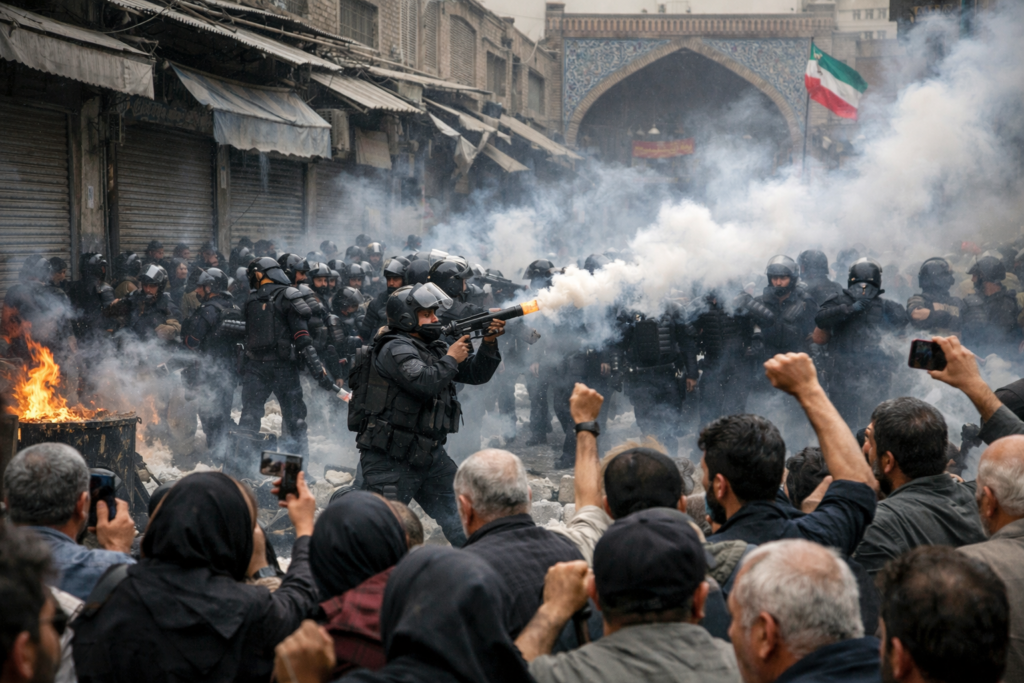
Image Credentials: Image Title: Tehran in Turmoil: Rial’s Historic Collapse Sparks Violent Protests and Political Defiance Source: (sora.openai) Date: December 2025. Attribution: This image was created using AI-generated imagery (sora.openai) and does not depict a real-world scene.
By Open Chronicle Staff with Agencies | December 29, 2025
TEHRAN — Iran has been gripped by a second day of intense street protests as the national currency, the rial, plummeted to a record low, nearing an unprecedented 1,250,000 rials to the US dollar. While the capital’s Grand Bazaar and local shops shuttered in a strike of economic despair, the regime has responded with tear gas and a narrative of “enemy psychological warfare.”
A Currency in Freefall
The Iranian rial reached its lowest point in history at the start of December 2025. This collapse has been exacerbated by a “perfect storm” of economic pressures:
-
Hyper-Inflation: The Statistical Centre of Iran reported a monthly inflation rate of 48.6% in October, the highest in 40 months.
-
Recession Warnings: The World Bank has forecasted an economic shrinkage of 1.7% in 2025 and 2.8% in 2026.
-
Fuel Price Hikes: The regime’s recent decision to raise the cost of subsidized gasoline, a move long delayed for fear of unrest, has served as a primary catalyst for the current uprising.
The Regime’s Defense: “Psychological Operations”
Faced with domestic chaos, high-ranking officials and the Islamic Revolutionary Guard Corps (IRGC) have dismissed the protests as a product of foreign interference.
“A large part of the currency problems is affected by the psychological atmosphere of the market. The enemy is desperately seeking to take advantage of the created atmosphere,” stated Brigadier General Ali-Akbar Pourjamshidian.
The IRGC echoed this sentiment, labeling the dissent as “cognitive warfare” and “seditious behavior,” with state-affiliated media like Tasnim claiming that social media accounts linked to the “Zionist regime” are fueling the fires of unrest.
The Hemmati Controversy
Further stoking public anger is the reappointment of Abdolnaser Hemmati as the head of the Central Bank.
-
The Irony of Appointment: Hemmati was impeached from his role as economy minister only nine months ago (March 2025) after inflation surged under his watch.
- Track Record: During his previous eight-month tenure as minister, the rial lost nearly 50% of its value.His return to power is seen by protesters as a sign of the regime’s inability, or unwillingness, to implement genuine structural reform.
🚨 Protests in Tehran continue into the night: Despite darkness falling, crowds chant "Don't be afraid, we're all together!" amid strikes over the rial's historic collapse (approaching 1,450,000 to $1).
Iranians refuse to back down against inflation and regime corruption. pic.twitter.com/aGiumOCBzx
— Daughters of Persia (@fightforpersia) December 28, 2025
From Economic Woes to Political Rebellion
While the protests began over the price of bread and fuel, the chants in the streets of Tehran have quickly turned political. Demonstrators are no longer just demanding lower prices; they are questioning the legitimacy of the Islamic Republic itself.
Chants recorded in Tehran included:
-
“May Reza Shah’s soul be happy”
-
“This is not the last battle, Pahlavi will return”
The explicit support for the exiled Crown Prince Reza Pahlavi marks a significant shift, echoing the sentiments of previous widespread protests in 2019 but with a renewed focus on a pre-revolutionary identity.
Economic Indicators: Iran’s Growing Crisis
| Indicator | Data Point | Significance |
| Exchange Rate | ~1,250,000 Rial / 1 USD | Historic low; erases purchasing power. |
| Oct. Inflation | 48.6% | Highest in over 3 years. |
| GDP Forecast | -1.7% (2025) | Signals a deepening recession. |
| Fuel Cost3 | Increased | Catalyst for street-level mobilization. |