
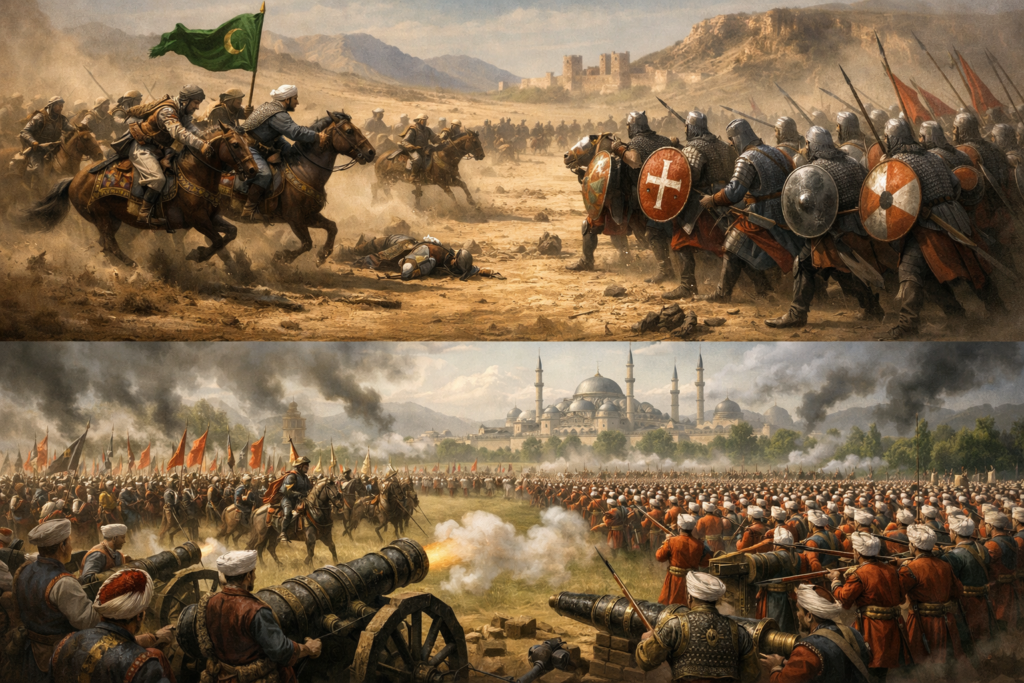
Image Credentials: Image Title: Quality vs. Quantity: The Evolution of Islamic Military Strategy Source: (sora.openai) Date: January 2026. Attribution: This image was created using AI-generated imagery (sora.openai) and does not depict a real-world scene.
By Open Chronicle History Desk | January 2, 2026
A common thread in early Islamic history is the image of a smaller, highly mobile force defeating the sprawling armies of established empires. From the dunes of Arabia to the Levant, the early Muslim conquests were defined by tactical superiority rather than numerical strength. However, as the Islamic world transitioned into the era of the “Gunpowder Empires,” a profound shift occurred: the strategic embrace of the mass army.
The David vs. Goliath Era: Rashidun and Ayyubids
In the 7th century, the Rashidun Caliphate faced the two superpowers of the day: the Byzantine and Sassanid Empires. In almost every major engagement, the Muslims were significantly outnumbered.
-
The Byzantine Front: At the pivotal Battle of Yarmouk (636 AD), historical estimates suggest a Rashidun force of roughly 15,000 to 40,000 faced a Byzantine army that was likely double or triple its size.
-
The Sassanid Front: At al-Qadisiyyah, the story was the same. The Persians deployed war elephants and massive infantry lines, yet the mobility and high morale of the lighter Arab cavalry carried the day.
-
The Ayyubid Defense: Centuries later, Saladin (Salah ad-Din) frequently faced Crusader coalitions that could muster immense heavy cavalry and European reinforcements. At the Battle of Hattin, while the forces were more evenly matched, Saladin’s victory relied on superior environmental knowledge and psychological warfare rather than sheer weight of numbers.
Why the Early Armies Were Smaller
The smaller size of early Islamic armies was not just a matter of population, but of strategic philosophy:
-
Mobility: Lighter armor and a reliance on camels and horses allowed for rapid desert maneuvers that larger, bogged-down imperial armies couldn’t match.
-
Logistics: Smaller forces are easier to feed and move across arid terrain.
-
Elite Specialization: The early warriors were often seasoned by tribal skirmishes, possessing high individual combat proficiency and a religious fervor that acted as a force multiplier.
The Great Shift: Ottomans and Timurids
As the Islamic world moved into the 14th and 15th centuries, the “Turkic” style of warfare introduced a new paradigm: the Mass Army.
The Timurid Juggernaut
Timur (Tamerlane) revolutionized the Central Asian military by combining the traditional Mongol horse archer with a highly organized, massive infantry and siege corps. He didn’t just want to win; he wanted to overwhelm. At the Battle of Ankara (1402), Timur’s army was estimated to be over 140,000 strong, a size that was nearly unprecedented for the time.
The Ottoman War Machine
The Ottoman Empire perfected the “First Modern Army.”They moved away from tribal levies toward a professional, permanent force.
-
The Janissaries: While the Janissaries began as an elite corps, the Ottomans backed them with a massive auxiliary force (the Azaps) and the Sipahi (landed cavalry).
-
Industrial Warfare: To capture cities like Constantinople (1453), the Ottomans needed a large force to manage massive siege engines and sustain long blockades. By the time of Suleiman the Magnificent, the Ottoman army could mobilize over 100,000 men for a single campaign.
Summary of Military Evolution
| Era | Primary Strategy | Army Size Comparison | Key Advantage |
| Rashidun | High Mobility / Skirmishing | Much smaller than rivals | Desert maneuverability |
| Ayyubid | Attrition / Psychological | Generally smaller/equal | Intelligence & Environment |
| Timurid | Total War / Overwhelming Force | Massive / Larger than rivals | Psychological terror & scale |
| Ottoman | Professional / Siege Focused | Massive / State-funded | Artillery & Logistics |
Strategic Data & Comparisons
| Conflict / Era | Core Source for Numbers | Historical Consensus on Disparity |
| Battle of Yarmouk | Theophanes the Confessor | Muslims: ~25k-40k vs. Byzantines: ~100k+ (debated) |
| Battle of Hattin | William of Tyre | Ayyubids: ~30k vs. Crusaders: ~20k (Rare case of parity) |
| Battle of Ankara | Sharaf ad-Din Ali Yazdi | Timurids: ~140k vs. Ottomans: ~85k |
| Siege of Vienna | Venetian Diplomatic Reports | Ottomans: ~100k-150k vs. Defenders: ~20k-30k |
References
-
Al-Tabari. The History of al-Tabari (Ta’rikh al-rusul wa’l-mulūk). Translated by various scholars. Albany: State University of New York Press.
The essential primary source for the Rashidun conquests, providing the early Islamic perspective on the numerical disparities at the battles of Yarmouk and al-Qadisiyyah.
-
Ibn al-Athir. The Chronicle of Ibn al-Athir for the Crusading Period. Translated by D.S. Richards. Aldershot: Ashgate, 2006–2008.
Offers detailed accounts of the Ayyubid military structure and Saladin’s tactical maneuvers against the Crusader states.
-
Schiltberger, Johannes. The Bondage and Travels of Johann Schiltberger. Translated by J. Buchan Telfer. London: Hakluyt Society, 1879.
An eyewitness account from a European soldier who served in the Ottoman army and was later captured by Timur, documenting the massive scale of the Battle of Ankara.
-
Akram, A.I. The Sword of Allah: Khalid bin al-Waleed, His Life and Campaigns. Rawalpindi: National Publishing House, 1970.
A classic military analysis of early Islamic skirmishing tactics and how smaller units defeated numerically superior Byzantine and Persian forces.
-
Nicolle, David. Armies of the Ottoman Turks 1300–1774. London: Osprey Publishing, 1983.
An expert breakdown of the Ottoman transition to a professional standing army and the logistics required to maintain large-scale forces.
-
Kennedy, Hugh. The Armies of the Caliphs: Military and Society in the Early Islamic State. London: Routledge, 2001.
Examines the social and economic factors that kept early Islamic armies small and mobile compared to the later imperial models.
-
Manz, Beatrice Forbes. The Rise and Rule of Tamerlane. Cambridge: Cambridge University Press, 1989.
The definitive study of Timur’s military organization and his use of overwhelming force to maintain control over Central Asia.