
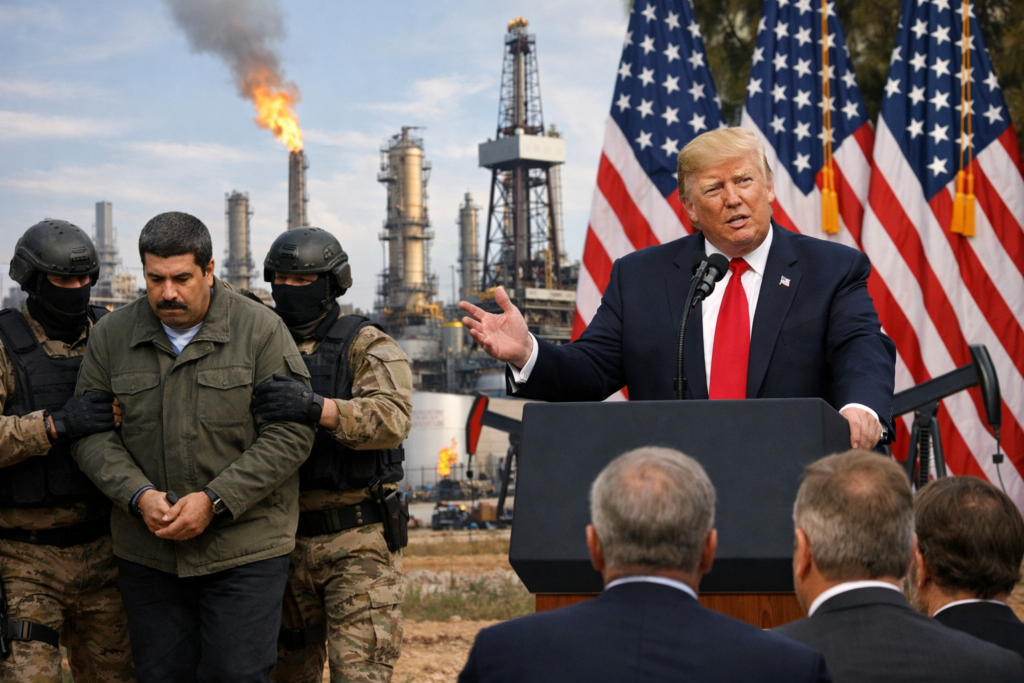
Image Credentials: Image Title: “Fixing the Broken”: Trump Announces Multi-Billion Dollar Entry of U.S. Oil Giants into Venezuela Source: (sora.openai) Date: January 2026. Attribution: This image was created using AI-generated imagery (sora.openai) and does not depict a real-world scene.
By Open Chronicle News Desk with Agencies | January 4, 2026
MAR-A-LAGO, FL — Following the dramatic capture of Nicolás Maduro, President Donald Trump has unveiled a sweeping energy strategy for Venezuela, calling on the world’s largest U.S. oil companies to “spend billions” to rehabilitate the nation’s decimated energy sector.
In a press conference held in Florida on Saturday, Trump positioned the U.S. private sector as the primary architect for Venezuela’s economic recovery, while simultaneously maintaining a strict federal embargo on the current regime’s remaining assets.
🚨The US is wasting no time and US oil companies will be going into Venezuela and will get its oil pumping.
Donald Trump
"We are going to have our very large United States oil companies go in, spend billions of dollars, fix the badly broken infrastructure and start making money… pic.twitter.com/j42hzKtBY0
— Kirk Lubimov (@KirkLubimov) January 3, 2026
A Multi-Billion Dollar Infrastructure Rescue
The President’s plan centers on a massive infusion of U.S. capital to address years of mismanagement and decay within Venezuela’s state-run oil giant, PDVSA.
-
The Vision: Trump expects “very large United States oil companies” to enter the country to repair “badly broken infrastructure.”
-
Economic Goal: The aim is to revitalize production to “start making money for the country,” though under a framework heavily influenced by Washington.
-
The Chevron Precedent: Until now, Chevron was the only U.S. company holding a narrow exemption to operate in Venezuela. Trump’s new stance suggests a massive expansion that could end the monopoly of current state-owned partnerships.
The Current State of Venezuelan Crude
💣🇻🇪 In less than 12 hours, the global energy map shifted
🇺🇸The US is now in a position of control over Venezuela’s oil reserves:
📊 303B barrels, roughly 18% of proven global reserves.At current prices, that is $17T+ in theoretical value.
Even with a brutal 50% haircut, you… pic.twitter.com/NLmjcCyrH3— Panofsky167 (@panofsky167) January 4, 2026
Despite possessing approximately 17% of the world’s oil reserves, Venezuela’s output has withered to just under a million barrels a day. The industry faces significant technical and political hurdles:
-
Quality Issues: Venezuelan crude is “heavy” and of lower quality. It is primarily processed into diesel or asphalt rather than gasoline.
-
Refining Synergy: Crucially, the United States possesses specialized refineries along the Gulf of Mexico specifically designed to handle this heavy Venezuelan grade, creating a natural economic loop.
-
The Black Market: Currently, much of Venezuela’s oil is sold via “ghost tankers” on the black market at steep discounts to bypass U.S. sanctions.
Sanctions and the “Narco-State” Justification
While inviting oil firms in, Trump clarified that the total embargo on Venezuelan oil remains in full effect. The administration continues to view oil revenue under the previous leadership as a tool for “drug terrorism, human trafficking, and kidnapping.”
Since the start of his second term in 2025, Trump has tightened the noose on the Venezuelan economy:
-
License Termination: He ended broad licenses for multinational firms, leaving only specific exemptions.
-
Naval Blockade: A total blockade remains on sanctioned tankers moving to and from Venezuelan ports.
Analysis: Political Motivation vs. Energy Need
Energy analysts are divided on the necessity of Venezuelan crude for the American market. Stephen Schork of the Schork Group noted that the “United States is doing just fine without Venezuelan oil,” suggesting that the move to seize and “fix” the industry is driven by long-term geopolitical strategy rather than immediate domestic fuel shortages.
By integrating U.S. firms into the Venezuelan oil fields, the Trump administration seeks to ensure that the world’s largest crude reserves are no longer used to fund a hostile “narco-state,” but are instead anchored to the U.S. economic sphere.