
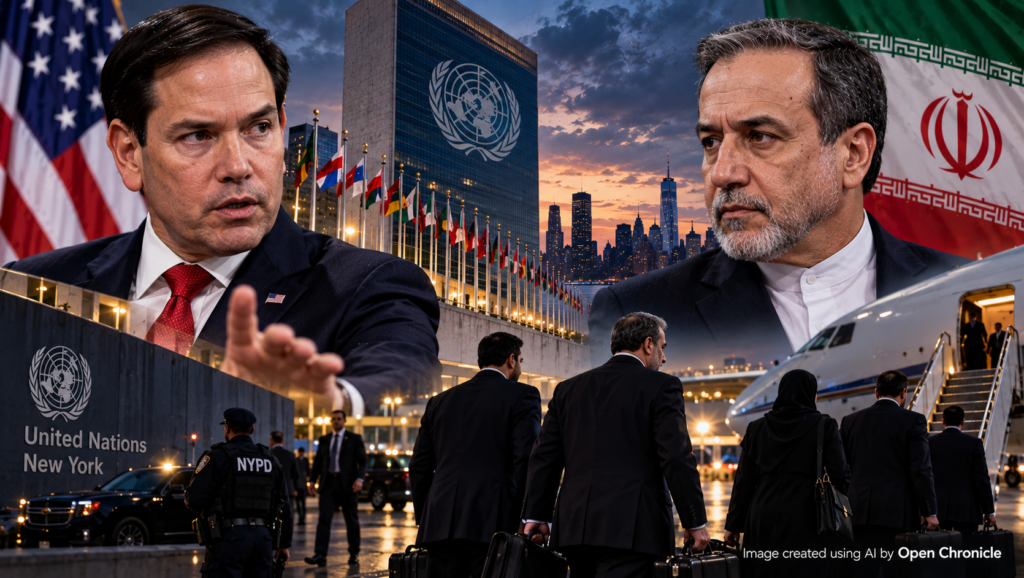
Iran has rejected reports that its delegation to the United Nations General Assembly was ordered out of the United States, insisting that Foreign Minister Abbas Araghchi and his team departed New York according to a schedule communicated to Washington weeks earlier. A US official, however, says Secretary of State Marco Rubio ordered the diplomats to leave after negotiations between Washington and Tehran reached a stalemate.
By Open Chronicle with agencies | October 1, 2026
NEW YORK — A diplomatic dispute has emerged between Washington and Tehran over the departure of Iran’s delegation from New York, with the two governments presenting sharply different accounts of what happened after negotiations aimed at easing the ongoing conflict failed to produce a breakthrough.
According to a US official, Secretary of State Marco Rubio ordered the Iranian delegation to leave the United States after diplomatic contacts stalled.
Iran denies that its representatives were expelled, saying their departure had already been scheduled and that the itinerary had been communicated to the US State Department on September 17.
The dispute comes as mediators continue attempting to find a compromise capable of bringing the conflict under control and addressing the continuing closure of the Strait of Hormuz.
Washington says delegation was told to leave
The US mission to the United Nations informed Iran’s mission on Monday evening that Foreign Minister Abbas Araghchi’s delegation had to leave New York immediately, according to the US account.
The instruction was reportedly issued on Rubio’s orders.
A US official said the Iranian delegation had “overstayed their welcome” and argued that because the UN General Assembly had concluded, it was time for the diplomats to depart.
The delegation subsequently boarded a flight from New York to Doha at approximately 1.20 am local time on Tuesday.
The timing of the departure is not disputed. What Washington and Tehran disagree about is why it happened.
Iran says departure was scheduled weeks earlier
Iran’s mission to the United Nations rejected the American version of events.
“The Iranian delegation left New York on Monday evening, in accordance with the schedule that had also been communicated to the US Department of State in advance on September 17,” the mission said.
Tehran accused the State Department of attempting to portray an already planned departure as an expulsion.
“Having achieved nothing, the State Department has resorted to propagating baseless and worthless news,” the Iranian mission said.
The competing statements leave two fundamentally different interpretations.
Washington maintains that the delegation was explicitly instructed to leave. Tehran says the diplomats were leaving anyway under an itinerary previously communicated to American authorities.
Negotiations reportedly reached stalemate
The diplomatic confrontation followed another unsuccessful attempt to make progress toward ending the war.
According to the account attributed to US officials, the White House entered Monday believing there was a possibility of movement in negotiations with Iran.
By late afternoon, however, American officials had concluded that the talks had reached a stalemate.
Rubio’s reported decision to order the delegation out of the country followed that assessment.
The episode illustrates the fragile state of diplomatic contacts between two countries simultaneously engaged in negotiations and military confrontation.
Qatar continues mediation
Despite the latest setback, diplomatic efforts have not ended.
Qatari mediators are continuing discussions with Washington and Tehran around a compromise proposal, according to regional sources cited in reports about the negotiations.
Qatar’s role could become increasingly important if direct or indirect contacts between the United States and Iran remain unable to produce an agreement.
The immediate objective is to identify terms capable of reducing military escalation while resolving disagreements over the Strait of Hormuz and Iran’s nuclear programme.
The details of the latest compromise proposal have not been disclosed in the information provided.
War has transformed regional security
The diplomatic crisis is unfolding against the backdrop of the war launched by the United States and Israel against Iran on February 28.
Iran responded with missile and drone attacks across the region.
Tehran also effectively closed the Strait of Hormuz, transforming the conflict from a direct military confrontation into a major international economic and energy security crisis.
The strait represents one of the world’s most strategically important maritime routes for oil and gas exports from the Persian Gulf.
Disruption to shipping through the waterway has therefore extended the consequences of the conflict far beyond the countries directly involved.
Restoring freedom of navigation has become one of the central issues in negotiations between Washington and Tehran.
June memorandum established framework for negotiations
Diplomatic efforts continued despite the fighting.
In June, the United States and Iran signed a memorandum establishing immediate steps intended to restore freedom of navigation through the Strait of Hormuz and address Iran’s nuclear programme.
That agreement created a framework for subsequent negotiations but did not resolve the fundamental disagreements between the two countries.
The latest contacts in New York appear to have represented another effort to build on that process.
The failure to reach an agreement on Monday demonstrates how difficult it remains to translate the June framework into a broader political settlement.
Strait of Hormuz remains central to negotiations
The status of the Strait of Hormuz is one of the most important elements of the confrontation.
Iran’s ability to disrupt maritime traffic gives Tehran significant leverage because of the waterway’s importance to global energy markets.
Washington, meanwhile, has made the restoration of freedom of navigation a central objective.
Any sustainable settlement would therefore have to address both immediate military tensions and the conditions under which commercial shipping could safely resume normal operations.
The nuclear issue adds another layer of complexity.
The June memorandum linked discussions surrounding navigation with efforts to address Iran’s nuclear programme, bringing two of the most difficult issues in US Iranian relations into the same diplomatic process.
New York dispute reflects deeper mistrust
The disagreement over whether the Iranian delegation was expelled may appear procedural, but it reflects the much deeper mistrust surrounding negotiations.
Washington’s account presents the departure as a deliberate diplomatic signal after talks failed.
Tehran’s account portrays the American claim as an attempt to manufacture the appearance of diplomatic pressure from a routine departure that had already been scheduled.
Both sides therefore disagree not only about the substance of negotiations but even about the circumstances surrounding the diplomats’ departure.
That level of disagreement complicates efforts by mediators attempting to maintain communication.
Diplomacy continues despite latest setback
The immediate focus now shifts toward Qatar’s mediation and whether the compromise proposal under discussion can provide a basis for renewed negotiations.
Neither Washington nor Tehran appears, based on the information available, to have abandoned diplomacy entirely.
At the same time, the failure of the New York discussions demonstrates the distance that remains between them.
The United States says Rubio ordered the Iranian delegation to leave after negotiations stalled. Iran insists its diplomats departed according to a schedule Washington had known about for nearly two weeks.
Behind that dispute lies the larger challenge: finding a formula capable of ending a war that has expanded across the region, restoring navigation through the Strait of Hormuz and addressing one of the world’s most persistent nuclear disputes.