
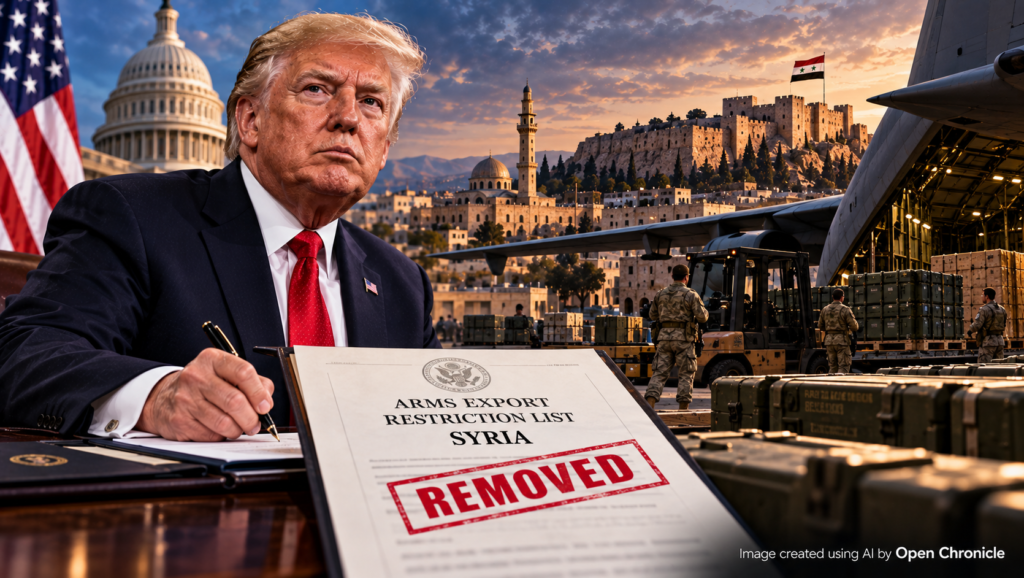
The Trump administration has removed Syria from the group of countries automatically denied licences for US arms exports, allowing future Syrian requests for American weapons and military equipment to be considered individually. The decision does not automatically authorise weapons sales but represents another significant step in Washington’s developing relationship with Syria’s new government.
By Open Chronicle with agencies | October 1, 2026
WASHINGTON — The United States has removed Syria from its list of countries subject to a general policy of denying licences for American weapons exports, opening the possibility for future defence transactions between Washington and Damascus.
The change takes effect on Thursday and replaces the previous blanket restriction with a system under which applications involving Syria can be examined by US authorities on a case by case basis.
The State Department published the regulatory change in the Federal Register through amendments to the International Traffic in Arms Regulations.
Under the revised rules, Syria is no longer included among countries automatically subject to the US policy of denial for licences and approvals involving the export of defence articles and services.
The decision does not mean Syria can immediately purchase American weapons. Any proposed transaction would still require review and approval by the relevant US authorities.
From blanket prohibition to individual review
The practical significance of the change lies in the removal of the automatic presumption against approving arms export licences involving Syria.
Previously, Syria’s presence on the restricted list meant applications involving US weapons and ammunition were subject to a general policy of denial.
With Syria removed, Washington now has the ability to consider individual applications.
That creates a regulatory pathway through which future defence cooperation could potentially develop, although approval would depend on the circumstances surrounding each request.
The distinction is important.
Removing Syria from the list does not constitute an arms deal, nor does it commit Washington to supplying weapons to Damascus.
It instead removes a major regulatory obstacle that had effectively prevented such transactions.
Another step in Washington’s Syria policy
The decision forms part of a broader series of measures adopted by the Trump administration as Washington gradually eases restrictions imposed on Syria.
For decades, US policy toward Damascus was dominated by sanctions and diplomatic isolation during the rule of former President Bashar al Assad.
The emergence of Syria’s new government has prompted Washington to reassess parts of that framework.
The arms export decision is particularly significant because military technology and weapons transfers traditionally represent one of the most sensitive areas of American foreign policy.
Moving from an automatic prohibition to individual consideration suggests Washington is creating options for a deeper security relationship without committing itself in advance to specific defence agreements.
Syria removed from state sponsors of terrorism list
The arms export decision follows another major policy change announced in August.
Secretary of State Marco Rubio announced Syria’s removal from the US list of state sponsors of terrorism.
That decision eliminated another important element of the restrictions surrounding relations between Washington and Damascus and helped create the conditions for additional measures.
The designation had imposed significant legal, diplomatic and economic consequences on Syria.
Its removal therefore represented an important change in how Washington formally treats the Syrian government.
The latest arms export amendment extends that transformation into the defence sector.
US plans to reopen embassy in Damascus
Washington has also announced plans to reopen the US embassy in Damascus.
The diplomatic mission has been closed for 14 years.
Reopening the embassy would mark a significant restoration of formal diplomatic relations and provide Washington with a permanent diplomatic presence inside Syria as relations with the new government develop.
Taken together, the reopening of the embassy, the removal of Syria from the terrorism designation and the easing of arms export restrictions represent a substantial change from the policies that defined US relations with Damascus during the Assad era.
The measures also provide Washington with greater flexibility to engage Syria politically, economically and potentially militarily.
Could American weapons eventually be sold to Syria?
The regulatory change creates that possibility, but it does not guarantee that defence deals will follow.
Any Syrian request for American military equipment would still have to pass through the US export control system.
Washington could approve, reject or impose conditions on individual applications depending on the equipment involved, the intended recipient and broader American national security considerations.
The change therefore gives US policymakers discretion that they previously did not have under the blanket denial policy.
If Washington eventually decides that strengthening Syrian security forces serves American interests, the revised regulations could provide a legal mechanism for defence cooperation.
Conversely, US authorities retain the ability to reject applications they consider inappropriate.
Defence cooperation could become another diplomatic tool
The ability to consider weapons exports could also provide Washington with additional leverage in its developing relationship with Damascus.
Defence agreements frequently involve more than the transfer of weapons.
They can include training, maintenance, logistical support, communications systems and long term relationships between military institutions.
Access to American equipment could consequently become part of broader negotiations over Syria’s security policies and regional relationships.
However, no specific weapons package or defence agreement was identified in the information accompanying the regulatory change.
For now, the decision should therefore be understood as opening a regulatory door rather than announcing a military partnership.
Seven countries remain under US policy of denial
Following Syria’s removal, seven countries remain subject to the American policy of denying arms export licences and approvals.
They are Belarus, China, Cuba, Iran, Myanmar, North Korea and Venezuela.
Syria’s departure from that group highlights the scale of the policy shift taking place in Washington.
For years, Damascus was treated alongside governments facing some of the most restrictive American controls on defence exports.
Its removal places Syria in a fundamentally different regulatory position.
A rapidly changing relationship
The transformation of US policy toward Syria is occurring across several fronts simultaneously.
Diplomatic relations are being restored. Longstanding designations are being reconsidered. Restrictions established during the Assad era are being dismantled or modified.
The latest decision adds defence policy to that process.
The central question now is how far Washington intends to take the relationship.
Allowing Syrian arms requests to be reviewed individually gives the Trump administration greater freedom to respond to developments inside Syria and across the Middle East.
It also creates the possibility that defence cooperation could eventually become part of the new relationship between the two countries.
Whether that results in actual American weapons sales will depend on future decisions in Washington and Damascus.
For the moment, the most important change is procedural but strategically significant: Syria is no longer automatically excluded from consideration when seeking access to American defence equipment.