
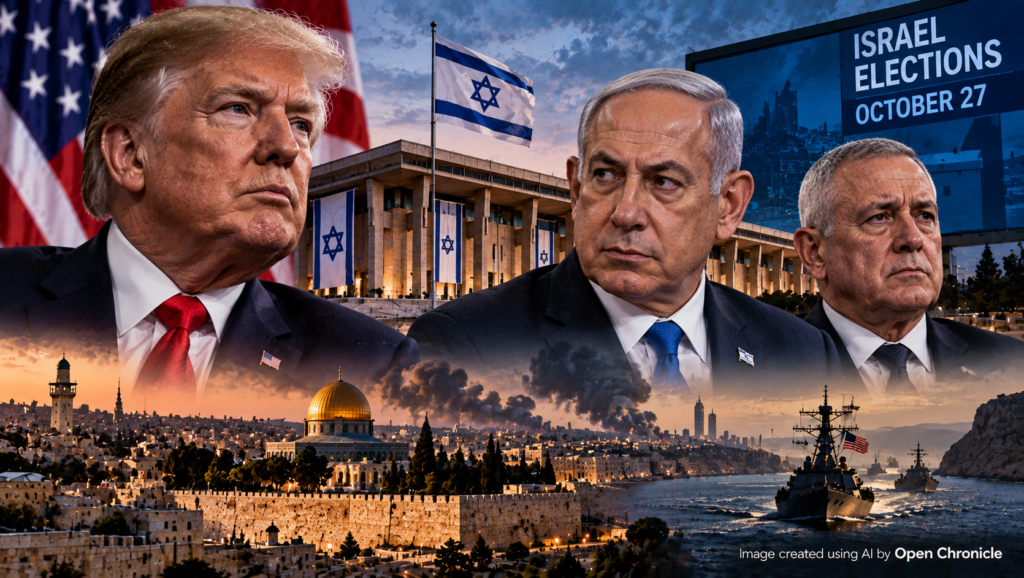
US President Donald Trump has stopped short of endorsing Israeli Prime Minister Benjamin Netanyahu for another term ahead of Israel’s October 27 election, while saying he has not heard “bad things” about opposition contender Gadi Eisenkot. Trump nevertheless warned against underestimating Netanyahu, whose political career has repeatedly survived periods of intense pressure.
By Open Chronicle with agencies | October 1, 2026
WASHINGTON — US President Donald Trump has declined to endorse Israeli Prime Minister Benjamin Netanyahu ahead of Israel’s upcoming election, avoiding direct support for his longtime ally as the relationship between Washington and Jerusalem faces growing strains over the widening regional conflict.
Asked during an interview with TIME magazine whether Netanyahu should receive another term in office in the October 27 election, Trump did not give his backing.
“Well, I can only say that I’m not involved in politics anymore, except that we’re popular,” Trump said.
Pressed again on whether he supported another Netanyahu term, Trump shifted the discussion toward American support for Israel’s security.
“No, my primary thing, I do want to help them defend Israel,” he said.
The comments represent a notable absence of an endorsement from a US president who has maintained a close but sometimes turbulent relationship with Netanyahu.
Trump avoids choosing between Netanyahu and Eisenkot
Trump was also asked about Gadi Eisenkot, the former chief of the Israel Defense Forces who has emerged as a major opposition contender.
The US president said he had not “heard bad things about him.”
Trump did not endorse Eisenkot either and immediately cautioned against assuming Netanyahu’s political career was approaching its end.
“People have written off Bibi many, many times, just like they’ve written off me many, many times,” Trump said.
“I wouldn’t underestimate Bibi.”
The remarks leave Trump publicly neutral between the two figures while acknowledging Netanyahu’s history of surviving difficult political circumstances.
Trump points to his popularity in Israel
Rather than backing a candidate, Trump emphasised what he described as his own popularity among Israelis.
The president claimed his support among the Israeli public was “like 99%,” attributing his standing to policies adopted during his presidencies.
Trump’s relationship with Israel has been shaped by a series of major policy decisions, but his latest remarks suggest he is seeking to separate his support for the country from an explicit endorsement of Netanyahu in the election.
That distinction could become increasingly significant as Israel enters the final weeks of its campaign.
Relationship with Netanyahu faces new strains
Trump’s relationship with Netanyahu has reportedly become more difficult in recent months as disagreements have emerged over the conduct and expansion of the Iran war and continuing Israeli military operations in Lebanon and Gaza.
The conflict with Iran, now in its seventh month, has dramatically transformed the strategic environment surrounding both governments.
Washington and Jerusalem remain closely aligned militarily, but differences over how far operations should extend and how the conflict should ultimately end have complicated the relationship.
Trump’s decision not to endorse Netanyahu does not establish a political break between the two leaders. His comments instead show that the US president is unwilling, at least publicly, to choose a candidate in Israel’s election.
Trump defends Netanyahu over October 7 intelligence question
During the interview, Trump also addressed reports concerning whether Netanyahu had received advance intelligence warnings before the October 7 attacks.
Trump expressed doubt that Netanyahu had known an attack was coming.
“I don’t think so. I think … if he would have known, he would have done something about it,” Trump said.
The president argued that Israeli forces would presumably have been placed on alert if Netanyahu had possessed actionable advance knowledge.
Trump’s comments represented his assessment rather than an independent determination of what Israeli political or security officials knew before the attack.
The question of intelligence warnings and decision making before October 7 has remained a major issue in Israeli political and security debate.
Trump says he deliberately expanded Iran campaign
Trump also provided new details about his thinking behind the continuing war against Iran.
The president said initial estimates had envisaged a military campaign lasting approximately four to eight weeks, but that he decided operations should continue in order to inflict greater damage on Iran’s military and nuclear infrastructure.
“Only because I wanted to go further,” Trump said when explaining why the campaign continued beyond its initial objectives.
“I could have stopped there, and I felt it was just inappropriate.”
His comments indicate that the prolonged campaign was, in his account, a deliberate decision rather than simply the result of operations taking longer than originally anticipated.
Strait of Hormuz remains at centre of conflict
The Strait of Hormuz also featured prominently in Trump’s account of the war.
Iran effectively closed the strategic waterway after the United States and Israel launched their military campaign against Tehran on February 28.
Before the war, approximately one fifth of global oil consumption passed through the strait, making control of the route a major issue for the global economy.
Trump acknowledged that Iran’s closure of the waterway “worked for a little while,” but claimed that the United States subsequently took control of the strait.
The maritime confrontation has become one of the defining elements of the conflict because disruption to the route affects energy markets well beyond the Middle East.
Trump says he rejected Iranian truce proposal
Trump also confirmed that his administration rejected an Iranian proposal for a truce that would have included reopening the Strait of Hormuz.
The president said the Iranian terms were “not good enough.”
Diplomatic efforts have nevertheless continued.
Washington and Tehran have maintained contacts aimed at establishing conditions for ending the conflict, while regional mediators have attempted to narrow the substantial differences between the two governments.
The status of the Strait of Hormuz and Iran’s nuclear programme remain among the central issues surrounding those negotiations.
Trump leaves future military escalation unclear
Asked whether the United States could intensify its air campaign after the upcoming congressional midterm elections, Trump initially said that further escalation was “possible.”
He then declined to elaborate.
“I can’t tell you that,” Trump said.
The exchange leaves American military intentions deliberately uncertain at a time when diplomatic contacts and military operations are continuing simultaneously.
Israeli election unfolds during regional war
The October 27 Israeli election will take place against an extraordinary regional backdrop.
Israel remains engaged in military operations connected with Iran, Lebanon and Gaza while facing domestic debate over security, political leadership and the conduct of the conflicts.
Netanyahu enters the campaign with decades of political experience and a history of recovering from periods when opponents believed his career was nearing its end.
Eisenkot brings a different profile, shaped heavily by his previous leadership of the Israeli military.
Trump’s remarks provide no endorsement of either candidate.
Instead, the US president has emphasised continued American support for Israel’s defence while keeping his distance from the choice Israeli voters will make.
With less than a month remaining before the vote, Trump’s position adds another element to an election already unfolding amid war, domestic political divisions and profound questions about Israel’s future security strategy.