
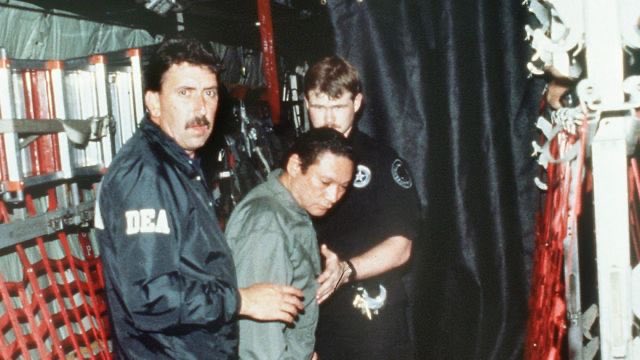
Image: from The Conservative Alternative X@OldeWorldOrder
By Open Chronicle News Desk | January 4, 2026
NEW YORK — As Nicolás Maduro arrives in a New York federal court to face narco-terrorism charges, legal experts are looking back more than three decades to the last time the United States forcibly removed a foreign leader: Manuel Noriega.
The 1989 invasion of Panama and the subsequent prosecution of its “strongman” provide a controversial yet firm blueprint for the judges, prosecutors, and defense attorneys now navigating the unprecedented case of the Venezuelan leader.
A Shared Playbook: Drugs and Direct Action
The parallels between the two cases are striking. Like Noriega, Maduro stands accused of transforming his nation into a transit point for a massive drug-smuggling operation targeting the United States. Both men were captured during high-stakes military operations on their own soil and flown to the U.S. to face the Department of Justice.
However, the defense strategies used by Noriega—and likely to be mirrored by Maduro, center on the legality of the arrest itself.
The “Ker-Frisbie” Doctrine: Capture vs. Jurisdiction
One of the most significant hurdles for Maduro’s defense is a long-standing principle in U.S. law: the Ker-Frisbie Doctrine.
-
The Rule: Federal courts have historically held that the manner in which a defendant is brought before a court, even if by force or in violation of international law, does not invalidate the court’s jurisdiction.
-
Noriega Precedent: In 1991, U.S. courts refused to consider the legality of the invasion of Panama as a reason to dismiss Noriega’s charges.
-
The Barr Memo: Prosecutors may rely on a 1989 memorandum by William Barr, which asserted that a President has the “inherent constitutional authority” to order the detention of individuals abroad, regardless of international law.
“The courts held that how a defendant is brought before a U.S. court… does not nullify criminal jurisdiction,” noted Clark Neily of the Cato Institute.
The Battle Over Immunity
The most complex legal fight will likely surround Head of State Immunity. Maduro’s lawyers are expected to argue that as the sitting president of a sovereign nation, he is immune from prosecution for acts performed in his official capacity.
The Noriega Distinction:
-
In the 1990s, the U.S. courts deferred to the Executive Branch’s view that Noriega was not a legitimate head of state.
-
The Maduro Twist: While the U.S. has labeled Maduro a “de facto but illegitimate ruler,” the legal community is watching to see if courts will reconsider this precedent given Maduro’s long-term control over the Venezuelan state.
| Legal Argument | Noriega Outcome (1991) | Potential Maduro Defense |
| Illegal Invasion | Rejected: Method of capture doesn’t affect jurisdiction. | Likely to be raised as a violation of sovereignty. |
| Head of State Immunity | Rejected: The Executive branch didn’t recognize him as such. | Will argue he is a sitting president with official immunity. |
| Due Process | Rejected: Standard criminal procedures were followed post-arrest. | Will claim the raid violated international human rights. |
“Prisoner of War” Status?
Following his 1992 conviction, a federal judge ruled that Manuel Noriega was technically a Prisoner of War (POW) under the Geneva Convention, entitling him to specific rights in prison. While this did not overturn his 40-year sentence, it added a layer of international legal complexity that Maduro’s team may attempt to exploit to secure better conditions or status.
The Road Ahead
“The process will not be simple,” concludes Steve Vladeck, a CNN legal analyst and Georgetown Law professor. With high-profile defense attorneys expected to join the case, the Maduro trial will likely push the boundaries of constitutional and international law further than any case in the 21st century.