
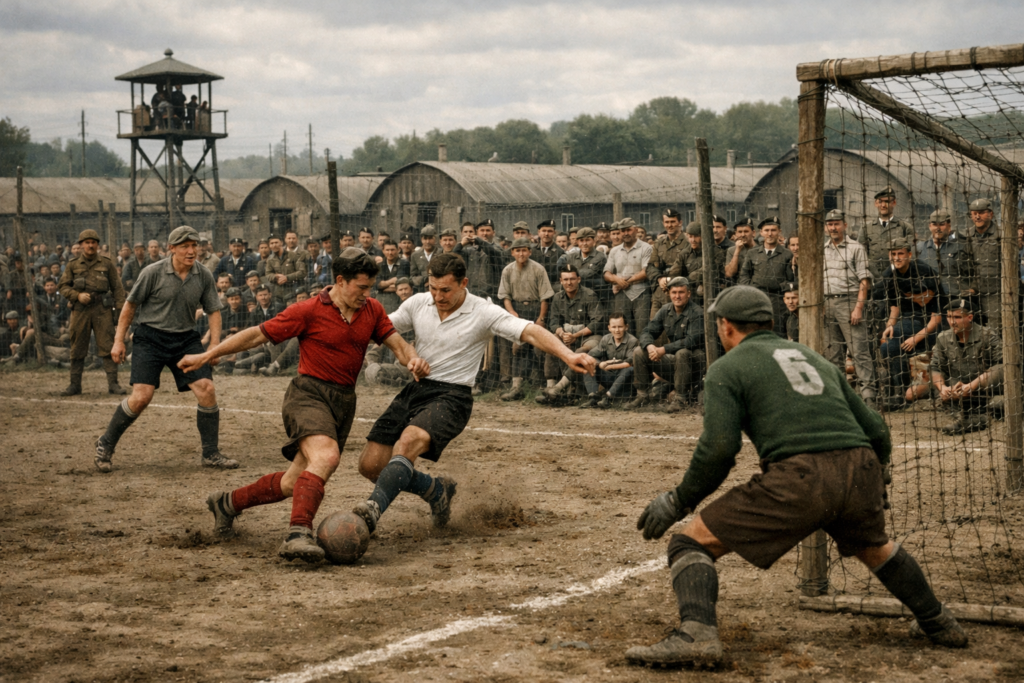
Image Credentials: Image Title: Arctic Ambitions: From Prisoner to Premier: How Wartime Britain, POW Camps, and Football Changed Lives Source: (sora.openai) Date: January 2026. Attribution: This image was created using AI-generated imagery (sora.openai) and does not depict a real-world scene.
By José Carlos Palma
During the Second World War, Britain held hundreds of thousands of Axis prisoners of war. By the later stages of the conflict, especially from 1944 onward, the system that governed these camps had evolved into something far more pragmatic and, in many cases, surprisingly humane. It was within this environment that an extraordinary and unlikely footballing story took root, one that would ultimately reshape English football folklore.
Life in British POW Camps
Britain adhered closely to the Geneva Convention, and while conditions varied by camp and by year, most prisoners experienced treatment that contrasted sharply with the brutality seen elsewhere in Europe. By late 1944, the war’s outcome was increasingly clear. Many German and Italian POWs understood that returning to the front was unlikely, and morale shifted from ideological fervour to simple survival and adaptation.
Trusted prisoners were frequently assigned work duties, often under civilian supervision. Engineers, maintenance staff, and farm owners regularly oversaw work parties of POWs, Italians and Germans alike. Accounts from British personnel of the time often describe pragmatic working relationships, mutual respect, and even friendships. Some prisoners remained in contact with their British supervisors long after the war ended.
When demobilisation came between 1945 and 1946, Britain faced severe labour shortages. POWs were offered the choice of repatriation or temporary civilian employment. A significant number chose to stay, forming the roots of new lives in Britain. Some married locally, settled permanently, and quietly became part of postwar British society.
Football, both informal and organised, played a central role in this transition.
Football Behind the Wire
Football matches were encouraged in many camps as a way to maintain morale and discipline. POW teams played each other, British military sides, and even local non-league clubs. These games became community events, blurring the line between captor and captive. Talent, when visible, did not go unnoticed.
No story captures this better than that of Bert Trautmann.
Bert Trautmann: From POW to Manchester City Icon
Bernhard Trautmann was born in Bremen and came of age in the turbulent Germany of the 1930s. A talented goalkeeper at junior level with Blau Weiß Bremen, he joined the Luftwaffe when war broke out, initially serving as a mechanic. A disciplinary incident led to imprisonment and a dishonourable discharge, after which he was reassigned to the infantry.
Trautmann fought on the Eastern Front and later near the Dutch-German border. In late 1944, after heavy fighting around Kleve, he deserted. Captured by British troops after a week on the run, he was sent first to a POW camp in Essex and later transferred north.
It was in southern Lancashire that his life took an unexpected turn. Playing for the camp football team, Trautmann faced British military sides and local clubs. His reflexes, bravery, and commanding presence quickly stood out. At the same time, he worked on local farms, integrating gradually into civilian life.
When the camp closed in 1946, Trautmann was offered farm work and chose to stay in England. He was also dating a local woman. Soon, he was playing part-time for St Helens Town, where his reputation as an outstanding goalkeeper grew rapidly.
Professional clubs began to take notice.
Manchester City and Redemption Through Football
In 1949, Manchester City signed Trautmann. The decision was controversial. For many supporters, the wounds of war were still raw, and a former German soldier in goal provoked hostility and abuse. Trautmann responded the only way he knew how, through performance.
Over the following years, he established himself as one of the finest goalkeepers in the country. His bravery became legendary, his consistency undeniable. By the mid-1950s, he was widely respected, not just tolerated.
In 1956, he was named Footballer of the Year. Two weeks later came the moment that would define his legacy.
The FA Cup Final and Football Immortality
Manchester City faced Birmingham City at Wembley. Leading 3 to 1 late in the game, Trautmann collided violently with Birmingham forward Peter Murphy in the 75th minute. Substitutions were not permitted at the time. Despite intense pain and restricted movement, he chose to play on.
In the closing minutes, he produced a series of remarkable saves to secure the cup. Three days later, still in agony, he sought medical advice. X-rays revealed he had broken his neck. Two vertebrae had fractured in a way that narrowly avoided paralysis or death.
It took nearly a year to recover. Though he was never quite the same player physically, Trautmann remained with Manchester City until 1964, finishing his playing career with non-league Wellington Town.
A Life Beyond the War
After retirement, Trautmann moved into coaching and management, working in Britain, Germany, and with several national teams. His postwar life embodied reconciliation through sport. He eventually retired to Spain, where he died in 2013.
More Than a Football Story
Trautmann’s journey reflects a broader truth about Britain’s treatment of POWs and the role football played in healing a fractured continent. Camps that once held enemies became places of transition. Football pitches became spaces where identity shifted, where former soldiers became teammates, and where reconciliation was not debated, but lived.
For some, like Trautmann, football did more than offer a career. It offered a second life.
References
- Bert Trautmann, Steppes to Wembley, Stanley Paul
- Catriona Pennell, Prisoners of Britain: German POWs in the United Kingdom during the Second World War, Oxford University Press
- Bob Moore, Prisoners of War: Europe 1939–1956, Oxford University Press
- Matthew Taylor, The Association Game: A History of British Football, Pearson
- David Kynaston, Austerity Britain 1945–1951, Bloomsbury
- Manchester City FC Archives, Bert Trautmann collection
- Imperial War Museum, Oral histories of British POW camp personnel and German prisoners
- National Archives UK, Home Office and War Office POW camp records
- FA Cup Final Official Programme, 1956
- Jonathan Wilson, The Anatomy of England, Orion