
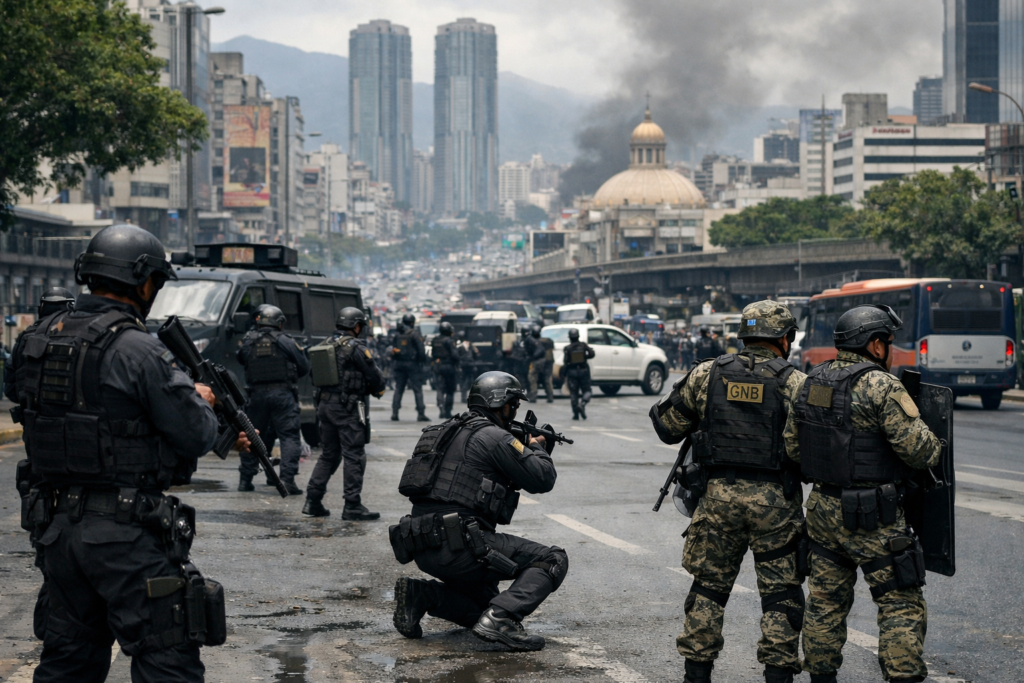
Image Credentials: Image Title: Armed Patrols Fill Caracas as US Intelligence Urges a Cautious Transition After Maduro Source: (sora.openai) Date: January 2026. Attribution: This image was created using AI-generated imagery (sora.openai) and does not depict a real-world scene.
By Open Chronicle News Desk | January 6, 2026
Armed police fanned out across central Caracas on Tuesday as Venezuela’s fragile post-Maduro order showed its first signs of strain, with US intelligence officials reportedly urging Washington to keep key figures from the former regime in place to avoid a total collapse of state authority.
According to multiple officials familiar with the matter, the CIA has advised President Donald Trump that Venezuela’s current interim leadership, headed by Delcy Rodríguez, offers the least risky path to stability following the dramatic removal of Nicolás Maduro. The agency is said to believe that sidelining the entire Maduro-era elite could fracture the security forces, trigger mass defections, and push armed groups into open rebellion.
The guidance marks a sharp departure from years of US policy aimed at dismantling Maduro’s inner circle. Instead, intelligence analysts are now prioritizing continuity in Venezuela’s security and administrative structures, arguing that keeping familiar power brokers in place may prevent the country from sliding into chaos. In downtown Caracas, armored police units and National Guard patrols were deployed around government buildings, transport hubs, and television stations. Residents reported checkpoints on major avenues, while helicopters hovered above the Miraflores Palace complex.
Interior Ministry officials said the security measures were necessary to prevent “acts of destabilization” by loyalists of the former president as well as criminal groups seeking to exploit the political vacuum.
The streets, however, told a more anxious story. Shops closed early in several neighborhoods, public transport slowed, and long lines formed outside fuel stations as rumors spread of possible unrest.
Why is Washington backing continuity?
US intelligence officials believe Venezuela’s power structure remains deeply tied to figures who rose under Maduro, particularly within the military, police, and intelligence services. Removing them too quickly, they warn, could lead to a breakdown in command and control, opening the door to militias, drug trafficking groups, and foreign-backed proxies.
Delcy Rodríguez, long seen as one of Maduro’s most trusted lieutenants, is viewed in Washington as a pragmatic operator with enough credibility inside the system to keep it functioning. CIA analysts reportedly judge that she and several other senior officials are more likely to ensure basic order, protect oil infrastructure, and prevent a violent scramble for power.
For the Trump administration, the overriding concern is avoiding a security implosion on the US doorstep, one that could trigger mass migration, disrupt energy markets, and create openings for Russia, China, or Iran to expand their influence. The approach is already controversial. Critics argue that keeping Maduro-era figures in place betrays years of US rhetoric about democracy and accountability. Venezuelan opposition leaders, many of whom suffered imprisonment or exile under the old regime, fear that the strategy will entrench the same power networks under a new label.
Human rights groups also warn that senior officials now being courted by Washington were linked to repression, corruption, and drug trafficking.
Yet intelligence officials counter that Venezuela’s institutions are so hollowed out that there is no ready-made alternative elite capable of governing. A clean break, they argue, would likely lead to a violent free-for-all.
Much now hinges on whether the interim leadership can hold the loyalty of the armed forces. The heavy police presence in Caracas reflects how uncertain that balance remains.
Behind the scenes, US diplomats and intelligence officers are expected to push for quiet guarantees from key generals and security chiefs, seeking to lock in a transition that preserves order even if it falls short of a democratic overhaul.
For ordinary Venezuelans, the immediate concern is far simpler. After years of crisis, hyperinflation, and repression, they are watching the armed patrols in their streets and hoping that this latest political shock does not plunge the country into yet another cycle of violence and hardship.