
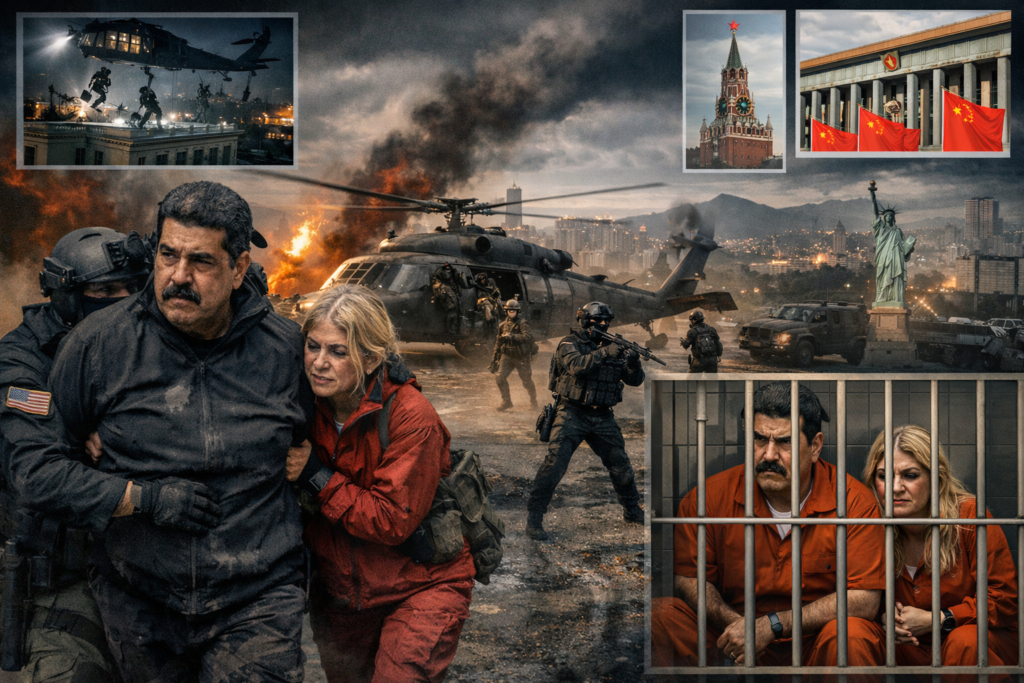
Image Credentials: Image Title: Putin, the EU, and the Caracas Shock, Why Europe Still Depends on American Power Source: (sora.openai) Date: January 2026. Attribution: This image was created using AI-generated imagery (sora.openai) and does not depict a real-world scene.
By Emma Cole | Open Chronicle Geopolitics Desk
The stunning raid on Caracas that reportedly ended with Nicolás Maduro and his wife in a New York detention center has sent tremors far beyond Venezuela. In Moscow, Brussels, and Beijing alike, the operation has been read as a brutal reminder of how power is exercised in the modern world. The United States demonstrated in a matter of hours what others have struggled to achieve in years, the ability to dismantle a hostile regime’s command structure, paralyze its defenses, and extract a leader from the heart of a fortified capital without suffering losses.
For Vladimir Putin, the implications are especially painful. For more than two decades, he poured resources into Russia’s armed forces, particularly elite airborne and special units designed for rapid decapitation strikes. Yet when Russia attempted to seize Kyiv and topple Ukraine’s government, the effort collapsed into chaos. The supposed spearhead of Russia’s modern military was mauled on the roads to Bucha and across the runways of Hostomel. What was meant to be a swift coup de main degenerated into a grinding, multi-year war that has exposed deep weaknesses in Russian command, logistics, and joint operations.
By contrast, the American operation in Caracas, dubbed Absolute Resolve by U.S. planners, showed the extraordinary power of a force built around integrated command, control, communications, and intelligence. The United States shut down Venezuela’s military networks, blinded its air defenses, and penetrated the most heavily guarded compound in the country. Russian-supplied equipment and Cuban-trained guards proved irrelevant. For a Kremlin that has long staked its prestige on being able to protect friendly regimes, the failure to safeguard allies in Damascus, Tehran, and now Caracas is a devastating blow to credibility.
The lesson for Europe is no less sobering. Polish Prime Minister Donald Tusk has warned that Europe risks irrelevance if it fails to unite, yet unity in foreign policy does not equal military capability. The European Union still lacks a true integrated force able to plan and execute operations at speed and in secrecy. Structures such as the Eurocorps exist, but they remain awkward hybrids outside the EU’s formal command system. Twenty-seven national governments continue to guard their control over armed forces, making decisive joint action painfully slow and politically fragile.
The contrast with the American system is stark. Since the Goldwater-Nichols reforms of 1986, the U.S. military has been built around jointness. The Army, Navy, Air Force, and intelligence agencies train, plan, and fight together under unified command. Decades of reform have produced an institution capable of synchronizing cyber, air, land, sea, and space assets in real time. That is what made an operation like Absolute Resolve possible.
Europe has no equivalent. Even NATO, which remains the continent’s true military backbone, relies overwhelmingly on U.S. infrastructure, surveillance networks, and nuclear guarantees. The EU’s cautious endorsement of the Caracas raid, including by Commission President Ursula von der Leyen, reflected an uncomfortable truth. Publicly criticizing Washington would only highlight how dependent Europe still is on American power for its own security.
This dependence is unlikely to disappear soon. Replacing U.S. command and intelligence capabilities would require vast investments and decades of institutional reform. Political obstacles are just as formidable. Joint operations cannot wait for twenty-seven leaders to negotiate a consensus, nor can they survive the risk of leaks and internal sabotage. Even the struggle to agree on funding for Ukraine has shown how fractured Europe remains when real stakes are involved.
As Washington shifts more of its attention toward the Pacific and the challenge posed by China, European leaders speak more urgently about strategic autonomy. Yet the reality is far less ambitious. At best, the EU will become a financing and coordination hub for forces that still operate within a NATO framework dominated by American technology and leadership. Expensive projects like future fighter jets matter, but far more critical are mundane investments in interoperability, logistics, transport corridors, and prepositioned equipment.
The Caracas operation may have humiliated Moscow, but it has also delivered a blunt message to Europe. Power in the modern world is not measured by declarations or defense white papers. It is measured by the ability to act quickly, secretly, and decisively. On that scale, the United States remains in a class of its own. For the European Union, true military autonomy remains not a project for the next decade, but a distant and uncertain ambition.