
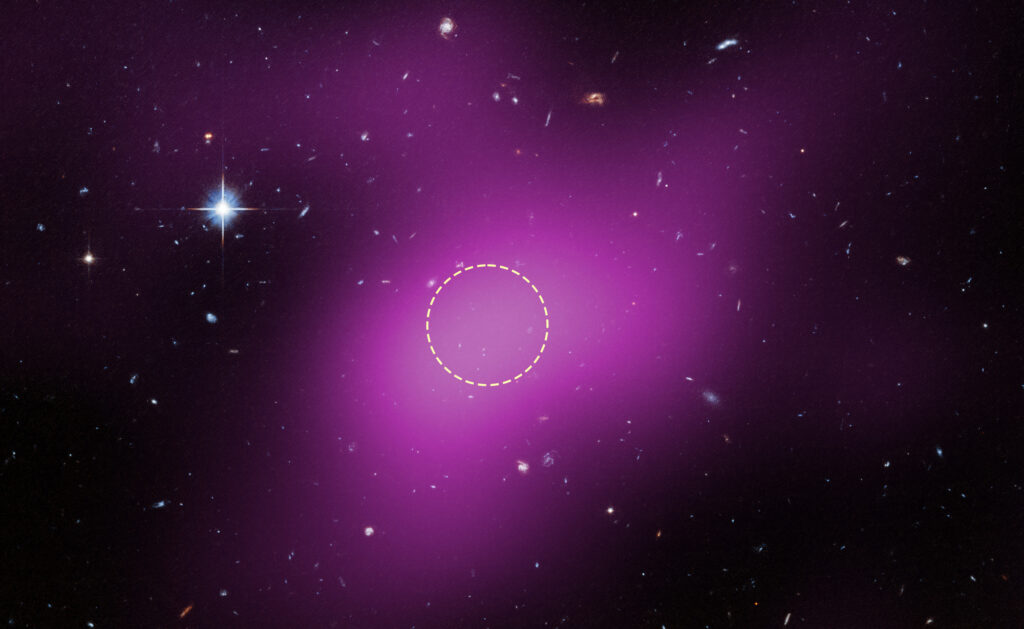
Image: from NASA X@NASA
By Open Chronicle Science Desk | January 6, 2026
NASA scientists have confirmed the discovery of what may be one of the most extraordinary cosmic objects ever observed, a starless, gas-rich body dominated almost entirely by dark matter. The object, known as Cloud 9, was identified through high-precision observations by the Hubble Space Telescope near the spiral galaxy Messier 94, offering scientists a rare and powerful new way to study how galaxies form and why some of them never do.
The findings, published in The Astrophysical Journal Letters and presented this week at the 247th meeting of the American Astronomical Society in Phoenix, mark the first confirmed detection of what researchers call a failed galaxy, an object that contains all the raw ingredients of a galaxy except stars.
“This is a tale of a failed galaxy,” said principal investigator Alejandro Benitez Llambay of the University of Milano Bicocca. “The absence of stars is the key piece of evidence. In science, we usually learn more from the failures than from the successes.”
A team using @NASAHubble has made the first confirmed detection of a new type of astronomical object: a starless, gas-rich, dark-matter cloud, nicknamed Cloud-9. Here's what this object is teaching us about dark matter and the early universe: https://t.co/csCRXnzgDM pic.twitter.com/ZnUnhy9EYL
— NASA (@NASA) January 5, 2026
A Galaxy That Never Ignited
Cloud 9 is composed primarily of hydrogen gas and is held together by a massive halo of dark matter, the invisible substance that makes up about 85 percent of all matter in the universe. What makes it unique is that, despite having enough gas to form stars, it never ignited the nuclear fusion processes that give rise to stellar light.
Follow-up imaging using Hubble’s Advanced Camera for Surveys confirmed the absence of even the faintest stars within the cloud.
“With Hubble’s Advanced Camera for Surveys, we’re able to nail down that there’s nothing there,” said lead author Gagandeep Anand of the Space Telescope Science Institute. “No hidden star clusters, no faint stellar glow, just gas and dark matter.”
The object’s proximity to Messier 94 makes it even more intriguing. Researchers believe Cloud 9 may be a primordial structure that survived for billions of years without ever evolving into a full galaxy.
A Window Into the Dark Universe
Dark matter cannot be seen directly because it does not emit or absorb light, yet it governs the motion of galaxies and holds cosmic structures together. Normally, astronomers infer its presence by observing how stars move. Cloud 9 removes that complication.
“This cloud is a window into the dark universe,” said Andrew Fox of AURA and the Space Telescope Science Institute. “Because it has no stars, we can study the dark matter halo in its purest form.”
The discovery provides long-sought observational evidence for theoretical models that predict the existence of many such failed galaxies in the early universe. Until now, none had been conclusively identified.
Why Failed Galaxies Matter
Astronomers believe that in the early universe, countless small dark matter halos formed. Some accumulated enough gas to ignite stars and grow into galaxies, while others were disrupted or stripped of their material before star formation could begin.
Cloud 9 appears to have escaped that fate, remaining intact but dormant, preserving a snapshot of a galactic building block frozen in time.
According to NASA, studying objects like Cloud 9 could help explain why some galaxies flourish while others never take shape, shedding light on the fundamental processes that shaped the cosmos.
“This is exactly the kind of object our models have predicted for decades,” said Benitez Llambay. “Now we finally have one we can study directly.”
A New Frontier for Cosmic Research
The confirmation of Cloud 9 opens a new chapter in astrophysics, one where scientists can explore dark matter structures without the complicating glow of stars. Future observations with the James Webb Space Telescope and upcoming space missions could reveal whether more of these ghostly objects are hidden across the universe.
For now, Cloud 9 stands alone, a silent, invisible galaxy that never was, offering humanity one of its clearest glimpses yet into the dark scaffolding of the cosmos.