
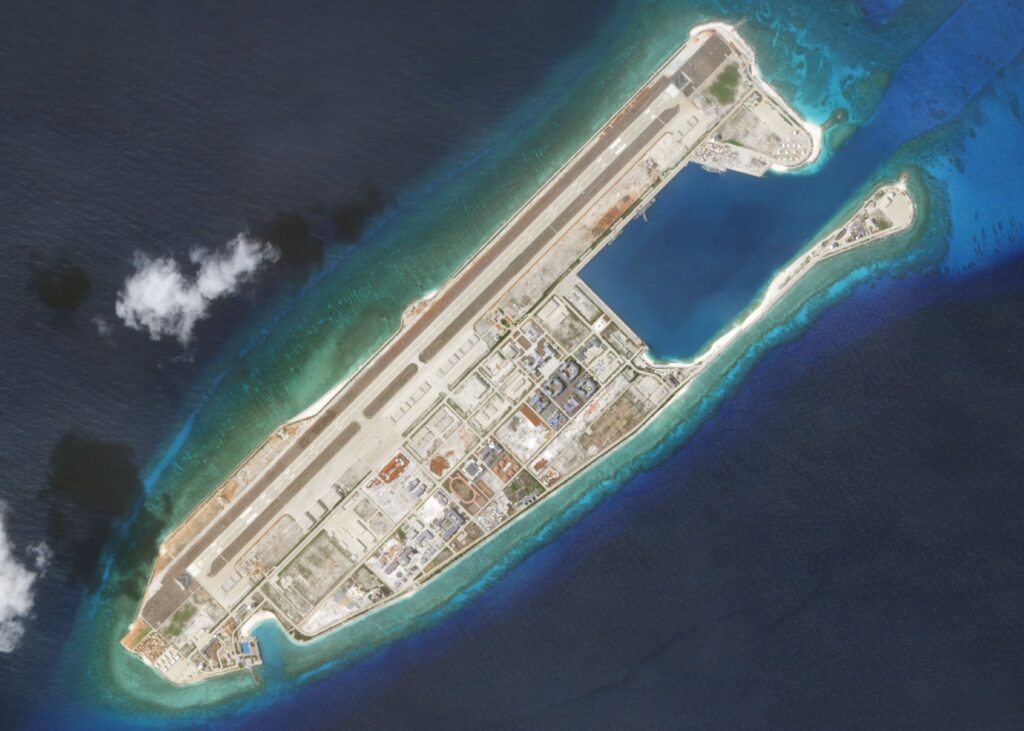
Image: from RodeoProfessor X@RodeoProfessor
By Open Chronicle News Desk with Agencies | January 6, 2026
Beijing has begun a new round of land reclamation in the South China Sea, deepening regional anxieties over its long-term strategy to dominate one of the world’s most vital maritime corridors. Fresh satellite imagery has revealed significant dredging activity at Antelope Reef in the Paracel Islands, a move that analysts say points to the expansion of another Chinese artificial island in a highly disputed area.
Recent satellite imagery indicates China is likely undertaking fresh land reclamation/island building at Antelope Reef in the Paracel Islands, South China Sea pic.twitter.com/bxn8g6g1J5
— Damien Symon (@detresfa_) January 5, 2026
The reef, known as Linyang Jiao in China and Da Hai Sam, or Sea Cucumber Rock, in Vietnam, lies in the western Paracels, roughly 250 miles east of the Vietnamese city of Hue and about 175 miles southeast of China’s major naval base in Sanya on Hainan Island. Images captured by the European Space Agency’s Sentinel 2 satellites indicate that sand dredging began after mid-October and is now concentrated at four points around the reef’s eastern and southern lagoon.
Newly reclaimed land is visible on both sides of an existing Chinese outpost and its adjoining port facility, suggesting that the site is being enlarged to accommodate additional infrastructure. Analysts note that this follows a broader pattern of Chinese construction across the South China Sea, where Beijing has spent more than a decade transforming reefs and submerged features into permanent bases.
China claims sovereignty over more than 80 percent of the South China Sea, a body of water through which up to one-third of global maritime trade flows. Its claims overlap with those of Vietnam, Taiwan, the Philippines, Malaysia, and Brunei, making the region one of the most sensitive geopolitical flashpoints in Asia.
Since 2013, China has reclaimed land on an unprecedented scale, creating at least 20 outposts in the Paracel Islands and seven major artificial islands in the Spratly chain farther south. Several of these have been heavily militarized, equipped with airstrips, missile systems, radar arrays, and hardened shelters. Environmental groups and marine scientists have also warned that the dredging and construction have caused severe and lasting damage to coral reefs and fragile marine ecosystems.
A December analysis by the Asia Maritime Transparency Initiative, a project of the Center for Strategic and International Studies, found that China continues to upgrade its island facilities with new antenna arrays and equipment resembling mobile electronic warfare systems. These enhancements, the group said, point to a sustained effort to strengthen Beijing’s intelligence, surveillance, and reconnaissance capabilities across the South China Sea.
“These upgrades underscore the fact that a major function of China’s bases is to provide unparalleled ISR coverage of the South China Sea, supporting the operations of China’s coastguard and navy in peacetime and allowing Beijing to contest the use of the electromagnetic spectrum by others in the event of a conflict,” the initiative wrote.
The latest activity at Antelope Reef comes as Vietnam has also accelerated its own land reclamation and construction on features it controls in the Spratly Islands, a move that has drawn sharp protests from Beijing. Hanoi has argued that its projects are defensive and limited in scope, though it has avoided confrontation with China, its powerful neighbor and one of its largest trading partners.
China has been building large scale artificial islands for a decade in the South China Sea. They dredge all the sand around the reefs and pile it directly on top of the same reefs you go diving on when on vacation, just like that.
These are aimed at militarization as they… https://t.co/zdoTCk1qex pic.twitter.com/l4a6mWouCM
— RodeoProfessor (@RodeoProfessor) January 5, 2026
China has held the Paracel Islands since 1974, when its navy seized them from South Vietnam in a brief but bloody battle. Since then, Beijing has steadily consolidated its control, building airfields, ports, and military facilities that now give it a dominant position in the northern half of the South China Sea.
It remains unclear whether Vietnam will issue a formal protest over the latest dredging at Antelope Reef. In past cases, Hanoi has responded with strong diplomatic statements, particularly when China has announced new territorial baselines or expanded its presence in contested waters. At the same time, Vietnam has sought to carefully balance its objections with the need to preserve stable diplomatic and economic relations with Beijing.
For regional governments and Western security planners, the new construction is another reminder that China’s push to entrench itself in the South China Sea is far from over. Each new strip of reclaimed land not only alters the physical map of the region but also shifts the strategic balance, reinforcing Beijing’s ability to project power, monitor rivals, and control one of the most important sea lanes on Earth.