
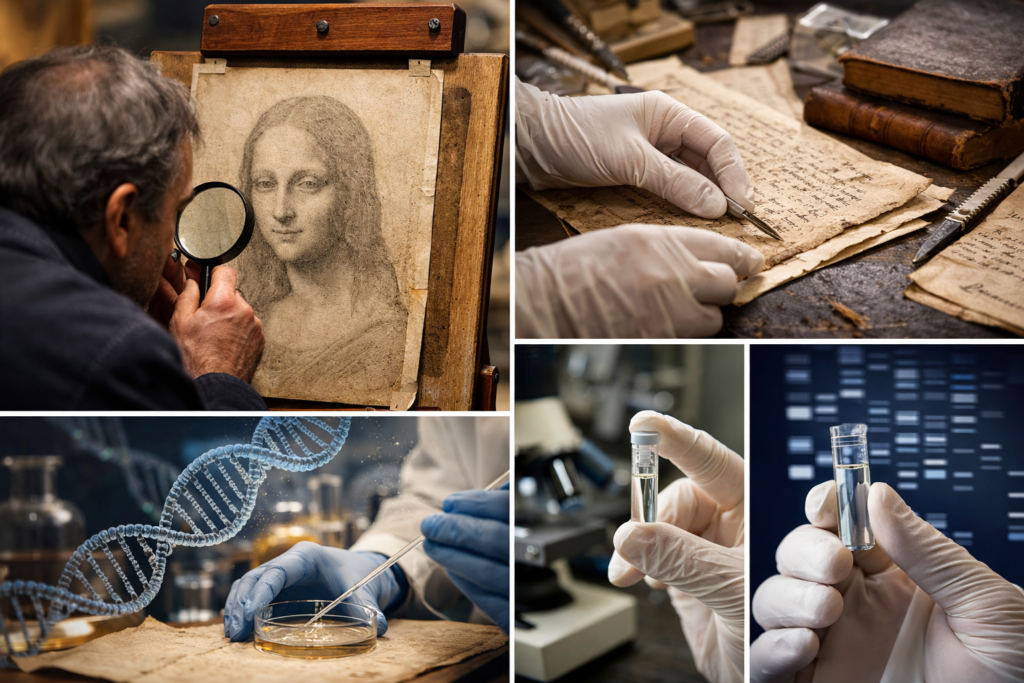
Image Credentials: Image Title: Tracing the Artist Through Biology, Scientists Explore Possible DNA Links to Leonardo da Vinci’s Art Source: (sora.openai) Date: January 2026. Attribution: This image was created using AI-generated imagery (sora.openai) and does not depict a real-world scene.
By Open Chronicle News Desk | January 7, 2026
For centuries, the attribution of Renaissance artworks has relied on trained eyes, stylistic comparison, and painstaking historical research. Now, an international team of scientists suggests that biology itself may offer a new tool. Researchers involved in the Leonardo da Vinci DNA Project say they may have recovered genetic material potentially linked to Leonardo da Vinci from a Renaissance-era drawing and historical family documents, raising the prospect that DNA analysis could one day complement traditional methods of art authentication.
The findings, released this week as a preprint on the bioRxiv server and reported by Science Magazine, are described by the researchers as preliminary. Even so, they highlight the rapid expansion of heritage science into what some specialists now call “arteomics”, the study of biological traces embedded in artworks.
Noninvasive sampling of art and archives
The Leonardo da Vinci DNA Project, launched in 2014, brings together geneticists, historians, conservators, and anthropologists. In its latest phase, the team used noninvasive swabbing techniques to collect microscopic biological material from a disputed red chalk drawing known as Holy Child. Similar samples were taken from fifteenth-century letters written by a male relative from Leonardo’s family line.
Rather than searching the entire genome, scientists focused on the Y chromosome, which is passed from father to son and remains relatively stable across generations. Genetic analysis showed that material recovered from both the drawing and the letters belonged to the same Y chromosome haplogroup, known as E1b1b. This lineage is commonly associated with Tuscany, the region where Leonardo was born in 1452.
The shared haplogroup suggests a possible familial connection, but researchers emphasize that it does not prove the DNA belonged to Leonardo himself.
Caution and complexity
“Establishing unequivocal identity is extremely complex,” said David Caramelli, an anthropologist and ancient DNA specialist at the University of Florence who is part of the project. Over five centuries, the drawing may have been handled by countless individuals, any of whom could share the same genetic lineage.
The challenge is compounded by the absence of confirmed remains. Leonardo left no direct descendants, and his burial site in Amboise, France, was disturbed in the early nineteenth century, leaving no authenticated bones for direct genetic comparison.
To narrow the uncertainty, the project is sequencing DNA from living male descendants of Leonardo’s father and analyzing skeletal material recovered from family vaults in Tuscany. The goal is to establish a clearer genetic baseline for the paternal line and compare it with biological traces found on artworks and documents.
Arteomics and the future of attribution
The study underscores a broader shift in how scientists and historians view biological material on cultural objects. For decades, traces such as skin cells, microbes, or residues were treated mainly as contamination to be removed during conservation.
Now, researchers argue that these traces may hold valuable information. Arteomics aims to analyze DNA, proteins, and microbial signatures alongside pigments, paper fibers, and brush techniques.
“Connoisseurship is still what counts,” said Jesse Ausubel, an environmental scientist at Rockefeller University who has followed the project. He argues that biological evidence should not replace expert judgment but could eventually reinforce it.
Leonardo himself may make such discoveries plausible. Historical accounts suggest that he often used his fingers in addition to brushes while painting. If so, microscopic fragments of skin cells could, in theory, be trapped within layers of pigment.
A cautious glimpse into the past
For now, the researchers stress restraint. The results remain provisional, and extraordinary claims require extraordinary evidence. Yet the work points toward a future in which art history, genetics, and conservation science intersect more closely than ever before.
If confirmed and refined, such techniques could transform debates over attribution, forgery, and provenance. More broadly, they offer an unusual possibility that centuries after his death, traces of Leonardo da Vinci’s biology may still linger on the surfaces he once touched, providing a faint but tangible connection between the modern world and one of history’s most studied minds.