
Image: from Venezuela Insider X@Andresevd
WASHINGTON — President Donald Trump publicly lashed out at five Republican senators on Thursday after they broke ranks with their party to advance a War Powers Resolution that would constrain his authority to pursue further military action in Venezuela without explicit congressional approval. The confrontation highlights rising intraparty tensions over national security and executive power.
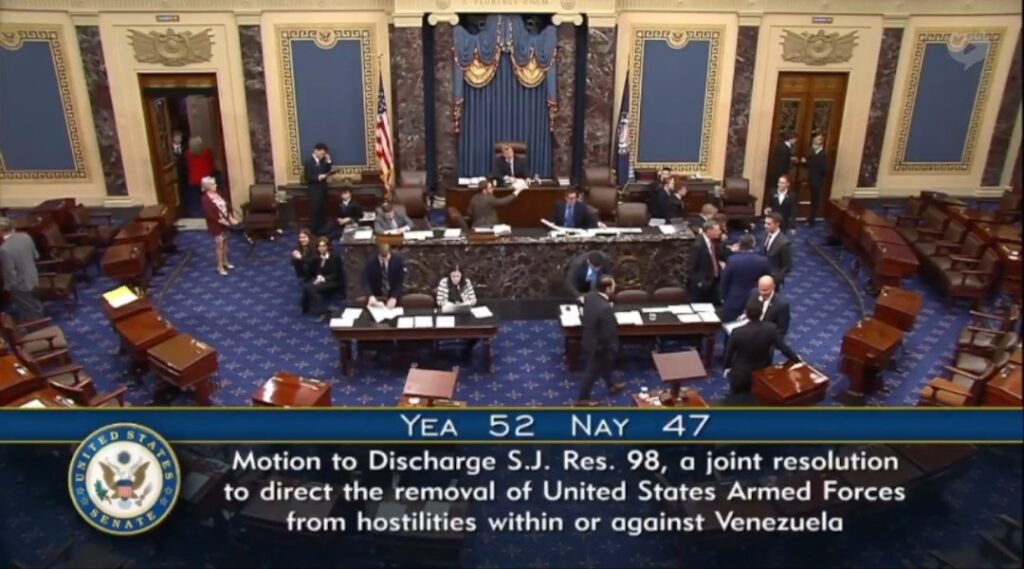
In a rare bipartisan moment, the U.S. Senate voted 52-47 on a procedural motion to advance a resolution curbing Trump’s ability to engage in additional military operations against Venezuela. The measure, introduced by Democratic Sen. Tim Kaine and backed by all Senate Democrats, would ultimately require congressional authorization before the president can commit U.S. forces to hostilities related to Venezuela. It now heads toward a final vote next week.
What made the vote notable was the defection of five Republican senators: Rand Paul (Kentucky), Susan Collins (Maine), Lisa Murkowski (Alaska), Josh Hawley (Missouri), and Todd Young (Indiana). Each crossed party lines to support advancing debate on the resolution, signaling discomfort within GOP ranks about the expansion of presidential military authority following the U.S. military’s surprise operation that captured Venezuelan leader Nicolás Maduro.
Trump responded sharply on his social media platform, Truth Social, singling out the senators by name and urging voters to reject them at the ballot box. “Republicans should be ashamed of the Senators that just voted with Democrats attempting to take away our Powers to fight and defend the United States of America,” he wrote, adding that the five “should never be elected to office again.”
The procedure vote does not yet change the law; the resolution must also clear the Republican-controlled House of Representatives and would likely face a presidential veto. Overriding a veto would require a two-thirds majority in both chambers, a high bar given current partisan dynamics in Washington.
Supporters of the resolution argued that Congress must reassert its constitutional role in authorizing military action. Under the Constitution, lawmakers hold the power to declare war, but presidents often use their authority as commander-in-chief to engage U.S. forces without formal declarations. Opponents of the measure, including Trump and several Republican leaders, defended the president’s authority and argued the resolution undermines executive flexibility in foreign policy.
Some GOP supporters of the resolution, such as Sen. Collins, framed their votes as a response to Trump’s comments, including his suggestion that U.S. involvement in Venezuela could be prolonged and involve significant commitments of American forces, which raised concerns about open-ended engagements without legislative oversight.
Sen. Josh Hawley echoed this sentiment, emphasizing that debate and congressional approval should precede any extended commitments of U.S. troops after the Maduro operation.
The White House has defended its actions in Venezuela as a law enforcement effort tied to Maduro’s indictment in U.S. courts, but the episode has amplified longstanding disputes over presidential war powers and Congress’s constitutional role, particularly given lingering questions about the scope and duration of U.S. involvement in foreign conflicts.
Thursday’s vote, while largely symbolic for now, marks a clear signal that some Republicans are willing to challenge Trump on national security issues, setting the stage for further clashes over foreign policy authority in the months ahead.