
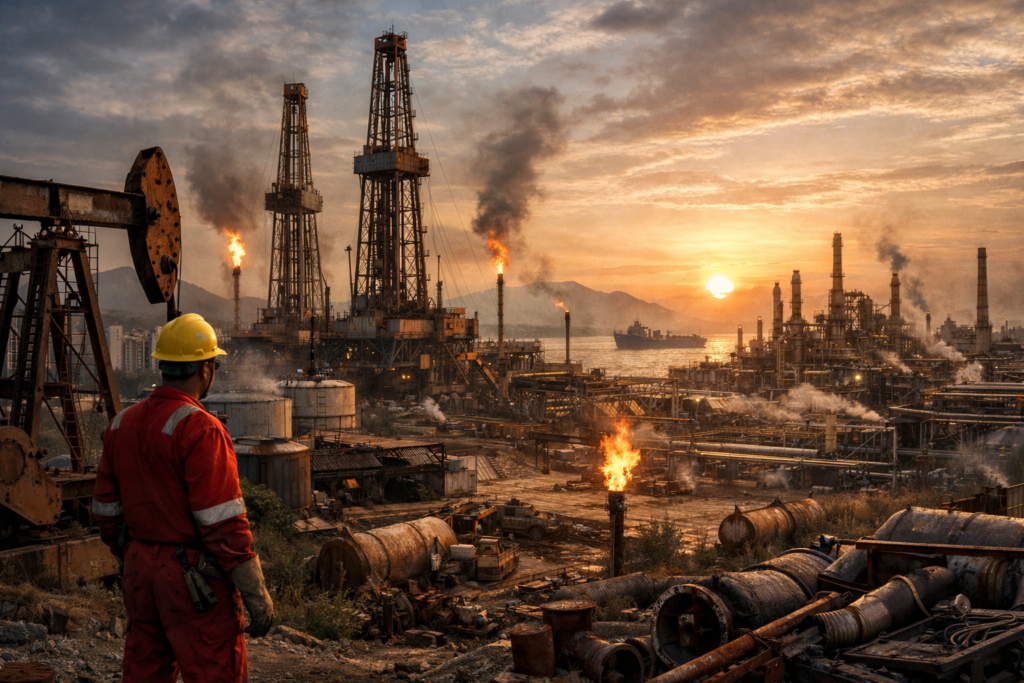
Image Credentials: Image Title: Rebuilding Venezuela’s Oil Industry Faces Enormous Financial, Technical and Political Barriers Source: (sora.openai) Date: January 2026. Attribution: This image was created using AI-generated imagery (sora.openai) and does not depict a real-world scene.
By Elliot Hayes | Open Chronicle Senior Editor
The effort to rebuild Venezuela’s oil industry is shaping up to be one of the most complicated economic recovery projects of the modern era, as the country attempts to revive what was once one of the world’s most powerful energy sectors.
Venezuela holds the largest proven oil reserves on the planet, yet its production has collapsed after decades of mismanagement, underinvestment, corruption, sanctions, and political upheaval. Experts estimate that restoring output to the 1990s peak of about three million barrels per day would require between 150 billion and 250 billion dollars in investment spread over at least a decade.
At the center of the rebuilding effort is the Venezuela Reconstruction Trust, a financial mechanism designed to collect and distribute funds for national recovery. However, the trust has become a battleground between competing priorities. The United States and international creditors are pushing to recover billions in unpaid bonds and arbitration awards, while industry experts argue that without massive reinvestment into oil fields, refineries, and power systems, there will be no sustainable revenue stream to pay anyone.
In practice, Venezuela’s oil sector is already moving toward what analysts describe as a de facto privatization. Major international firms such as Chevron, Halliburton, and Schlumberger are no longer just contractors but are increasingly managing production and operations because the state oil company, PDVSA, lacks the technical capacity, capital, and trained workforce to run the system on its own.
The challenge goes far beyond drilling new wells. Much of Venezuela’s oil infrastructure has deteriorated into what engineers call “cannibalization,” where functioning equipment is stripped of parts to keep other units barely operational. Major refineries like Amuay and Cardón, once among the most advanced in the hemisphere, now operate at a fraction of capacity or not at all.
Electricity is another critical bottleneck. Oil extraction, upgrading, and refining depend on stable power, yet Venezuela’s national grid and the massive Guri hydroelectric dam that supplies it are in poor condition. Rebuilding these systems would add tens of billions of dollars to the overall cost of reviving oil production.
Even transporting Venezuelan crude is complicated. The country’s extra-heavy oil must be blended with lighter petroleum products known as diluents so it can flow through pipelines and be exported. Today, the United States is the primary supplier of these diluents, meaning Venezuela is dependent on U.S. imports just to sell its own oil, creating a tight economic and political loop.
Timing adds another layer of risk. By 2026, global energy markets will be increasingly sensitive to carbon intensity. Venezuelan crude is among the most carbon-heavy in the world to produce and refine. If global climate policies tighten and demand for heavy oil declines, the country could find itself finishing a costly rebuild just as the market shifts away from its main product.
Perhaps the greatest obstacle is human capital. Since 2003, and accelerating during the economic collapse of the 2010s, more than 30,000 oil professionals have left the country. Many now hold senior positions in the United States, Colombia, and the Middle East. Engineers, geologists, project managers, and refinery specialists who once ran Venezuela’s oil empire are now scattered across the global industry.
Whether they return will depend on whether a new, internationally backed government can provide security, competitive salaries, and long-term stability. Without that diaspora of expertise, even the largest financial investment would struggle to translate into sustained production.
In the end, rebuilding Venezuela’s oil industry is not just about extracting hydrocarbons. It is about reconstructing a complex industrial ecosystem, restoring trust in institutions and convincing a lost generation of professionals that the country has a future worth coming back to.
The Grand Strategy Institute
Continue Exploring Strategic Analysis
Return to The Grand Strategy Institute for strategic assessments, long-form analysis and research examining geopolitics, military affairs, international security, emerging technologies and the changing international order.
← Back to The Grand Strategy Institute