
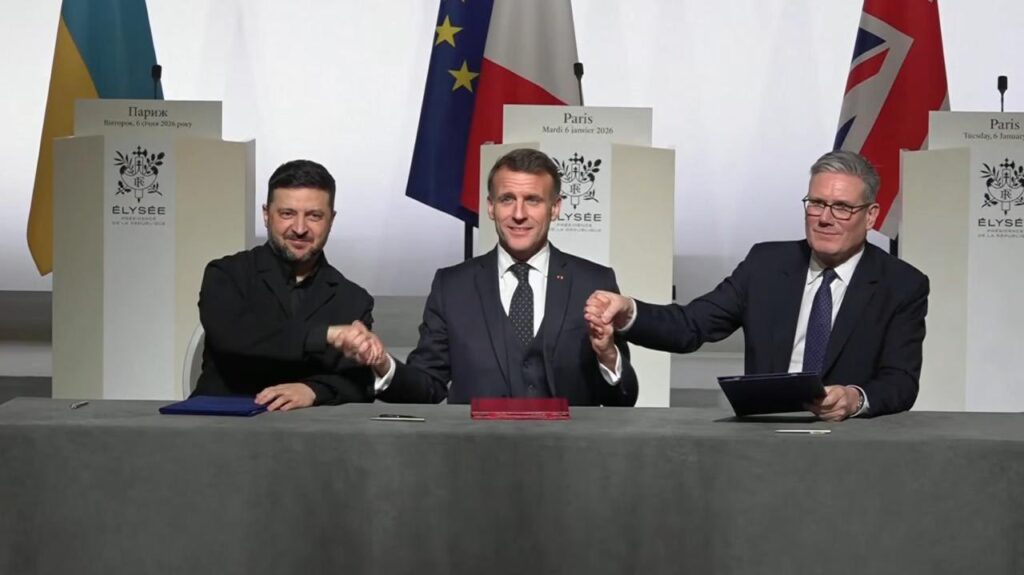
Image: from Dhairya Maheshwari X@dhairyam14
By Open Chronicle News Desk with Agencies | January 8, 2026
The United Kingdom, France, and Ukraine have released new details of a declaration of intent outlining plans for the deployment of multinational forces to support Ukraine’s defense, reconstruction, and long-term security, marking a significant step in European-backed efforts to stabilize the country once a ceasefire is achieved.
The declaration, issued on Wednesday, follows a meeting in Paris where UK Prime Minister Keir Starmer, French President Emmanuel Macron, and Ukrainian President Volodymyr Zelenskyy signed the agreement after a summit of the so-called Coalition of the Willing. It positions London and Paris at the forefront of a coalition aimed at guaranteeing Ukraine’s sovereignty and creating conditions for an enduring peace.
At the center of the plan is the creation of the Multinational Force – Ukraine, known as MNF-U, which would bring together armed forces from the UK, France, and other contributing nations. The force is intended to support Ukraine across defense, deterrence, and post-war reconstruction, while reinforcing the country’s strategic sustainability.
Zelensky, Macron and Starmer have just signed a declaration of intent to deploy a future multinational force in #Ukraine — a clear signal that Europe is moving from statements to boots, structure and security guarantee #Russia pic.twitter.com/ZSLg7X8N92
— Stephen Mutoro (@smutoro) January 6, 2026
According to the declaration, Ukraine will grant participating nations the right to use all necessary means, including the use of force, to fulfill the mission of the MNF U. This authority would extend to protecting personnel, equipment, and infrastructure belonging both to the multinational force and to Ukraine itself.
The document reaffirms the UK and France’s commitment to Ukraine’s sovereignty and territorial integrity within its internationally recognized borders. It also underlines support for Ukraine’s irreversible path toward Euro-Atlantic integration, with both countries pledging to use military, economic, and diplomatic tools to help secure a peace agreement that strengthens Ukraine’s long-term security position.
Beyond deployment, the declaration highlights plans to deepen military, technical, and logistical cooperation. This includes the creation of military hubs to support the MNF-U and to provide favorable conditions for the training, restoration, and regeneration of Ukraine’s security and defense forces. Strengthening Ukraine’s defense industrial potential is also identified as a priority.
Ukraine, for its part, intends to establish a legal and institutional framework governing the presence of foreign forces on its territory. This framework would be based on existing international agreements, including the NATO Status of Forces Agreement signed in London in 1951, granting privileges and immunities to deployed personnel.
Operationally, all movements, support activities, and missions carried out by the MNF U would fall under the strict control of a joint operations staff, with compulsory coordination with the General Staff of the Armed Forces of Ukraine. The declaration stresses that forces may be deployed across all domains to enhance Ukraine’s ability to deter further attacks by third countries.
The agreement also emphasizes interoperability and experience sharing, aligning Ukrainian doctrine, equipment, and standards more closely with those of NATO. Supporters say this approach is designed not only to address immediate security needs but also to anchor Ukraine firmly within the Euro-Atlantic security architecture in the years ahead.
Taken together, the declaration signals a more structured and assertive European role in shaping Ukraine’s post conflict security environment, while stopping short of formal NATO membership. For Kyiv, it represents a significant political and military endorsement. For Europe, it reflects a growing willingness to take collective responsibility for stability on the continent’s eastern flank.