
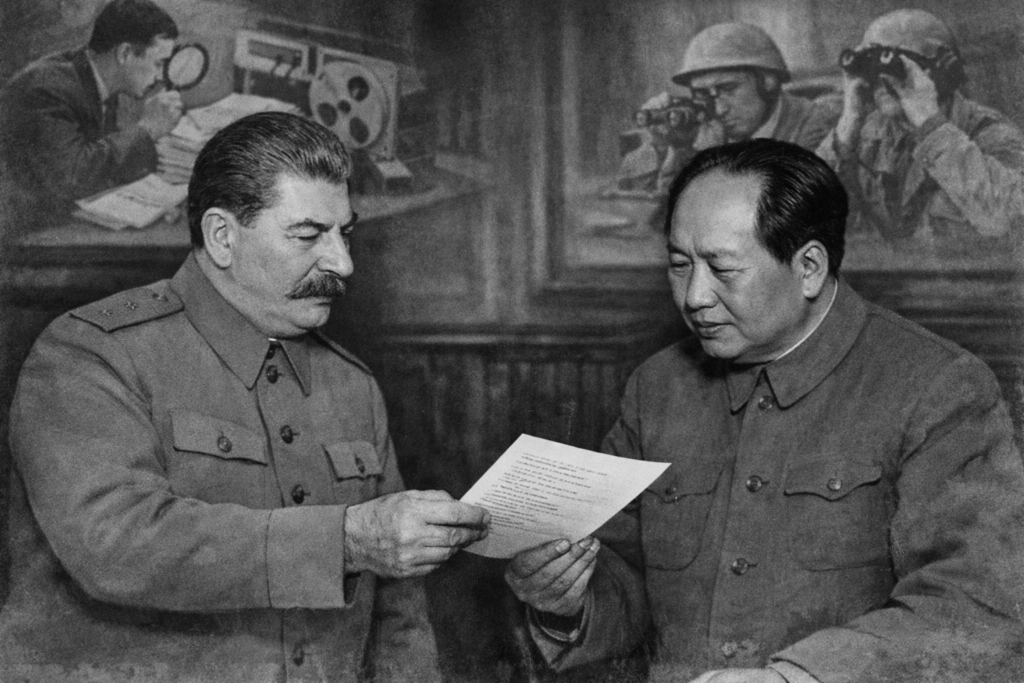
Image Credentials: Image Title: Shadow Files of the Red Empire Source: (sora.openai) Date: January 2026. Attribution: This image was created using AI-generated imagery (sora.openai) and does not depict a real-world scene.
By Open Chronicle History Desk | January 9, 2026
In the fog-soaked corridors of Cold War espionage, few stories are as seductive as the one claiming that Joseph Stalin once slid a thick folder across a table to Mao Zedong, a list of hundreds of Soviet agents supposedly hidden inside the Chinese Communist Party. It sounds like the perfect act of psychological warfare, a master spy revealing his invisible army to intimidate a rival.
The truth, however, is colder and more revealing.
There is no credible historical evidence that such a list ever existed, let alone that Stalin handed it to Mao. No Russian or Chinese archive, no American or East German intelligence record, and no memoir from anyone who sat in that room in Moscow between December 1949 and January 1950 contains a trace of it. Yet the legend refuses to die because it captures the essence of what that moment really was, a struggle for control inside the communist world.
When Mao arrived in Moscow after winning China’s civil war, he expected to be greeted as the leader of the largest revolutionary state on Earth. Instead, Stalin kept him waiting for weeks, confined to a dacha outside the city, summoned only when it suited the Kremlin. The message was clear, China was not an equal; it was a subordinate.
Behind the scenes, Stalin’s mistrust ran deep. For more than two decades, he had backed Mao’s rivals inside the CCP, especially Wang Ming and the group of Moscow-trained cadres known as the 28 Bolsheviks. He had even urged the Chinese communists to compromise with Chiang Kai-shek rather than seize power outright. A strong, independent China was never part of Stalin’s plan. What terrified him in 1949 was the possibility that Mao might become another Tito, a communist leader who would not take orders from Moscow.
The Soviet Union did have people inside China. NKVD and GRU officers had operated alongside CCP units. Political advisers sat inside ministries. Comintern networks had linked Chinese communists to Moscow since the 1920s. Soviet intelligence monitored Chinese communications and logistics throughout the civil war. But these were not shadowy super spies unknown to Mao. By the time he took power, many of these networks were visible, tolerated, or already being dismantled.
What Stalin did not do was dramatically expose his own intelligence apparatus. Instead, he chose a far more effective weapon, dependency. The 1950 Sino Soviet Treaty locked China into massive debts, gave Moscow control over key railways and ports in Manchuria, and kept Soviet advisers embedded in every major institution. Technology was rationed, military assistance came with strings, and Beijing was forced into a junior role inside the socialist camp.
The myth of the spy list was born later, when the Sino Soviet alliance collapsed. For Maoists, it became a story of heroic resistance against Soviet infiltration. For anti-Stalinist defectors, it painted Stalin as a paranoid tyrant who weaponized secrets. Both sides found the tale useful. Neither could prove it.
What remains is the deeper truth the legend points to. The relationship between Stalin and Mao was never built on trust. It was built on fear, manipulation, and an unspoken war for supremacy inside the communist world. In the end, Mao did what Stalin feared most. He broke free, purged Soviet aligned factions, and split the socialist camp in two.
No list was needed. The shadows were already there.
Bibliography
- Chen, Jian. Mao’s China and the Cold War. Chapel Hill: University of North Carolina Press, 2001.
- Fitzpatrick, Sheila. On Stalin’s Team: The Years of Living Dangerously in Soviet Politics. Princeton: Princeton University Press, 2015.
- Goncharov, Sergei, John Lewis, and Xue Litai. Uncertain Partners: Stalin, Mao, and the Korean War. Stanford: Stanford University Press, 1993.
- Kotkin, Stephen. Stalin: Waiting for Hitler, 1929–1941. New York: Penguin Press, 2017.
- Kotkin, Stephen. Stalin: Paradoxes of Power, 1878–1928. New York: Penguin Press, 2014.
- Lüthi, Lorenz M. The Sino Soviet Split: Cold War in the Communist World. Princeton: Princeton University Press, 2008.
- McDermott, Kevin, and Jeremy Agnew. The Comintern: A History of International Communism from Lenin to Stalin. London: Macmillan, 1996.
- Roberts, Geoffrey. Stalin’s Wars: From World War to Cold War, 1939–1953. New Haven: Yale University Press, 2006.
- Service, Robert. Stalin: A Biography. Cambridge: Harvard University Press, 2005.
- Shen Zhihua and Yafeng Xia. Mao and the Sino Soviet Partnership, 1945–1959. Lanham: Lexington Books, 2015.
- Westad, Odd Arne. The Global Cold War: Third World Interventions and the Making of Our Times. Cambridge: Cambridge University Press, 2005.
- Zubok, Vladislav. A Failed Empire: The Soviet Union in the Cold War from Stalin to Gorbachev. Chapel Hill: University of North Carolina Press, 2007.