
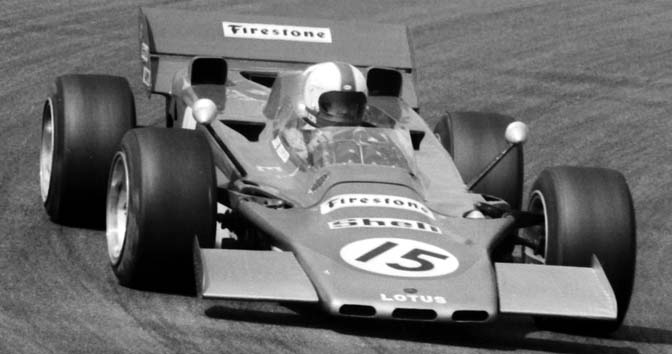
Image: Australian racing driver David Walker at the wheel of the Lotus 56 B Pratt & Whitney gas turbine Formula 1 car. The picture was taken in June 1971 at Zandvoort on the occasion of the Dutch Grand Prix there. By Raimund Kommer, CC BY-SA 3.0,(Wikipedia)
By Open Chronicle F1 Staff
In Formula 1, rules are often portrayed as the enemy of speed, a dense web of restrictions designed to slow cars down and keep engineers in check. Yet those same rules are what turn raw engineering into a competitive sport rather than a reckless experiment. Imagining an F1 without limits is thrilling, but it also exposes why regulation is the thin line between genius and disaster.
Early Formula 1 was a true wild west of design. Engineers tried almost anything that could move a car faster. Gas turbine-powered machines like the Lotus 56B, experimental Four Wheel Drive layouts, and radical aero concepts were all fair game. The cars looked futuristic, but they were also brutally unsafe. Aerodynamics were poorly understood, crash structures were primitive, and safety was an afterthought. Innovation flourished, but the cost was paid in injuries and lives.
Those machines were fast and fascinating, yet they earned a grim reputation. They were not just racing cars; they were, in many cases, barely controlled missiles.
Today, the biggest limiting factor is not a lack of imagination; it is the rulebook. Engineers use computational fluid dynamics, wind tunnels, and simulation tools so powerful that they can find performance in the smallest loophole. The famous double diffuser of 2009 showed how a single reinterpretation of a regulation could instantly rewrite the competitive order.
In a world without limits, this mindset would not disappear; it would become lethal. With no restrictions on aerodynamics or power, engineers would build cars capable of cornering at forces that a human body could not withstand. The technology would race ahead of what a driver could physically survive.
Even if we could build a car that could generate seven or more g through corners, the circuits themselves would not be able to cope. Most modern tracks are already designed around current safety standards.
Run-off areas would need to be vastly larger. Barrier systems would have to absorb impacts at speeds far beyond what they were designed for. On tight, historic circuits, the geometry itself would limit speed. An unlimited car would not necessarily be faster; it would just reach the walls more violently.
In this sense, the track, not the engine, becomes the ultimate limiter.
An unrestricted Formula 1 would produce extraordinary machines. We would see active aerodynamics, exotic engines, radical layouts, and performance that would make today’s cars look tame. But the sport would also become wildly unequal, as only the richest teams could afford such extreme development, and dangerously close to unmanageable.
Modern Formula 1 works because engineers are forced to be clever within constraints. The challenge is not simply to build the fastest possible car, but to build the fastest legal one.
That tension between rules and creativity is what makes F1 compelling. Without it, the sport would still be spectacular, but it would also be unsustainable. In the end, the thrill of Formula 1 is not just speed; it is the elegance of solving a puzzle at 300 kilometers per hour.
Bibliography
- Benson, Andrew. The Formula 1 Technical Guide. London: Haynes Publishing, 2018.
- Brawn, Ross, and Adam Parr. Total Competition: Lessons in Strategy from Formula One. New York: Penguin Press, 2016.
- FIA. Formula One Technical Regulations. Paris: Fédération Internationale de l’Automobile, annual editions.
- Jenkins, David. The Unfair Advantage: How British Formula One Changed Racing. London: Random House, 1999.
- Jones, Gareth. “The Double Diffuser Explained.” Autosport, April 2009.
- McBeath, Simon. Competition Car Aerodynamics. Sparkford, UK: Haynes Publishing, 2012.
- Nye, Doug. The Grand Prix Car 1945–1965. London: Motor Racing Publications, 1980.
- Pomeroy, Steve. “Why Formula One Needs Rules.” Motorsport Magazine, July 2017.
- Wright, Paul. Formula 1 Technology. Warrendale, PA: SAE International, 2001.