
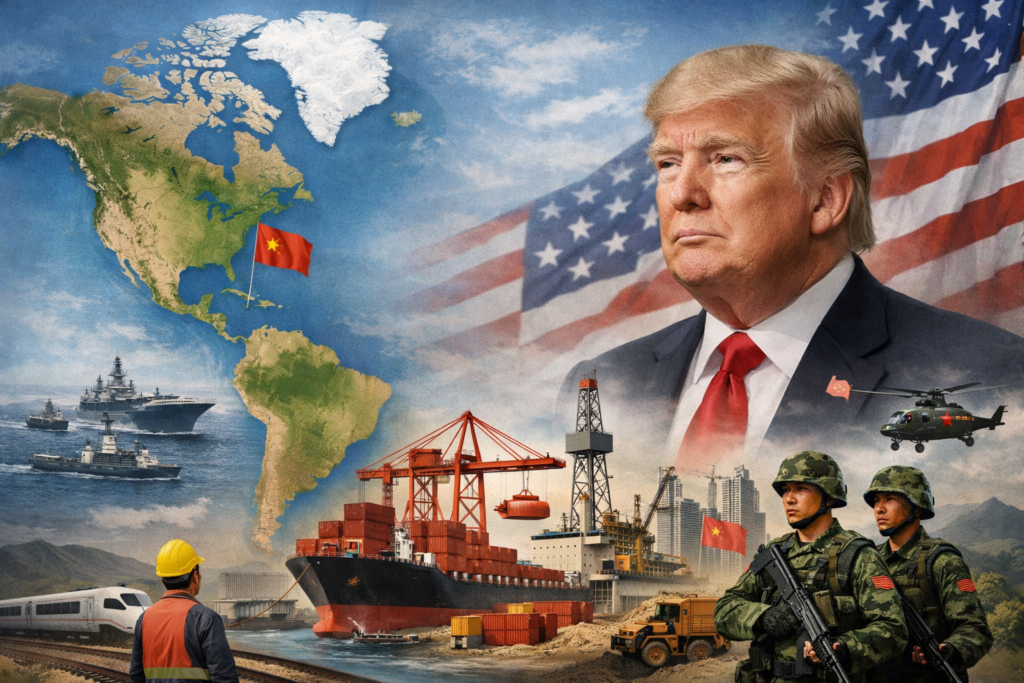
Image Credentials: Image Title: China Is Pressing Into Trump’s Hemisphere, Just Not Through Greenland Source: (sora.openai) Date: January 2026. Attribution: This image was created using AI-generated imagery (sora.openai) and does not depict a real-world scene.
By José Carlos Palma | Open Chronicle Editor-in-Chief
As the Trump administration intensifies its focus on Greenland as a keystone of Arctic security and North American defense, a parallel geopolitical narrative has been quietly circulating in Washington, namely that China is using the island as a back door into the Western Hemisphere. According to Danish officials, that narrative does not match reality.
A senior Danish diplomat recently stated that China has virtually no economic or strategic footprint in Greenland. There are no active Chinese investments on the island, very few Chinese ships operating in Greenlandic waters, and several proposed Chinese-backed infrastructure and mining projects have been blocked by Danish and Greenlandic authorities before they could move forward. This undercuts one of the most frequently cited justifications for an American takeover or coercive control of the territory.
That does not mean Beijing has abandoned its Arctic ambitions. China continues to define itself as a near-Arctic state and has steadily expanded its presence across the polar regions through research stations, shipping partnerships, and mineral investments. The difference is that China has found far more receptive environments elsewhere in what President Trump has described as his hemisphere.
Across Latin America and the Caribbean, Chinese state-backed firms have poured tens of billions of dollars into ports, telecommunications, mining, and energy projects. From lithium fields in Argentina to port facilities in Panama and Brazil, Beijing is building a dense web of economic dependencies that translate into long-term political influence. This approach aligns with China’s Belt and Road strategy, which favors infrastructure leverage over military presence.
Greenland, by contrast, has become a rare example of a small strategic territory that has successfully resisted that model. Danish and Greenlandic authorities have repeatedly intervened to prevent Chinese companies from gaining control over airports, mining concessions, and infrastructure that could be repurposed for dual-use military or intelligence activities. In effect, the island has already been quietly firewalled against Chinese strategic penetration.
This creates an awkward reality for Washington. If China is not meaningfully embedded in Greenland, then the argument that the United States must seize or dominate the island to keep Beijing out becomes far weaker. The real Chinese advance into what Trump frames as America’s strategic backyard is happening thousands of miles south, not in the High Arctic.
The situation also highlights a deeper contrast in methods. In Greenland, Western alliances operate through treaties, sovereignty, and consent. The 1951 defense agreement between the United States and Denmark already gives Washington broad military access to Greenlandic territory without ownership. China, lacking those alliances, has relied elsewhere on commercial footholds that slowly become geopolitical leverage.
By blocking Chinese projects, Denmark and Greenland have already chosen a side in the emerging great power competition. They have aligned themselves with NATO’s security architecture rather than Beijing’s economic statecraft. From a strategic perspective, Greenland is not a weak link being infiltrated; it is one of the most tightly controlled and politically anchored parts of the Arctic.
For the Trump administration, this leaves a more uncomfortable truth. If the goal is to counter China in the Western Hemisphere, Greenland is not the primary battlefield. The real contest is unfolding in ports, mines, and digital networks across the Americas, where Chinese capital has built deep and durable influence.
In that context, Greenland is less a vulnerability than a symbol. It represents the old model of security based on alliances and legal frameworks, standing in contrast to China’s newer model of economic penetration. The irony is that while Washington debates whether it needs to assert direct control over the island, its allies have already done the strategic work of keeping Beijing out.
China may be moving into Trump’s hemisphere, but Greenland, for now, is not one of the doors it has managed to open.
The Grand Strategy Institute
Continue Exploring Strategic Analysis
Return to The Grand Strategy Institute for strategic assessments, long-form analysis and research examining geopolitics, military affairs, international security, emerging technologies and the changing international order.
← Back to The Grand Strategy Institute