
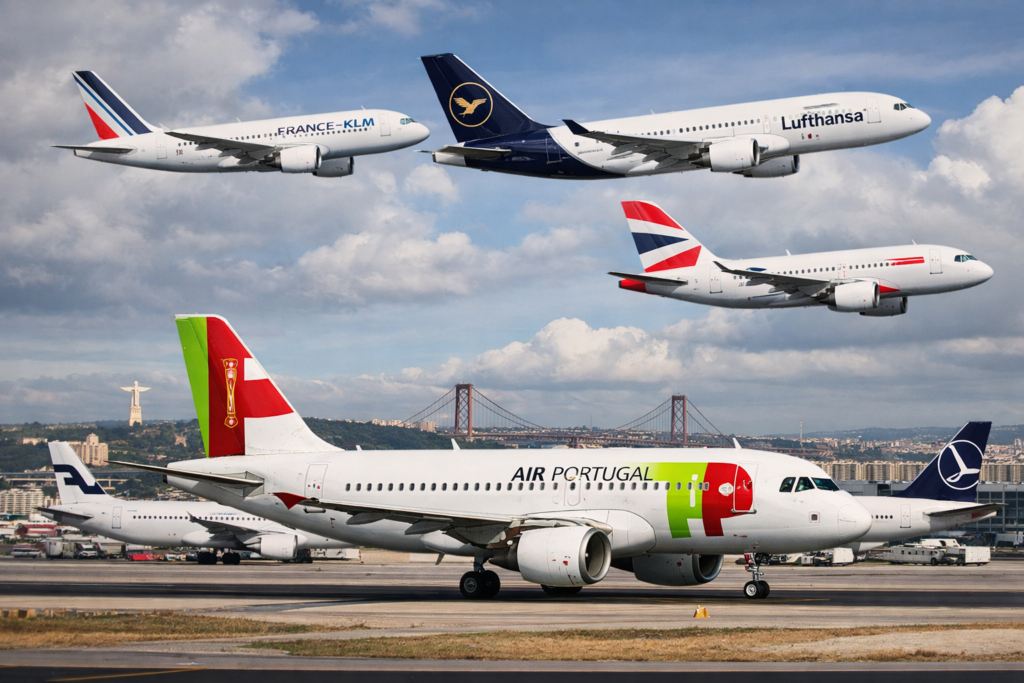
Image Credentials: Image Title: Aviation Intelligence: The Three Way Contest for TAP Air Portugal Source: (sora.openai) Date: January 2026. Attribution: This image was created using AI-generated imagery (sora.openai) and does not depict a real-world scene.
By Open Chronicle News Desk Staff with Agencies
Portugal’s flag carrier, TAP Air Portugal, has emerged as one of the most coveted assets in the European aviation market. With consolidation accelerating across the continent, TAP now finds itself courted by three heavyweight airline groups, Air France KLM, Lufthansa, and IAG. After recent mergers and acquisitions reshaped Northern and Southern Europe, TAP stands as one of the last major European airlines still legally independent, alongside LOT of Poland and Finnair. This status is unlikely to last beyond the current year.
Both Air France KLM and Lufthansa have formally declared their intention to submit non-binding offers to Parpública, Portugal’s state investment holding company, while IAG has also signaled sustained interest.
Market analysts value TAP’s strategic stake at approximately 1.5 billion euros, based on fleet size, route network, airport slots, and long-haul market access. Under the privatization framework, 44.9 percent of the airline will be sold to a private investor. An additional 5 percent will be reserved for employees, leaving the Portuguese state with a controlling stake of 50.1 percent.
Assuming competitive but disciplined bidding, Parpública can expect proceeds in the region of 700 million euros. While aggressive offers could drive valuations higher, Lisbon has made clear that price alone will not determine the outcome.
From an industrial and operational perspective, Lufthansa enters the process with notable advantages. TAP is already a member of the Star Alliance, simplifying network integration and commercial cooperation. In addition, Lufthansa Technik has announced plans to expand its maintenance footprint in Portugal through a new engine-focused repair and overhaul center near Porto. Employment at the facility is expected to rise from 450 to around 1,000 by 2030, aligning closely with government priorities on skilled job creation.
Lufthansa has also outlined a strategic vision for Lisbon’s Humberto Delgado Airport, positioning it as a major passenger and cargo gateway linking Europe with South America and parts of Africa.
Air France KLM, by contrast, is widely expected to submit the most financially attractive offer. The Franco-Dutch group has demonstrated a willingness to pay for strategic access, as shown by its recent investment in SAS. TAP would significantly strengthen its South Atlantic network, particularly toward Brazil.
IAG is generally viewed as the weakest contender. With Iberia and Vueling already under its control, an acquisition of TAP would further consolidate traffic across the Iberian Peninsula. This concentration is likely to raise concerns among European Union competition authorities, potentially limiting IAG’s prospects.
TAP has returned to profitability and holds a unique geographic and commercial position. It serves as a critical bridge between southwestern Europe and Brazil, operating passenger services to 13 Brazilian destinations, including São Paulo, Rio de Janeiro, Belo Horizonte, and Brasilia. Although TAP does not operate dedicated cargo aircraft, its belly capacity plays a growing role in transatlantic freight flows.
Interest in TAP has been further amplified by the approval of the European Union Mercosur free trade agreement by the EU Commission on 09JAN26. Covering Brazil, Argentina, Paraguay, and Uruguay, the agreement creates a combined market of around 700 million people. Once implemented, it is expected to drive significant growth in both passenger and freight traffic, particularly in automotive, pharmaceutical, chemical, and agricultural sectors. TAP’s network is well-positioned to benefit from this expansion.
As Parpública marked its twenty-fifth anniversary in SEP25, it reaffirmed three core requirements guiding the partial privatization of TAP.
First, any investor must strengthen TAP’s role as a provider of highly skilled employment in aviation operations, engineering, and maintenance. Second, the airline must continue to serve essential domestic and international routes, including connections to Portuguese-speaking countries in Africa such as Angola and Mozambique. Third, TAP’s national identity as Portugal’s flag carrier must be preserved through a credible industrial plan and a coherent long-term route strategy.
Following the evaluation of non-binding offers, shortlisted bidders will be invited to submit full purchase proposals. These will be assessed not only on financial terms but on the overall strategic package offered for TAP’s future.
Negotiations are expected to extend over several months, with industry observers anticipating a decision by next summer. For Portugal, the outcome will shape not just the ownership of its national airline, but its position within the evolving architecture of European and transatlantic aviation.