
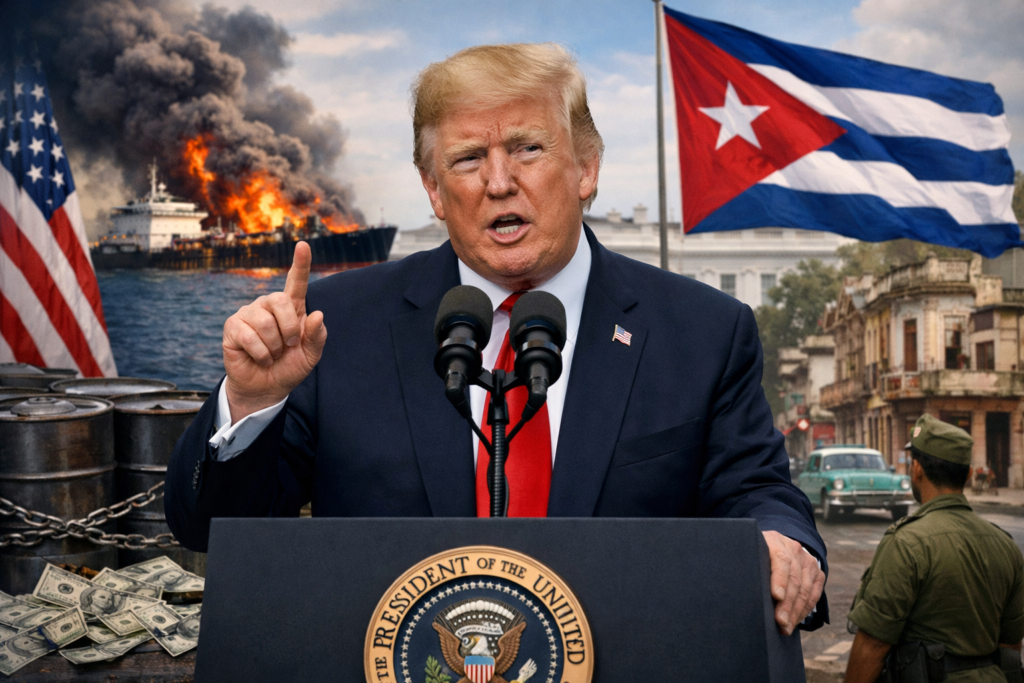
Image Credentials: Image Title: Trump Escalates Pressure on Cuba, Cutting Off Venezuelan Oil and Financial Support Source: (sora.openai) Date: January 2026. Attribution: This image was created using AI-generated imagery (sora.openai) and does not depict a real-world scene.
By Open Chronicle News Desk Staff with Agencies
WASHINGTON, D.C. — President Donald Trump dramatically intensified his administration’s campaign against the Cuban government on Sunday, declaring a complete end to Venezuelan oil shipments and financial support to the island and urging Havana to negotiate a “deal” with Washington before it is “too late.”
Taking to his Truth Social platform, Trump wrote, “THERE WILL BE NO MORE OIL OR MONEY GOING TO CUBA — ZERO! I strongly suggest they make a deal, BEFORE IT IS TOO LATE.”
The ultimatum represents a sharp escalation in U.S. policy toward one of its longest‑standing regional adversaries. The move follows the U.S. military’s capture of Venezuelan President Nicolás Maduro earlier this month, a seismic event that upended decades of geopolitical alignments in Latin America and virtually halted Cuba’s oil lifeline. Data from shipping logs indicate that no Venezuelan tankers have left for Cuba since the operation began, tightening economic pressure on an already struggling Havana.
Cuba has been heavily dependent on Venezuelan crude for more than two decades, a relationship first forged under the late Venezuelan President Hugo Chávez. Before Maduro’s capture, Venezuela supplied roughly half of Cuba’s fuel needs, helping keep the island’s energy grid functioning amid chronic shortages and rolling blackouts.
With the U.S.-directed naval blockade around Venezuelan ports now blocking those shipments, the island faces escalating energy scarcity. Analysts warn that the loss of oil could cripple key sectors, from electricity generation to transportation and food distribution, potentially deepening Cuba’s already severe economic crisis.
Havana responded to Trump’s ultimatum with staunch opposition. President Miguel Díaz-Canel took to social media to stress that Cuba is a “sovereign nation” and insisted that “nobody dictates what we do.”
Foreign Minister Bruno Rodríguez echoed that defiance, denouncing the United States as an “out‑of‑control criminal hegemon” and asserting Cuba’s right to trade freely with any willing partner. Rodríguez denied U.S. accusations that Havana received material compensation for security and intelligence services provided to Maduro’s regime.
Cuban state media and public statements have also recalled the historic context of U.S.-Cuba relations, framing Trump’s pressures as a continuation of longstanding economic coercion and pointing to U.S. embargoes and sanctions as core drivers of Cuba’s economic hardship.
As Cuba scrambles to find alternative energy sources, attention has turned to Mexico. President Claudia Sheinbaum acknowledged that while Mexico has not formally increased oil exports, the political vacuum in Venezuela has elevated Mexico’s importance as a supplier to Havana, albeit on limited terms.
Nevertheless, the aggressive U.S. ultimatum risks forcing regional partners into a diplomatic tightrope, balancing humanitarian considerations with potential fallout from antagonizing Washington.
Inside the United States, Trump’s focus on Cuba has ignited debate about administration priorities. Some political analysts and voters have questioned the wisdom of escalating foreign confrontations at a time when many Americans are concerned with domestic issues such as inflation, housing costs, and everyday affordability.
Critics argue that extensive military or economic pressure abroad, including the seizure of Venezuelan oil shipments bound for Cuba, may be perceived as a departure from the “America First” rhetoric that emphasized avoiding protracted foreign entanglements.
Trump did not specify what kind of “deal” Cuba should pursue with the United States, leaving analysts to speculate on possible diplomatic or economic frameworks. Some observers suggest that Washington might be seeking broader political concessions or security assurances in exchange for re‑establishing energy flows.
The intensifying standoff comes at a precarious moment for Cuban stability. With energy shortages already deepening hardship on the island, including frequent blackouts, transportation disruptions, and shrinking economic output, an extended cutoff of Venezuelan oil could have far‑reaching humanitarian and political consequences.