
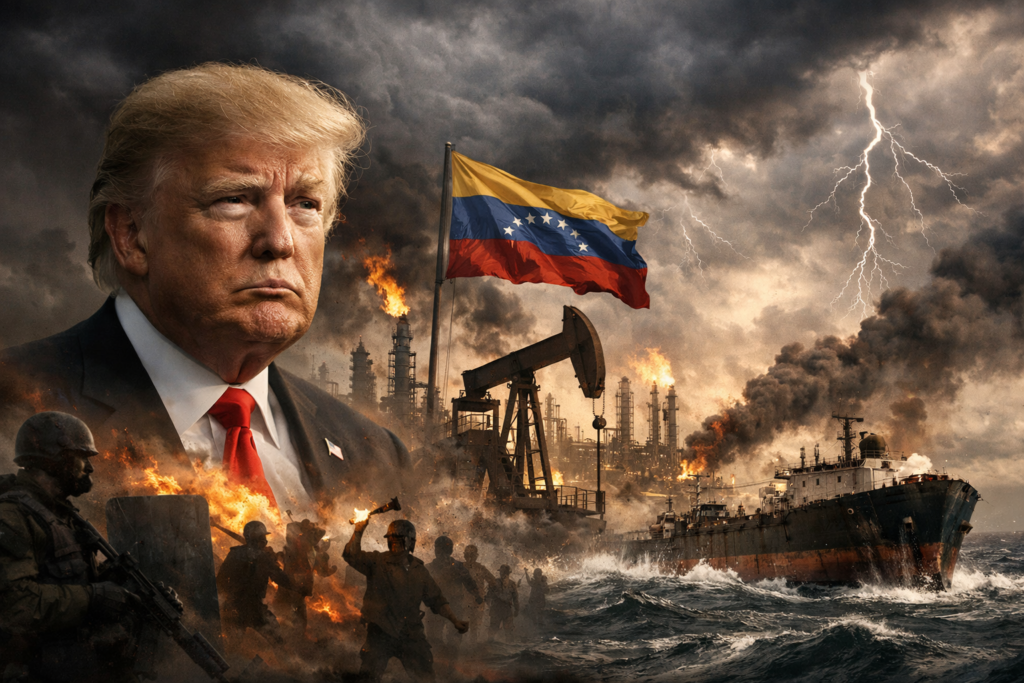
Image Credentials: Image Title: Trump’s Venezuelan Oil Ambitions Face Turbulent Reality Source: (sora.openai) Date: January 2026. Attribution: This image was created using AI-generated imagery (sora.openai) and does not depict a real-world scene.
By Madison Walker | Open Chronicle Senior Editor
The U.S. military raid that captured Venezuelan President Nicolás Maduro in Caracas was executed with precision after months of planning, delivering a stunning geopolitical victory for President Donald Trump. However, the smoothness of the operation masks the immense challenges now facing Washington as it attempts to turn that tactical win into strategic success, especially in reviving Venezuela’s once‑mighty oil industry.
Trump and senior U.S. officials have tied the capture of Maduro to a broader plan of using Venezuela’s vast oil resources as leverage in U.S. energy and foreign policy. The White House now says Venezuela will continue supplying oil to the United States “indefinitely,” with plans to market 50 million barrels of previously restricted crude and steer future exports toward U.S. interests.
But analysts warn that this vision presumes a degree of political stability that does not yet exist in Caracas. Ongoing political uncertainty, competing power centers inside Venezuela, and resistance from regional actors make a quick economic turnaround highly unlikely.
Venezuela holds nearly one‑fifth of the world’s proven oil reserves, making it a potentially transformative prize for any energy strategy. Yet years of underinvestment, mismanagement, and international sanctions have devastated the industry. Current production hovers around 800,000 barrels per day, a fraction of the 3 million bpd it once achieved, and restoration will require massive capital outlay. Analysts estimate that returning to mid‑2000s output levels could cost well over $180 billion and take years of sustained investment.
Trump’s administration has tried to jumpstart this process. On January 10, he signed an executive order to protect Venezuelan oil revenues in U.S. accounts, blocking creditors from seizing funds and signaling Washington’s intention to safeguard its strategic leverage over Caracas’s energy assets.
Despite Washington’s high‑profile push, major U.S. energy executives remain cautious. At a recent White House meeting, ExxonMobil’s CEO described Venezuela as “uninvestable” under current conditions because of legal uncertainty and crumbling infrastructure, even as the administration outlined a $100 billion plan to attract foreign investment and revitalize the oil sector.
Chevron, which has maintained a limited presence in Venezuela longer than most U.S. majors, could see increased activity, and industry strategists note that Venezuelan heavy crude is well‑suited to Gulf Coast refineries. However, the scale of rebuilding and risk involved means eager declarations may run against economic reality.
The Trump administration’s strategy hinges on a belief that control of oil assets, and even direct U.S. oversight of Venezuela’s political transition, will deliver economic benefits. But this gamble carries sharp risks.
U.S. citizens have been warned to leave Venezuela amid reports of armed paramilitary groups targeting foreigners, reflecting the wider environment of instability that a rebound in oil production would have to overcome.
Moreover, external actors such as China, Russia, and Cuba have strong economic and political stakes in Venezuelan oil and may resist any attempt to marginalize their interests. China, Venezuela’s largest oil customer, has condemned U.S. actions as violations of international law, and Cuba has warned of further destabilization ahead.
Even with access restored, Venezuelan oil is entering a market currently awash with supply. Analysts suggest that additional barrels could push down global prices, potentially undermining the commercial case for rapid increases in production.
Oil infrastructure, pipelines, refineries, and export terminals have deteriorated under two decades of neglect. In some regions, even operational logistics such as shipment authorizations have been disrupted, leaving exports effectively paralyzed.
Trump’s vision of a Venezuela oil boom powering both U.S. economic and regional objectives remains aspirational. The raid that removed Maduro may have been swift, but stabilizing Venezuela, much less rebuilding its oil industry, will almost certainly be a protracted and complex process.
Experts warn that without clear political authority in Caracas, legal certainty for investors, and fundamental reconstruction of energy infrastructure, the promise of a quick oil‑fueled recovery is likely to remain out of reach. U.S. leverage over Venezuelan oil, through naval presence, executive orders, and strategic shipments, may offer a temporary advantage, but converting that into lasting economic transformation for Venezuela and profit for U.S. interests will require far more than tactical military success.
The Grand Strategy Institute
Continue Exploring Strategic Analysis
Return to The Grand Strategy Institute for strategic assessments, long-form analysis and research examining geopolitics, military affairs, international security, emerging technologies and the changing international order.
← Back to The Grand Strategy Institute