
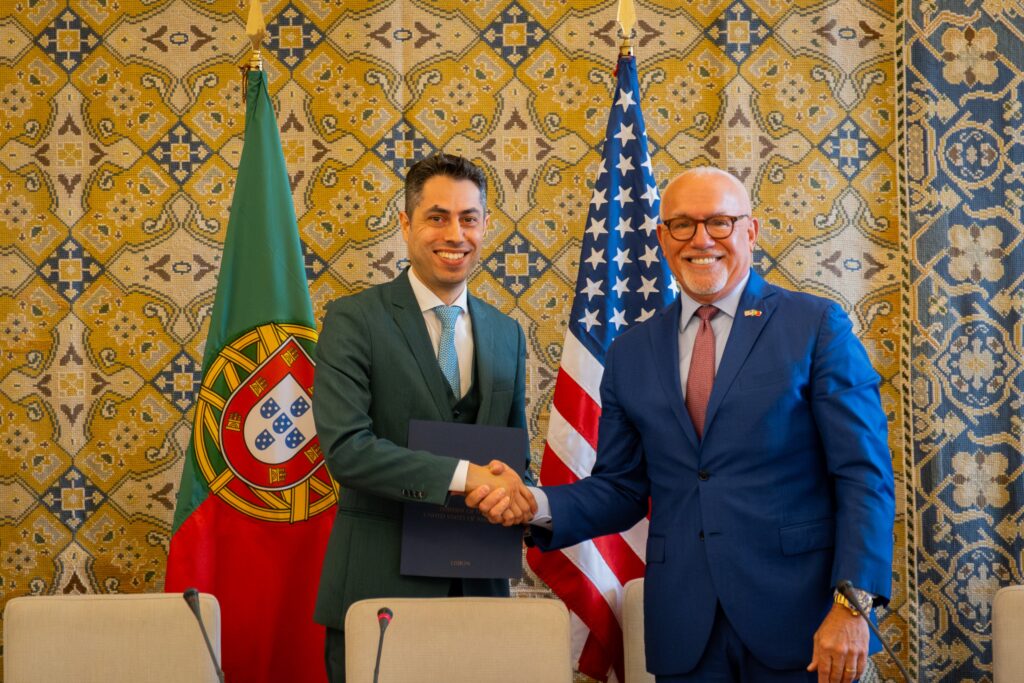
Image: from State Department Economic Affairs  X@EconAtState
By Open Chronicle News Desk Staff with Agencies
LISBON — Monday, January 12, 2026 — In a move that bridges the maritime “Age of Discovery” with the future of lunar exploration, Portugal has officially signed the Artemis Accords. By joining the international agreement on Sunday, January 11, Portugal becomes the landmark 60th nation to commit to the peaceful, transparent, and sustainable exploration of deep space.
The signing was formally celebrated today at an event in Lisbon, where government officials from both the United States and Portugal gathered to discuss deepening scientific ties.
Congratulations to Portugal on becoming the 60th signatory to the Artemis Accords – guidelines for peaceful space exploration and use in the 21st century and beyond!
Read more: https://t.co/VwpBaCfKb4 pic.twitter.com/kHEOeUCjcq
— State Department Economic Affairs (@EconAtState) January 12, 2026
Welcome to the Artemis Accords, Portugal! 🇵🇹
One of America's oldest allies has joined this growing coalition of nations committed to safe, transparent, and peaceful exploration of space.
This 60th signing strengthens the Artemis alliance, ignites more opportunities for… pic.twitter.com/6D9WxLRlMu
— NASA Administrator Jared Isaacman (@NASAAdmin) January 12, 2026
From Magellan to the Moon
The ceremony drew deliberate parallels to Portugal’s historic role in global exploration. Helena Canhão, Portugal’s State Secretary for Science and Innovation, signed the document, signaling the nation’s intent to be an active participant in the 2026 return to the lunar surface.
“2026 is the year in which humans will return to the moon,” said Hugo Costa, executive director of the Portuguese Space Agency. “It will mark the beginning of a new era of space exploration, reminiscent of the Portuguese explorers of the past, such as Magellan and his circumnavigation of our planet.”
The Race for the 60th Spot
Portugal’s signing comes after a brief period of diplomatic anticipation. While Latvia had announced its intent to sign in late 2025, administrative delays meant the Baltic nation had not yet formalized its status. Portugal’s swift action on January 11 allowed it to claim the 60th spot, becoming the first country to sign in the year 2026.
NASA Administrator Jared Isaacman—the former commercial astronaut now leading the agency—congratulated Portugal in a video message. “Portugal’s history makes this moment especially fitting,” Isaacman said, noting that the country is helping “usher in a new golden age of exploration.”
A “Bulwark Against Chaos”
The Artemis Accords, established in 2020, are designed to refine the principles of the 1967 Outer Space Treaty for a modern era of high-frequency launches and commercial lunar activity. US officials at the State Department emphasized that as space becomes more crowded, these norms are essential.
-
Space Sustainability: Portugal has pledged to manage space resources responsibly and mitigate orbital debris.
-
Norms and Standards: NASA Associate Administrator Amit Kshatriya described the Accords as a “bulwark against chaos” in an environment seeing a sharp increase in satellite and lunar traffic.
-
Security: John Thompson of the State Department noted the Accords are a tool to push back against “aggressive use of outer space” by ensuring activities benefit all humankind.
With Portugal’s signing, the Artemis Accords have reached 60 international signatories.
What began during the President’s first administration with 8 nations has grown, in just 5 years, into a coalition spanning the globe. The Accords are growing as our missions to the Moon and… pic.twitter.com/ydjXEjBmtp
— NASA (@NASA) January 12, 2026
Artemis Accords: Milestones to 60
| Year | Total Signatories | Notable Additions |
| 2020 | 8 | Founding members (US, UK, Japan, etc.) |
| 2025 | 59 | Rapid expansion with 7 new countries. |
| 2026 | 60 | Portugal (First signing of the year). |
As the global space community prepares for the Artemis III mission later this year, Portugal’s inclusion reinforces the European commitment to a US-led lunar coalition. For Lisbon, the Accords represent more than just a treaty; they are a return to the national identity of exploration—this time, looking toward the stars rather than the horizon.