
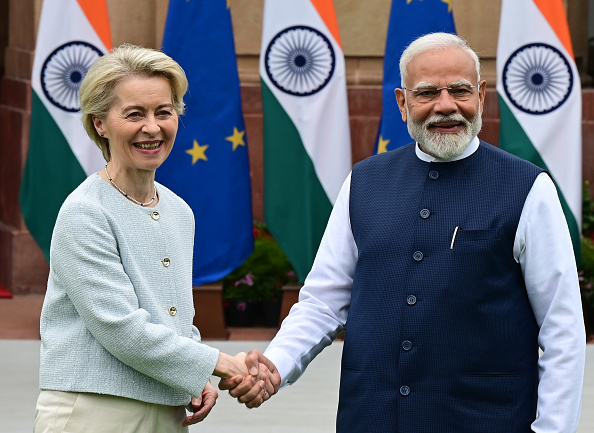
Image: from Euractiv X@Euractiv
By Open Chronicle Foreign Affairs Desk with Agencies
European Union efforts to redraw its global trade map may reach a decisive milestone within weeks. Speaking during an official visit to India on Monday, German Chancellor Friedrich Merz said a long awaited free trade agreement between the EU and New Delhi could be signed by the end of February, signaling renewed momentum after years of difficult negotiations.
According to Merz, European Commission President Ursula von der Leyen and European Council President Antonio Costa could travel to India toward the end of the month to formalize the deal. While earlier plans to conclude talks by the end of 2025 fell short, intensified negotiations in recent months appear to have pushed the agreement into its final phase.
Germany’s Strategic Bet on Open Trade
Merz’s remarks come just days after a majority of EU member states approved the contentious Mercosur free trade agreement, a pact strongly backed by Berlin. Germany views these deals as central to a broader strategy aimed at diversifying trade relations beyond the United States and China, both of which have embraced increasingly nationalist and protectionist trade policies over the past year.
“We are seeing a renaissance of protectionism,” Merz warned at a press conference in India, arguing that it runs counter to the principles of open markets and free trade. He framed closer economic ties with India as both an economic necessity and a geopolitical choice, describing the country as the fastest-growing economy in the G20 and a pivotal partner in the Indo-Pacific.
Negotiations Under Pressure from Global Trade Tensions
Momentum toward an EU–India deal has been driven in part by shared external pressures. Both sides are grappling with strained trade relations with Washington, which has raised tariffs on multiple partners, and with Beijing, which European officials accuse of leveraging global dependencies on raw materials and advanced technology.
Last week, India’s Minister of Commerce and Industry Piyush Goyal traveled to Brussels for high-level talks with EU trade commissioner Maroš Šefčovič. The latter has previously characterized Indian negotiators as tough, a reflection of the complexity surrounding market access, regulatory alignment, and sustainability commitments.
The most sensitive issues remain concentrated in the agreement’s sustainability chapter. The European Commission has acknowledged persistent disagreements over the introduction of a dispute settlement mechanism linked to environmental and green standards. India has also voiced strong objections to the EU’s Carbon Border Adjustment Mechanism, adopted in 2023, which New Delhi views as a protectionist measure in disguise.
Despite these obstacles, Merz expressed confidence that negotiations have entered their final stretch, calling the prospective signing an encouraging signal of the EU’s determination to continue forging comprehensive trade agreements.
Political Fallout Inside the European Union
While Berlin champions trade liberalization, the EU’s diversification agenda is triggering political turbulence elsewhere, particularly in France. Paris opposed the Mercosur agreement, warning that an influx of agricultural imports from Latin America could undermine French farmers and destabilize rural economies.
Tensions have escalated as von der Leyen prepares to travel to Paraguay on 17 January to sign the Mercosur pact. In France, both far-right and far-left opposition parties have seized on the issue, threatening to challenge President Emmanuel Macron’s government through a vote of no confidence.
A Broader Strategic Shift
If concluded, the EU–India trade agreement would mark one of the bloc’s most significant economic partnerships in years, reinforcing a shift toward multipolar trade relations. For Brussels and Berlin, the deal is about more than tariffs and market access. It is a strategic response to a fragmenting global order, where economic resilience increasingly depends on diversified alliances.
Whether the agreement can be sealed by February will depend on bridging the remaining gaps on sustainability and climate-related provisions. Yet the political signal is clear. As protectionism rises elsewhere, the EU is betting that deeper ties with India can anchor its vision of open trade in an increasingly contested world.