
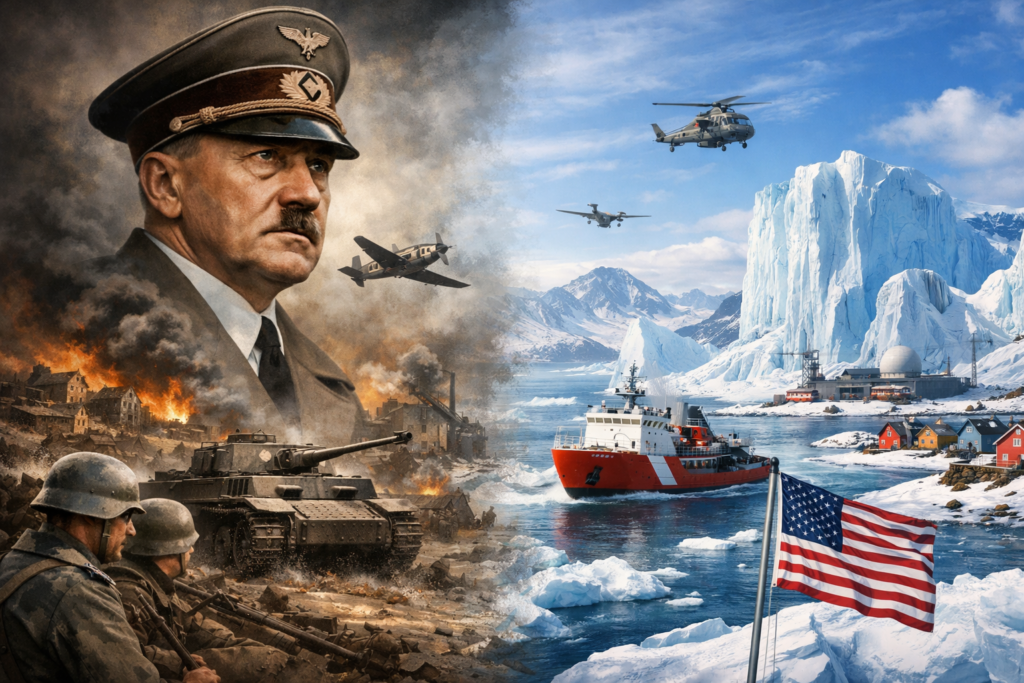
Image Credentials: Image Title: Hitler, Greenland, and the Arctic Reality: Separating History from Headlines Source: (sora.openai) Date: January 2026. Attribution: This image was created using AI-generated imagery (sora.openai) and does not depict a real-world scene.
By Open Chronicle History Desk | January 13, 2026
As of January 2026, there is no historical or contemporary evidence linking Adolf Hitler personally to Greenland. The renewed appearance of both names in recent headlines has created confusion, but the overlap is coincidental rather than factual. One story belongs firmly to the history of the Second World War, the other to present-day geopolitics in the Arctic.
Understanding why these narratives have converged requires a careful distinction between historical analysis, modern political debate, and the persistence of long-standing myths.
The Nuclear Question and the Limits of Nazi Science
One of the stories drawing attention this week is a widely circulated feature titled Ghosts of the Atom: Why Hitler Never Had the Bomb. The article revisits the long-examined failure of Nazi Germany to develop nuclear weapons. Its conclusions are consistent with established historical scholarship.
The German nuclear program was fragmented, underfunded, and hampered by internal rivalries. It lacked access to sufficient fissile material and never achieved the coordinated industrial scale required for atomic weapon development. While German scientists made theoretical contributions to nuclear physics, the regime never approached a viable bomb.
Public interest in the article has been amplified by the use of artificial intelligence-generated imagery. These visuals, clearly labeled as synthetic, were designed to illustrate hypothetical scenarios rather than depict real events. They do not constitute new historical evidence and should not be mistaken for documentation.
Greenland and a Modern Diplomatic Dispute
At the same time, Greenland has re-entered global headlines for entirely different reasons. On January 13, 2026, Greenland’s Prime Minister Jens Frederik Nielsen publicly rejected renewed interest from President Donald Trump in acquiring the island. Nielsen reaffirmed Greenland’s decision to remain within the Kingdom of Denmark, a position strongly supported by Copenhagen.
The United States administration has framed its interest in Greenland around national security concerns and access to Arctic resources. Danish officials have described this pressure as unacceptable, highlighting the sensitivity of sovereignty in a region increasingly shaped by climate change and great power competition.
This modern dispute has no connection to Adolf Hitler or Nazi Germany, despite the coincidental timing of the headlines.
What Nazi Germany Actually Did in the Arctic
The historical reality is more limited and far less dramatic than many conspiracy theories suggest. Adolf Hitler never visited Greenland, nor is there any record of senior Nazi leadership traveling to the island. However, Nazi Germany operated small and secret meteorological stations across parts of the Arctic.
During the Second World War, weather forecasting was a strategic asset. Because weather systems generally move from west to east, data collected in the Arctic and North Atlantic could provide Germany with valuable advance knowledge for naval and air operations over Europe. Accurate forecasts were especially important for U-boat deployments in the Atlantic.
Germany attempted to establish several covert weather stations along the eastern coast of Greenland, which at the time was under American protection following the occupation of Denmark. To counter this threat, Danish and Greenlandic forces formed the Sledge Patrol, a small unit tasked with monitoring the vast and inhospitable coastline.
In 1943, the patrol discovered the German station known as Holzauge. This encounter marked the only recorded ground engagement on Greenland during the war. After brief skirmishes, the station was destroyed by United States air strikes, though some patrol members were temporarily captured before being rescued.
Another station, Edelweiss, was seized by United States Coast Guard vessels in 1944. These installations were rudimentary, consisting of wooden huts and radio equipment rather than fortified bases.
Operation Haudegen and the End of the War
The most unusual Arctic episode occurred far from Greenland, on the Norwegian archipelago of Svalbard. Operation Haudegen was a German weather mission dispatched late in the war. Cut off from Germany after the fall of Berlin, the team continued transmitting meteorological data for months without knowing the full scope of the conflict’s end.
They finally surrendered on September 4, 1945, to a Norwegian sealing vessel, four months after the war in Europe had officially concluded. Technically, they were the last German soldiers to lay down their arms.
Facts Against Fiction
Claims of secret underground Nazi bases in the Arctic or Antarctica have circulated for decades. These stories have been repeatedly debunked by historians and archaeologists. Modern expeditions continue to uncover remnants of abandoned weather huts, radios, and supply caches preserved in permafrost, confirming their limited and purely observational purpose.
The simultaneous attention given to Hitler’s failed nuclear ambitions and Greenland’s contemporary political status has created a misleading narrative overlap. One story belongs to the well-documented limits of Nazi science during the Second World War. The other reflects a twenty-first-century geopolitical debate over sovereignty and security in the Arctic.
There is no historical bridge between Adolf Hitler and Greenland beyond a handful of isolated weather stations operated by anonymous technicians. Separating documented history from speculation remains essential, particularly in an era where technology and politics can blur the line between fact and fiction.