
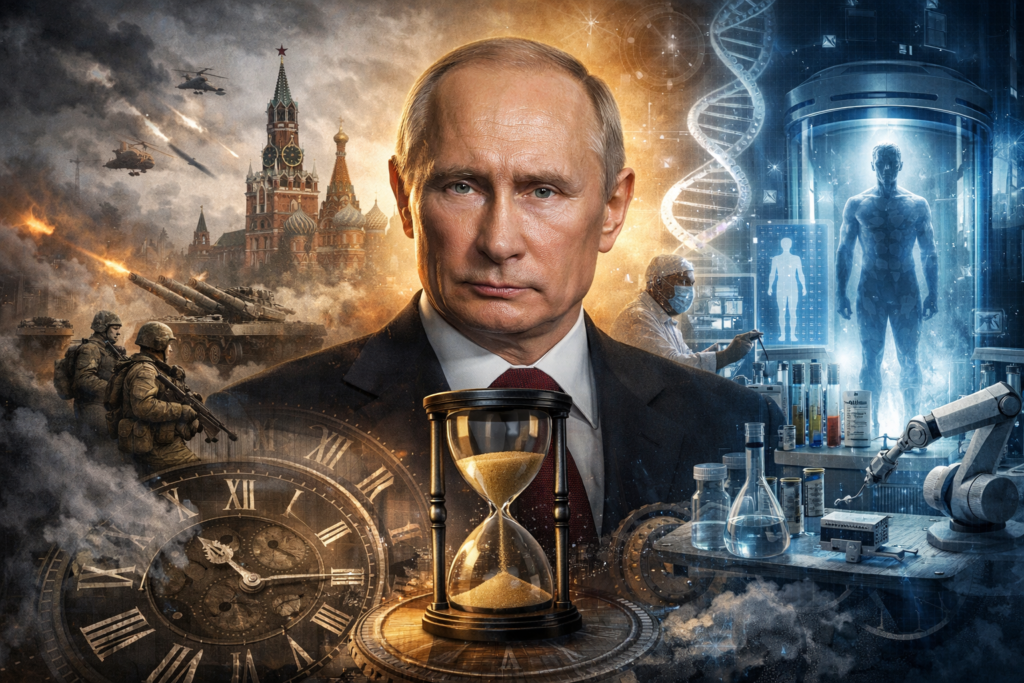
Image Credentials: Image Title: The Eternal Autocrat: Putin’s Quest for 150 Years of Life Source: (sora.openai) Date: January 2026. Attribution: This image was created using AI-generated imagery (sora.openai) and does not depict a real-world scene.
By Open Chronicle History Desk
In the contemporary struggle for global power, Vladimir Putin is no longer competing solely for territory, influence, or prestige. He is competing against time itself. As the Russian president moves deeper into his seventies, a parallel campaign has taken shape alongside military planning and geopolitical maneuvering. It is a campaign aimed at extending life, authority, and relevance far beyond the biological limits that have constrained rulers throughout history.
Behind the Kremlin’s familiar projection of strength, a quieter and more consequential effort is unfolding in laboratories across Moscow and St. Petersburg. There, state-backed research programs are exploring radical forms of rejuvenation and biological replacement, driven by a vision that seeks not merely longevity, but dominance over aging itself.
The Cult of Vitality and Its Contradictions
For years, the Kremlin has carefully cultivated an image of unyielding virility. State media routinely circulate images of Putin riding horses bare-chested, diving into icy waters, or engaging in carefully staged displays of physical endurance. These scenes are designed to reinforce a narrative of masculine permanence, deliberately contrasted with depictions of a weakening and decadent West.
Yet specialists in aesthetic medicine point to a growing contradiction. Putin’s face increasingly bears signs of extensive cosmetic intervention. Heavy use of Botox and lifting procedures has produced a rigid, mask-like appearance, limiting facial expression and amplifying speculation about anxiety over visible aging. The result is a paradoxical image, one that seeks to deny mortality while inadvertently drawing attention to it.
From Image Management to Strategic Longevity
What once appeared to be a personal fixation has evolved into a strategic project. In 2025, a series of public exchanges between Putin and Chinese President Xi Jinping offered a rare glimpse into how deeply the issue of aging preoccupies both leaders. In translated broadcasts that circulated widely, Xi remarked that seventy was still the age of a child in a future shaped by biotechnology. Putin responded by openly embracing a far more radical vision, suggesting that continuous organ transplantation and advanced biomedical intervention could one day make immortality achievable.
These remarks were not rhetorical flourishes. Russia has since expanded specialized institutes dedicated to genomics, regenerative medicine, and molecular aging. Unlike Western research institutions, which often emphasize gradual progress and ethical constraints, Russian programs appear to prioritize rapid application and state-directed outcomes.
The Science of Replacement as Power Strategy
While Western aging research, including work at institutions such as the British Society for Research on Ageing in Manchester, focuses on incremental advances using animal models and molecular pathways, the Russian approach gravitates toward replacement. The underlying logic is direct. If biological components fail, they should be substituted.
This approach encompasses several experimental avenues. Bioengineered organs grown from a patient’s own stem cells could theoretically bypass immune rejection. Cellular replacement strategies, including research explored by figures such as Jean Hébert in the United States, suggest the possibility of renewing aging brain tissue itself. Russian laboratories are also reportedly studying mitochondrial manipulation and telomere extension, targeting the cellular mechanisms most closely associated with aging.
While these ideas remain speculative and fraught with ethical and technical barriers, they represent an attempt to shortcut decades of biological limitation through aggressive state investment.
The Geopolitics of a Permanent Leader
The implications extend far beyond medicine. Longevity in authoritarian systems carries profound political consequences. If technological intervention enables a single ruler to maintain power for generations, the natural cycles of succession, reform, and renewal are disrupted. Governance risks becoming static, insulated from accountability by both repression and biology.
Critics argue that Putin’s pursuit of longevity reflects a broader state objective. Life extension is framed not as personal vanity, but as a strategic asset. A long lived leader ensures continuity of ideology, protection of loyal elites, and the endurance of a political system built around centralized control.
In this context, regenerative medicine becomes a tool for power projection. It reinforces the image of a Russia that defies not only Western pressure but the fundamental limits of nature itself.
Between Science and Myth
The gap between scientific reality and political aspiration remains vast. Radical life extension is still decades away, and many proposed therapies carry high failure rates and unpredictable consequences. Yet the symbolism matters. By investing heavily in rejuvenation research, the Kremlin signals its intent to outlast adversaries not just politically, but biologically.
Putin’s quest for an extended life represents a fusion of propaganda and technological ambition. It reflects a leadership style unwilling to accept decline, whether national or personal. Immortality may remain a myth, but the pursuit itself reveals a regime preparing for permanence in a world defined by change.
References
- Kremlin.ru, Official transcripts and public statements by President Vladimir Putin and President Xi Jinping on biotechnology and longevity, 2025.
- Russian Ministry of Science and Higher Education, Program documentation on state-funded research in genomics and regenerative medicine, Moscow and St. Petersburg.
- British Society for Research on Ageing, Publications and conference materials on molecular aging and lifespan research, Manchester.
- ARPA-H, United States Department of Health and Human Services, Public program descriptions and interviews related to cellular and regenerative replacement research, including work referenced by Jean Hébert.
- Open Chronicle Science Desk, Investigative reporting on Russian biomedical institutes and elite longevity initiatives, 2025–2026.
- Peer-reviewed journals, including Nature Aging, Cell Stem Cell, and The Lancet Healthy Longevity, Articles on bioengineered organs, telomere biology, and mitochondrial repair.
- Independent aesthetic medicine analyses cited in European media outlets, Assessments of cosmetic intervention trends among political leaders.
- International bioethics reviews published by UNESCO and the World Health Organization, Discussions on the ethical implications of radical life extension research.