
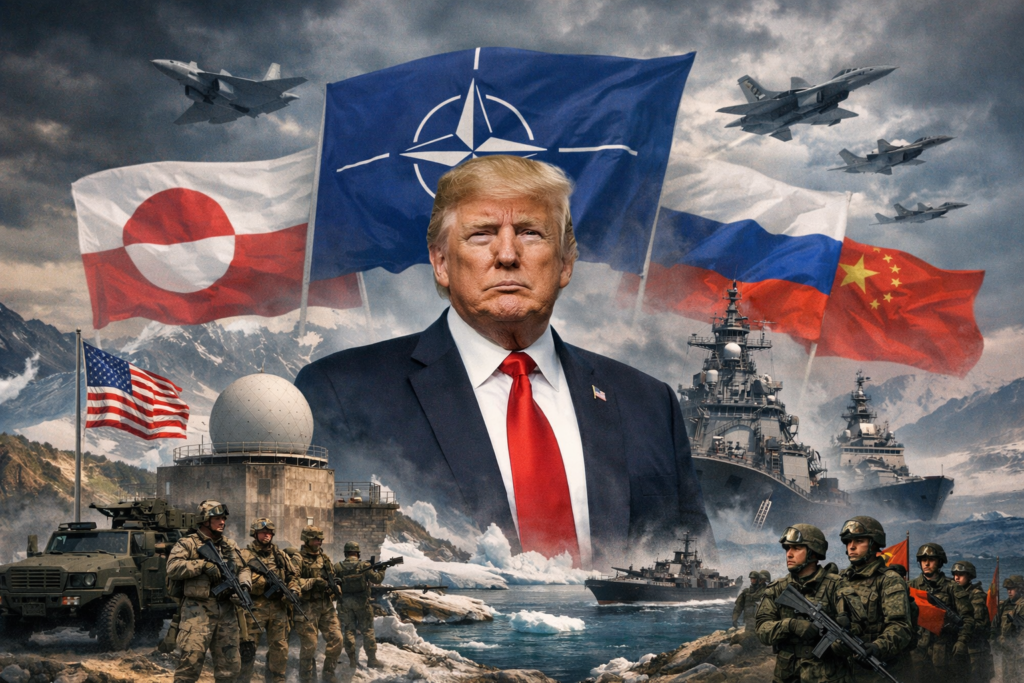
Image Credentials: Image Title: A widening rift in the Arctic Source: (sora.openai) Date: January 2026. Attribution: This image was created using AI-generated imagery (sora.openai) and does not depict a real-world scene.
By Madison Walker | Open Chronicle Senior Editor
The dispute over Greenland has entered a more dangerous phase after high-level talks in Washington exposed what Danish officials described as a “fundamental disagreement” between the United States and the Kingdom of Denmark. The meeting, which brought together US Vice President JD Vance, Secretary of State Marco Rubio, Danish Foreign Minister Lars Løkke Rasmussen, and Greenland’s Foreign Minister Vivian Motzfeldt, confirmed that the gap between Washington’s ambitions and European red lines is now stark and unresolved.
At the center of the crisis is President Donald Trump’s insistence that the United States must take control of Greenland for national security reasons. In his view, the Arctic island is too strategically important to be left in the hands of Denmark, which he has publicly portrayed as incapable of defending it against Russian and Chinese influence. Trump’s blunt rhetoric, including claims that “there’s not a thing that Denmark can do about it,” has sent shockwaves through European capitals and placed NATO unity under unprecedented strain.
Greenland’s value lies in its geography and resources. Sitting between North America, Europe, and the Arctic approaches to Russia, the island is a key platform for early warning radar, missile defense, satellite tracking, and control of future Arctic shipping routes. As climate change opens new sea lanes and access to minerals, the strategic importance of Greenland is only growing.
For Washington, this has turned Greenland into a centerpiece of its long-term Arctic strategy. For Denmark and Greenland, however, Trump’s language goes far beyond security cooperation and into the realm of territorial challenge. That is why Rasmussen and Motzfeldt have drawn a firm line around sovereignty and the right of Greenland’s people to self-determination.
Despite the sharp exchanges, the talks did produce one important result. Denmark, Greenland, and the United States agreed to create a high-level working group that will seek a path forward. The goal is to reconcile Washington’s security concerns with Copenhagen’s and Nuuk’s insistence on sovereignty and political autonomy.
Rasmussen described the discussions as frank but constructive, though he openly admitted he did not know whether compromise was truly possible. His reference to Neville Chamberlain’s failed diplomacy in 1938 was a clear warning that Denmark will not trade away fundamental principles for short-term calm.
Motzfeldt struck a similar tone. She emphasized Greenland’s willingness to deepen cooperation with the United States, especially on defense and security, while rejecting any suggestion that this cooperation should turn into ownership or control by Washington.
Trump’s suggestion that NATO should lead the way in securing Greenland has created further unease. For European allies, the idea that a NATO member could be pressured into giving up territory to another member is deeply destabilizing. It challenges the core principle that alliance borders are inviolable and that disputes are resolved through diplomacy rather than coercion.
Denmark’s decision to increase its military presence in Greenland, including with allied support, is meant to send a signal that the island is not undefended and that its sovereignty is backed by collective security. Yet this move also highlights how quickly the Arctic is becoming a militarized and politically charged space.
The creation of a working group offers a narrow diplomatic off-ramp, but it does not resolve the central conflict. The United States is pressing for control. Denmark and Greenland are defending sovereignty. As long as these positions remain so far apart, the risk of a deeper geopolitical rupture will persist.
Greenland has become more than a remote Arctic territory. It is now a test of whether the rules-based order among Western allies can survive the return of raw power politics in the High North.
The Grand Strategy Institute
Continue Exploring Strategic Analysis
Return to The Grand Strategy Institute for strategic assessments, long-form analysis and research examining geopolitics, military affairs, international security, emerging technologies and the changing international order.
← Back to The Grand Strategy Institute