
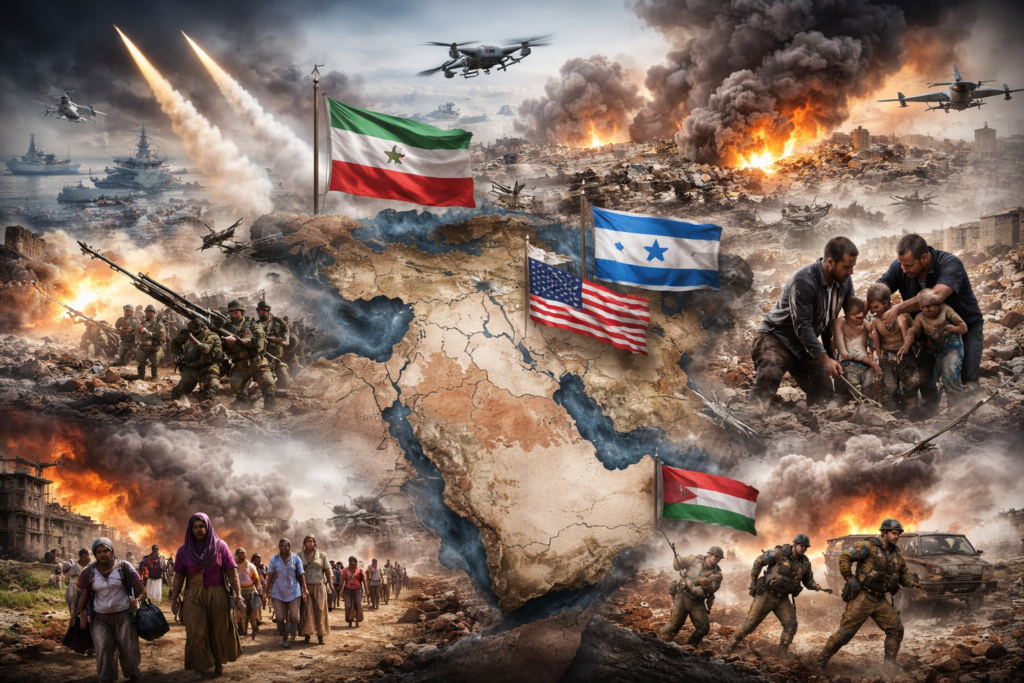
Image Credentials: Image Title: Thursday Global News Brief | January 15, 2026 Source: (sora.openai) Date: January 2026. Attribution: This image was created using AI-generated imagery (sora.openai) and does not depict a real-world scene.
By Open Chronicle News Desk Staff with Agencies
January 15, 2026
Regional tensions across the Middle East and beyond are intensifying as reports emerge of possible United States military action against Iran, alongside a series of parallel crises stretching from Syria and Gaza to Sudan and the wider global diplomatic arena.
Media reports indicating that Washington has begun withdrawing some personnel from key United States bases in the Middle East have fueled speculation about an imminent strike on Iran. The developments come as Iran faces sustained anti government protests that began late last month, driven by deep economic distress and political dissatisfaction. Analysts warn that any military escalation could further inflame regional instability, disrupt energy markets, and widen existing conflicts involving allied and proxy forces.
Against this backdrop, security conditions in Syria have deteriorated once again. The Syrian Army has carried out intermittent attacks on positions held by the YPG SDF in Deir Hafer, east of Aleppo. According to field reports, the operations followed drone and heavy machine gun attacks by the group on army positions and civilian homes near the village of Hamima. The exchanges have heightened fears among civilians of renewed large scale violence in an area that has seen repeated shifts in control over the past years.
In Gaza, the ceasefire agreement continues to fray as Israeli forces have carried out a series of attacks across the Gaza Strip, killing and injuring numerous people. Local sources report that the humanitarian situation is worsening rapidly, with heavy rains and strong winds compounding the suffering of displaced families living in makeshift shelters. Aid agencies warn that prolonged insecurity and harsh weather are pushing already vulnerable communities toward a deeper humanitarian crisis.
Sudan is also facing escalating violence, particularly in the Kordofan region. The Sudanese army has repelled a major attack by the paramilitary Rapid Support Forces in South Kordofan, yet intense clashes continue across the region. The fighting has forced tens of thousands of civilians to flee their homes, placing additional strain on humanitarian operations that are already stretched thin by access restrictions and insecurity.
Beyond active conflict zones, political tensions are unfolding on multiple fronts. European countries have firmly rejected renewed discussions questioning Greenland’s status following remarks by United States President Donald Trump, who described the island as vital to United States security due to increased Russian and Chinese activity in the Arctic. European Union officials and individual governments reaffirmed that Greenland remains an autonomous territory under Danish sovereignty, signaling strong resistance to any challenge to the existing order.
Diplomatic activity remains intense elsewhere. Türkiye’s Vice President Cevdet Yilmaz is visiting the Turkish Republic of Northern Cyprus, where he is scheduled to hold a joint press conference with Prime Minister Unal Ustel, focusing on bilateral coordination and regional issues. In Moscow, Russian President Vladimir Putin is set to receive the letters of credence from 34 newly appointed foreign ambassadors, while Foreign Ministry spokeswoman Maria Zakharova will address journalists during her weekly press briefing.
In the Americas, United States President Donald Trump is preparing to meet Venezuelan opposition figure Maria Corina Machado at the White House. The meeting marks their first encounter since the January 3 operation that resulted in the capture of Venezuelan President Nicolas Maduro, an event that has reshaped political dynamics in Venezuela and drawn international scrutiny.
Security alliances in the Asia Pacific are also in focus. United States Defense Secretary Pete Hegseth will host Japanese Defense Minister Shinjiro Koizumi at the Pentagon for talks aimed at strengthening bilateral defense cooperation amid growing concerns over China’s regional influence. Separately, Philippine Foreign Secretary Maria Theresa Lazaro is hosting Japanese Foreign Minister Toshimitsu Motegi in Manila, underscoring deepening ties between Japan and Southeast Asian partners.
At the United Nations, Secretary General Antonio Guterres is set to brief the General Assembly on his priorities for 2026. He has warned that global conflict levels are the highest since World War II, urging world leaders to prioritize people and environmental sustainability over further escalation.
Political developments are also unfolding in Africa and East Asia. Ugandans are heading to the polls to elect a president and parliament, with long serving President Yoweri Museveni seeking a seventh term against several challengers, including opposition figure Bobi Wine. In Japan, opposition parties are expected to deliberate over a possible merger to form a new centrist force, a move that comes amid a rise in far right sentiment and expectations of snap elections.
Meanwhile, high level diplomacy continues between major economies. Chinese Premier Li Qiang is hosting Canadian Prime Minister Mark Carney in Beijing, the first such visit in eight years, while Italian Prime Minister Giorgia Meloni has begun a three day visit to Japan to discuss strategic cooperation, including a joint next generation fighter jet project involving the United Kingdom.
Taken together, these developments reflect a world facing simultaneous security, political, and economic pressures. From the risk of direct confrontation between Washington and Tehran to persistent regional conflicts and shifting alliances, global stability appears increasingly fragile as 2026 unfolds.