
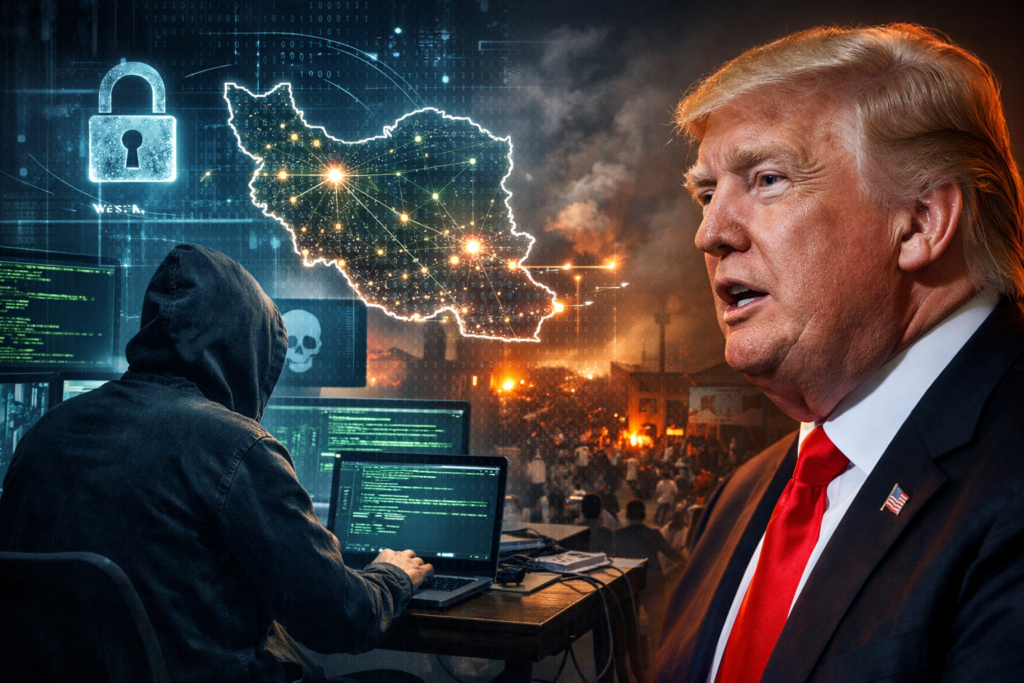
Image Credentials: Image Title: Can U.S. Cyberwarfare Tip the Scales for Iranian Protesters? Source: (sora.openai) Date: January 2026. Attribution: This image was created using AI-generated imagery (sora.openai) and does not depict a real-world scene.
Open Chronicle | Middle East Defense Analyst Desk
Washington | Thursday, January 15, 2026
As the reported death toll from Iran’s ongoing unrest surpasses 3,400, the United States administration is signaling a form of intervention that departs sharply from the familiar playbook of air strikes and troop deployments. President Donald Trump has publicly stated that “help is on its way,” yet the emerging strategy suggests that the next phase of United States involvement may unfold not in the skies over Iran, but within its digital infrastructure.
Weeks of mass protests across Iran have been met with severe crackdowns by security forces, often concealed by near-total internet shutdowns imposed by Tehran. These blackouts have limited the flow of information, obstructed coordination among demonstrators, and obscured the scale of repression from the outside world. In response, Washington is reportedly weighing a decisive shift toward offensive cyber operations as a means of pressuring the Iranian state while avoiding the risks of open military conflict.
From a political standpoint, President Trump faces a narrow corridor for action. His domestic base remains wary of renewed military entanglements in the Middle East, reflecting a broader preference for restraint and disengagement from what are seen as prolonged regional conflicts. At the same time, key regional partners, including Saudi Arabia and the United Arab Emirates, have urged caution, warning that direct strikes could provoke Iranian retaliation across the Gulf and beyond.
Cyber operations offer a compromise that aligns with these constraints. Rather than targeting physical facilities of the Islamic Revolutionary Guard Corps, digital operations can focus on command networks, internal communications, and coordination systems. Such actions have the potential to disrupt repression on the ground while staying below the threshold that would likely trigger a full-scale military response.
Defense and cybersecurity experts suggest that the United States has long maintained deep access to Iranian networks, preserving advanced capabilities for moments of strategic necessity. One option under consideration involves exploiting previously unknown software vulnerabilities, commonly referred to as zero-day flaws, to penetrate secure government and security force systems. Access of this nature could allow temporary control or disruption of internal communications, surveillance platforms, or even air defense coordination.
Cyber espionage also plays a central role. Analysts note that United States intelligence services are almost certainly monitoring Iranian command and control structures to identify decision makers responsible for directing the crackdown. This intelligence can shape diplomatic pressure, sanctions enforcement, and more targeted cyber actions. Another potential avenue is network sabotage aimed at degrading coordination among police, militia units, and intelligence services, thereby slowing their ability to respond rapidly to protest activity in multiple cities.
Alongside offensive measures, Washington is also looking at ways to empower Iranian civilians directly. Satellite-based internet services, most notably SpaceX’s Starlink, have emerged as a crucial tool for bypassing state-imposed blackouts. Despite Iranian efforts to locate and confiscate unauthorized terminals, reduced service fees and expanded coverage have helped protesters regain limited access to the outside world. Some analysts argue, however, that civilian satellite internet alone is insufficient. They advocate for the discreet provision of hardened, high-grade communication equipment to trusted protest networks, systems that are more resistant to jamming and interception.
When compared with conventional military options, the appeal of cyber-based intervention becomes clearer. Physical strikes against security infrastructure carry a high risk of escalation and face political resistance at home. Cyber sabotage, by contrast, offers moderate risk with lower visibility, while cyber espionage remains largely hidden and supports broader strategic decision making. Digital support for civilians carries its own dangers, particularly for users on the ground, but it aligns strongly with pro democracy messaging and international legitimacy.
Iran’s past experience suggests a critical vulnerability in this domain. While the country has demonstrated significant offensive cyber capabilities against regional and Western targets, it has struggled defensively. The Stuxnet operation against its nuclear facilities in 2010 remains a defining example of how digital tools can inflict strategic damage without a single shot being fired.
The central question now is whether these invisible instruments of power can meaningfully alter conditions for protesters inside Iran. Cyber operations may weaken the security apparatus and expose regime actions, yet they also risk becoming tools that primarily serve external strategic interests. As Washington navigates this path, the balance between assisting a popular uprising and pursuing geopolitical advantage will shape not only the outcome in Iran, but the future norms of intervention in an increasingly digital age.