
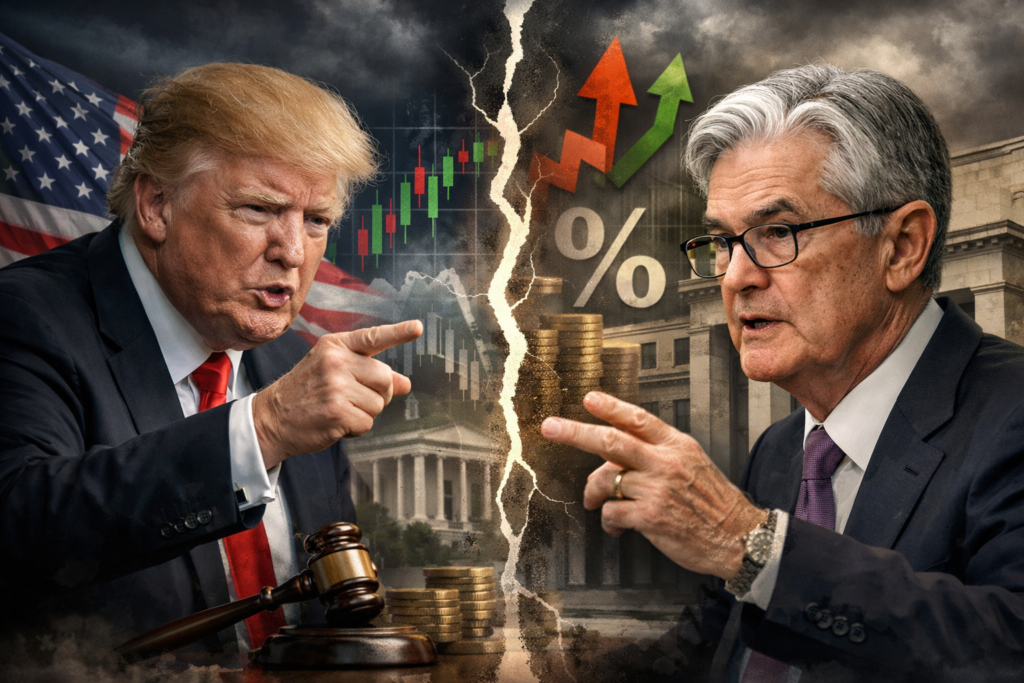
Image Credentials: Image Title: Governing the Economy or Governing Interest Rates? Inside the Trump–Powell Clash Source: (sora.openai) Date: January 2026. Attribution: This image was created using AI-generated imagery (sora.openai) and does not depict a real-world scene.
By Open Chronicle News Desk Staff with Agencies
The renewed tension between United States President Donald Trump and Federal Reserve Chair Jerome Powell has once again captured the attention of global markets. At first glance, the dispute appears to revolve around interest rates. In reality, it reflects a much deeper struggle over whether political power can override economic data, institutional norms, and central bank credibility without destabilizing the economy itself.
This confrontation is not unprecedented. Historical episodes of friction between presidents and Federal Reserve leaders, from Paul Volcker in the 1980s to Alan Greenspan in the 1990s and Ben Bernanke during the 2008 financial crisis, show a consistent pattern. Federal Reserve chairs, regardless of political pressure, have traditionally defended institutional independence and data-driven decision-making. The current clash follows this tradition, even as it pushes it into more contested territory.
The core question today is not what Jerome Powell will do in his remaining months in office. The real issue is whether the United States seeks to govern the economy as a complex system shaped by data and long-term constraints, or whether it attempts to govern interest rates as a political instrument. While politics may try to influence rates, the broader economy does not respond to political will alone.
During 2025, the Federal Reserve cut interest rates three times, in September, October, and December, lowering the policy rate to around three percent. These decisions were not driven by electoral considerations, but by tangible signals from the labor market, including cooling employment growth and slowing wages. At the same time, tariffs introduced by the Trump administration kept inflation pressures alive through higher costs, limiting how far and how fast rates could fall. The result was a cautious and clearly data-oriented easing cycle.
Yet interest rates were only part of the story. Political pressure is increasingly extended to the institutions and data systems that underpin monetary policy itself. Public calls to remove the head of the Bureau of Labor Statistics and repeated government shutdowns undermined confidence in the reliability of economic data. In this environment, debates over the cost of renovating the Federal Reserve headquarters or threats of legal action against Powell became symbols of a broader challenge to institutional autonomy.
When monetary policy, statistical credibility, and institutional governance are all drawn into political conflict, the issue moves far beyond a single rate decision. The question becomes whether a data-driven central bank can continue to function under sustained political pressure tied to short-term electoral goals.
Central bank independence is often described as a technical arrangement. In reality, it is a safeguard against the mismatch between political timeframes and economic realities. Inflation does not follow election cycles, and financial stability cannot be managed according to campaign calendars. Politics demands quick results, while monetary policy requires patience and consistency. This tension explains why independence is not a luxury, but a necessity.
The roots of this principle lie in the inflationary crises of the 1970s, when political influence over monetary policy produced severe economic and social costs. Over time, democratic systems accepted that insulating central banks from direct political control was a way to protect long term stability, not to undermine democratic authority.
Credibility is the true currency of central banking. The Federal Reserve does not enforce its decisions through force, but through trust. Each attempt to politicize its actions weakens that trust. Once credibility erodes, even technically sound interest rate decisions lose their effectiveness.
This matters far beyond the United States. The global role of the dollar, international capital flows, and the stability of emerging markets are all linked to confidence in the Federal Reserve. Its independence acts as a stabilizing anchor for the global financial system.
In the end, modern central banking is not simply about setting rates. It is about managing expectations, reducing uncertainty and maintaining trust through clear communication and institutional discipline. A central bank may still announce interest rates after losing credibility, but without trust, it can no longer guide the economy. The Trump–Powell clash, therefore, is not about rates alone. It is about whether economic governance will remain grounded in data and institutions, or be reshaped by political impulse.