
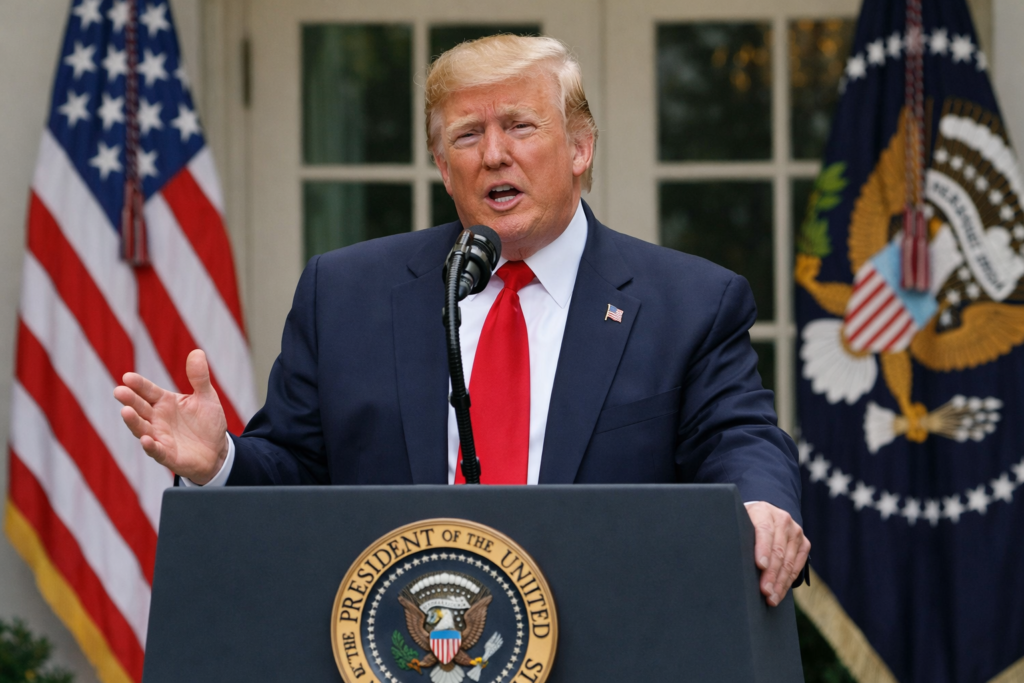
Image Credentials: Image Title: Trump Threatens Allies Over Greenland as Bipartisan Delegation Seeks Calm Source: (sora.openai) Date: January 2026. Attribution: This image was created using AI-generated imagery (sora.openai) and does not depict a real-world scene.
By Open Chronicle News Desk Staff with Agencies
COPENHAGEN — Friday, January 16, 2026 — President Donald Trump has introduced a potent new weapon into his campaign to acquire Greenland: the threat of massive trade tariffs. Speaking from the White House on Friday, Trump suggested he could impose punitive tariffs on countries that do not support a U.S. takeover of the Arctic island, a move that has sent shockwaves through European capitals and created a stark divide between the Oval Office and a bipartisan congressional delegation currently in Denmark.
During an event focused on rural healthcare, the President pivoted to international trade, recounting how he had successfully used the threat of tariffs on European pharmaceuticals to extract concessions. “I may do that for Greenland too,” Trump declared. “I may put a tariff on countries if they don’t go along with Greenland, because we need Greenland for national security.”
The President has labeled anything less than total U.S. control of the territory, currently an autonomous region of NATO ally Denmark, as “unacceptable.” He argues that “ownership” is the only way to prevent China and Russia from seizing the island’s vast untapped reserves of critical minerals.
While the White House adopts a confrontational posture, a bipartisan group of U.S. lawmakers in Copenhagen is working to repair the damage. Led by Senator Chris Coons (D-Delaware) and Senator Lisa Murkowski (R-Alaska), the delegation met with Danish Prime Minister Mette Frederiksen to reaffirm a 225-year-old partnership.
Senator Murkowski was particularly vocal in her disagreement with the President’s rhetoric. “Greenland needs to be viewed as our ally, not as an asset,” she told reporters. Murkowski and Senator Jeanne Shaheen (D-New Hampshire) have introduced legislation that would strictly prohibit the use of federal funds to annex or take control of Greenland without the explicit consent of Denmark or the North Atlantic Council.
The rhetoric has drawn sharp criticism from those who call the island home. Sara Olsvig, chair of the Inuit Circumpolar Council, expressed deep concern over how the U.S. administration views Indigenous peoples. “Indigenous Inuit in Greenland do not want to be colonized again,” she stated in Nuuk, noting that the White House’s insistence on “owning” the island reveals a troubling disregard for the self-determination of smaller nations.
Aaja Chemnitz, a Greenlandic politician, added that the primary threat currently felt by the island is not coming from Moscow or Beijing, but from Washington. “We have heard so many lies… the threats that we’re seeing right now are from the U.S. side,” she remarked.
As the Trump administration pivots toward economic warfare to secure its Arctic ambitions, the gap between the U.S. President and his own legislature has never been wider. With 75% of the American public reportedly opposed to the acquisition, and the Inuit people decrying a return to colonial-era politics, the “Greenland Question” is evolving from a diplomatic oddity into a full-blown crisis within the NATO alliance.