
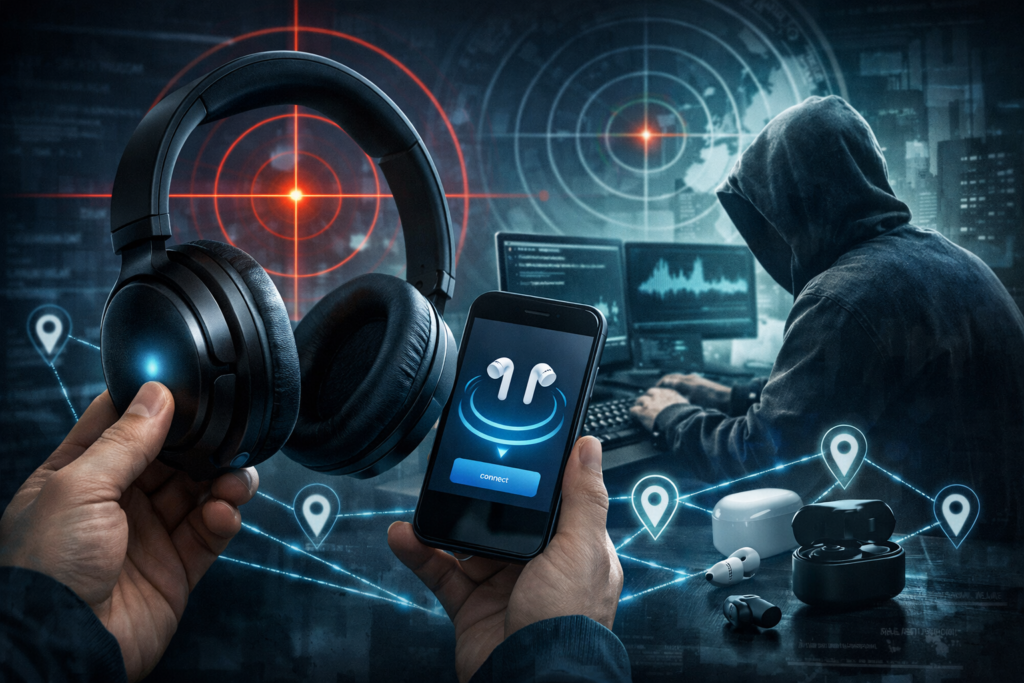
Image Credentials: Image Title: Your Headphones May Be Tracking You: How a Google Fast Pair Flaw Exposes Users to Silent Spying Source: (sora.openai) Date: January 2026. Attribution: This image was created using AI-generated imagery (sora.openai) and does not depict a real-world scene.
By José Carlos Palma | IT Tech – IT Consultant | Open Chronicle Editor-in-Chief
A feature designed to make life easier for Android users is now raising serious privacy and security concerns. Google’s Fast Pair, which allows headphones and speakers to connect to devices with a single tap, has been found to contain vulnerabilities that could let hackers take control of audio devices in a matter of seconds.
The issue was uncovered by cybersecurity researchers at KU Leuven University in Belgium, from the Computer Security and Industrial Cryptography group. The researchers have named the collection of flaws “WhisperPair,” a reference to how quietly and easily attackers could exploit the system.
According to their findings, at least 17 popular headphone and speaker models are affected. These devices are produced by major brands including Google, Sony, JBL, Jabra, Logitech, Marshall, Nothing, OnePlus, Soundcore, Xiaomi, and others. The scale of the problem suggests that millions of users worldwide could be at risk.
How the exploit works
Fast Pair is designed to simplify Bluetooth connections by automatically recognizing nearby compatible devices. However, the researchers found that attackers can abuse this convenience. By exploiting weaknesses in how Fast Pair handles device ownership and multi-device pairing, a hacker within Bluetooth range can impersonate a legitimate user.
In practical terms, this could allow an attacker to remotely activate a device’s microphone, inject audio into the headphones, or listen in on private conversations without the user noticing. In some cases, the attacker could also use the speakers to play sounds directly into the victim’s ears.
The threat goes beyond audio surveillance. If the compromised device supports Google’s Find Hub location tracking system, attackers could track the victim’s physical location in real time. This is particularly concerning given that Find Hub has faced security criticism in the past.
iPhone users are not immune
One of the most alarming aspects of WhisperPair is that it not only affects Android users. Even people using iPhones can be vulnerable. If a set of headphones or speakers has never been paired with a Google account, the first Android device that connects to it is automatically registered as the owner.
This means a hacker could pair the victim’s device to their own Google account and then track its location using Find Hub. To do this, the attacker only needs to be nearby and to know the device’s model ID. That information can be obtained by owning the same device model or by querying a publicly accessible Google API.
No easy way to opt out
Unlike some other system features, Fast Pair cannot be fully disabled on Android devices. This leaves users with limited defensive options. While several manufacturers have already issued patches to address the vulnerabilities, applying those fixes is not always straightforward.
In many cases, users must download the manufacturer’s companion app to receive the update. Researchers warn that many headphone and speaker owners are unaware that such apps exist, which increases the risk that devices remain unpatched.
To help users assess their risk, the research team has launched a WhisperPair website that lists vulnerable devices and provides guidance on updates. Users are strongly advised to check whether their headphones or speakers are affected and to install any available firmware updates immediately.
What needs to change
The researchers argue that the root of the problem lies in Fast Pair’s lack of strong authentication. They recommend that Google cryptographically enforce device ownership and block secondary pairing attempts unless the original owner explicitly approves them.
Until such systemic changes are implemented, users are left with only partial protections. Keeping device firmware up to date and installing official manufacturer apps are currently the most effective steps to reduce risk.
The WhisperPair discovery serves as a reminder that convenience features can come with hidden costs. In a world increasingly filled with always-connected devices, even something as ordinary as a pair of headphones can become an unexpected surveillance tool if security is treated as an afterthought.