
Image: from Belga News Agency_English X @Belga_English
By Open Chronicle News Desk with Agencies
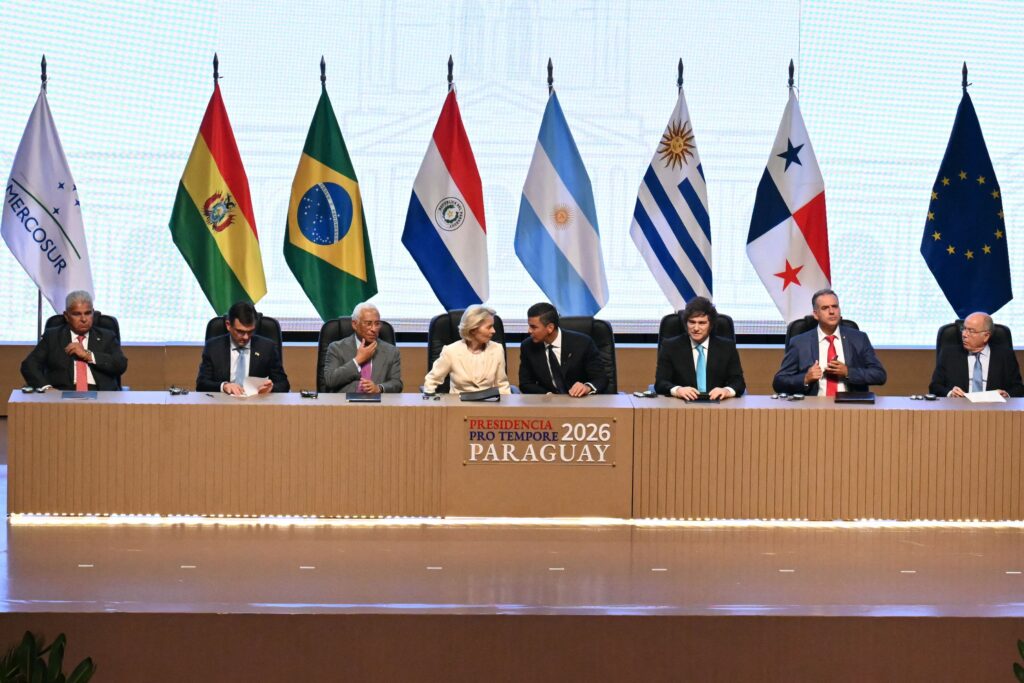
European and South American leaders have signed a historic free trade agreement between the European Union and the Mercosur bloc, concluding negotiations that have stretched over a quarter of a century. The pact, finalised on Saturday, establishes one of the largest free trade areas in the world and is being framed by its supporters as a strong political and economic signal in an era marked by rising tariffs, protectionism, and global uncertainty.
EU and Mercosur officials signed a free trade agreement in Paraguay after 25 years of talks, paving the way for the European Union's largest trade accord https://t.co/d1QtkiO0Dy pic.twitter.com/hSCqiEUQ4N
— Reuters (@Reuters) January 17, 2026
The agreement brings together the 27 member states of the European Union and the Mercosur countries of Brazil, Argentina, Paraguay, and Uruguay. Combined, the two blocs represent around 30 percent of global gross domestic product and a consumer market of more than 700 million people. Once implemented, the treaty will eliminate tariffs on more than 90 percent of trade between the two regions and is expected to enter into force by the end of 2026.
European officials have described the deal as the largest trade agreement ever concluded by the EU. Leaders meeting in Paraguay emphasised that the accord is designed to promote economic growth, create jobs, and strengthen long term cooperation between Europe and South America. They also highlighted its strategic importance at a time when multilateral institutions and global trade norms are under strain.
Article by President Lula published in newspapers across 27 countries of Mercosur and the European Union (Brazil 🇧🇷, Argentina 🇦🇷, Paraguay 🇵🇾, Uruguay 🇺🇾, Bolivia 🇧🇴; Austria 🇦🇹, Belgium 🇧🇪, Bulgaria 🇧🇬, Croatia 🇭🇷, Cyprus 🇨🇾, Czech Republic 🇨🇿, Estonia 🇪🇪, France 🇫🇷, Germany… pic.twitter.com/8WLL9ORVbw
— Lula (@LulaOficial) January 17, 2026
From an economic perspective, the agreement is expected to boost European exports of manufactured and high-value goods significantly. Automobiles, industrial machinery, wine, and cheese are among the sectors likely to benefit most from improved access to South American markets. In return, Mercosur countries will gain easier access to the European market for agricultural products such as beef, poultry, sugar, rice, honey, and soybeans.
This agricultural dimension has proven controversial within Europe. Thousands of farmers, particularly in Ireland and France, have staged protests in recent weeks, arguing that cheaper imports from South America could undermine local producers and weaken food security standards. Critics fear that European farmers will struggle to compete with large-scale agribusiness operations operating under different cost structures and regulatory environments.
Supporters of the deal counter that it includes safeguards, quotas, and environmental commitments designed to address these concerns. They argue that the agreement creates predictable rules for trade while opening opportunities for European companies and consumers. European leaders have also stressed that stricter environmental and production standards will apply to Mercosur exports entering the EU market.
From the South American perspective, the agreement is widely seen as a major economic opportunity. Mercosur countries possess vast agricultural capacity and abundant natural resources, including critical raw materials that Europe increasingly seeks for its green and digital transitions. Access to the EU market offers the potential for higher export revenues, increased foreign investment, and deeper integration into global value chains.
Beyond economics, the deal carries a clear geopolitical message. Reporting from Paraguay, analysts noted that European and South American leaders are deliberately signalling support for multilateralism and rules-based trade at a moment when isolationist policies are gaining ground elsewhere. The timing of the agreement has been widely interpreted as a response to escalating trade tensions and the renewed use of tariffs as a political tool.
These tensions were underscored just hours before the signing ceremony, when United States President Donald Trump announced new tariffs targeting several European countries. The move followed European opposition to his controversial stance on Greenland, a semi-autonomous territory of Denmark. Trump has refused to rule out the use of military force to take control of the Arctic island, triggering international concern and protests.
In this context, the EU-Mercosur agreement is being portrayed by its architects as more than a trade deal. It is presented as a statement of shared values and strategic alignment between two regions seeking to reinforce cooperation, stability, and open markets in an increasingly fragmented global landscape.
While ratification hurdles and domestic opposition remain, the signing of the agreement marks a decisive milestone. After 25 years of negotiations, the EU and Mercosur have taken a significant step toward reshaping transatlantic trade relations and reaffirming their commitment to global economic cooperation.