
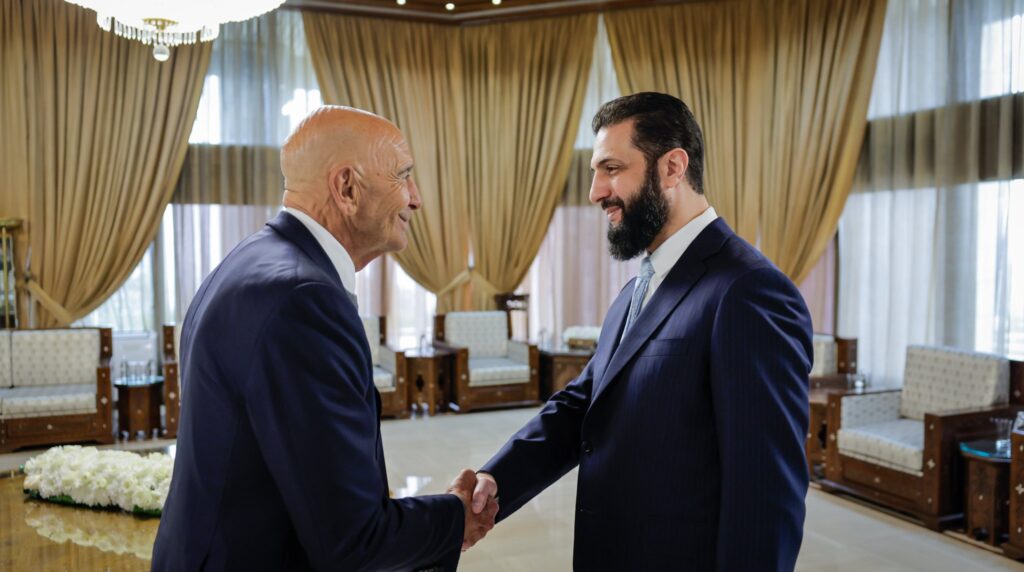
Image: from Political Uprising X@Political_Up
By International Desk with Agencies
DAMASCUS — Sunday, January 18, 2026 — In a move that has sent shockwaves through the region, the Syrian government and the Kurdish-led Syrian Democratic Forces (SDF) have announced a comprehensive ceasefire. The agreement, reported by Euronews today, marks one of the most significant diplomatic breakthroughs in the decade-long conflict, potentially signaling a new era of internal cooperation.
🔥 BREAKING: SHOCK PEACE DEAL IN SYRIA — AFTER 13 YEARS OF WAR 🔥
The unthinkable just happened:
Assad’s post-war government + the U.S.-backed Kurdish SDF have signed a FULL nationwide ceasefire and unification deal.
Yes — the same sides that fought each other for a decade.… pic.twitter.com/UrOJ43wFZD— Richard Miriti (@miriti55453) January 18, 2026
The Terms of the Agreement
📌 The Syrian government and the SDF terror group have reached a comprehensive ceasefire deal, following intense clashes along the Euphrates river ⤵️
• Integration of SDF forces into Syria’s Defense and Interior ministries after vetting
• Withdrawal of SDF forces east of the… pic.twitter.com/Q989Pt08Xf
— Anadolu English (@anadoluagency) January 18, 2026
The ceasefire, which went into effect at midnight, covers all frontlines where the Syrian Arab Army and the SDF are currently in contact. Beyond a simple cessation of hostilities, the deal includes several key provisions:
-
Joint Coordination: The establishment of shared military committees to manage security in sensitive border areas.
-
Resource Management: Preliminary agreements on the distribution of oil and wheat revenues from the SDF-controlled northeast.
-
Security Corridor: The creation of a humanitarian corridor to allow the free movement of civilians and goods between Damascus and Qamishli.
A Strategic Realignment
Analysts suggest that this sudden rapprochement is driven by shared external pressures. Both Damascus and the SDF face mounting challenges along the northern border, where foreign military incursions remain a constant threat. By aligning their security interests, both parties hope to stabilize the volatile northern regions.
“This is not just about stopping the fighting; it’s about a shared realization that internal division only invites external intervention,” stated a diplomatic source close to the negotiations.
A new ceasefire was announced under American sponsorship. Thus, the PYD/SDF dissolved itself.
⭕The governorates of Raqqa and Deir ez-Zor will be completely handed over to Jolani, both militarily and civilianly.
— Sermal (@sermal_) January 18, 2026
International Reactions
The global response has been a mix of cautious optimism and skepticism.
-
The United Nations: Welcomed the move as a “vital step toward a broader political solution” and urged both sides to adhere to the terms.
-
Regional Powers: Several neighboring nations have expressed concerns over how this shift in the balance of power will affect their own strategic interests in northern Syria.
-
The United States: While a key supporter of the SDF, the U.S. has yet to release a detailed official stance on this bilateral agreement with the Assad government.
The Road Ahead
While the ceasefire is a monumental achievement, significant hurdles remain. Issues such as the long-term political status of the Autonomous Administration of North and East Syria (AANES) and the integration of military forces have been deferred to future “deep-dive” negotiations. For the millions of Syrians living in these contested areas, however, the immediate silence of the guns brings a rare and welcome sense of relief.
The Syrian government and the SDF have chosen a path of pragmatism over continued conflict. Whether this truce evolves into a lasting political settlement or remains a temporary marriage of convenience will depend on the negotiations scheduled for the coming months in Geneva.