
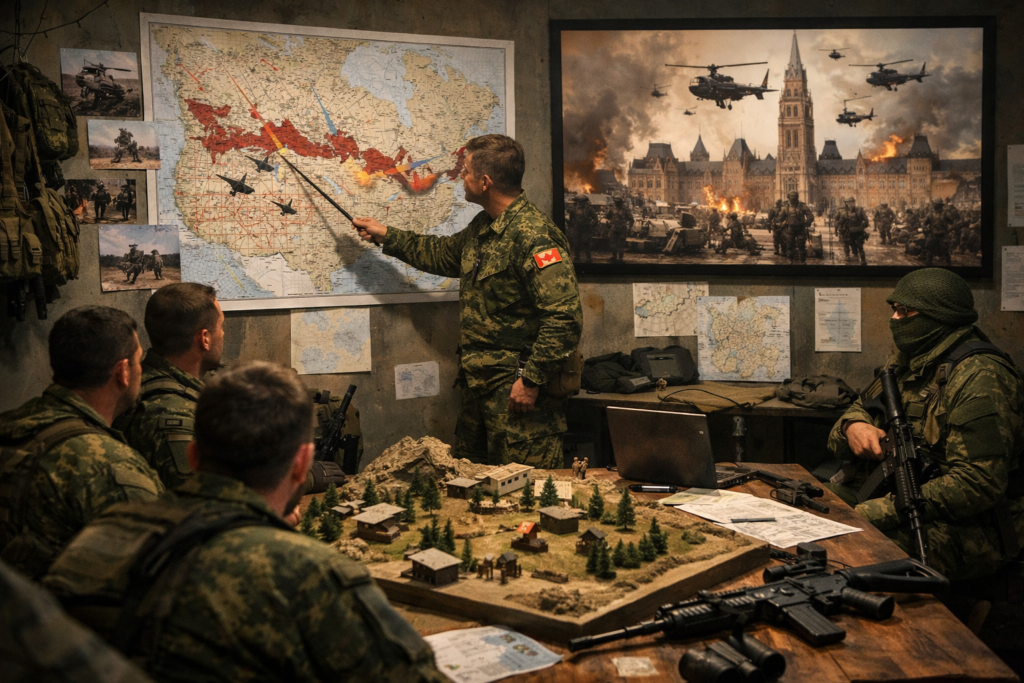
Image Credentials: Image Title: “Mujahideen Style”: Canadian Military Models Guerilla Resistance Against Potential U.S. Invasion Source: (sora.openai) Date: January 2026. Attribution: This image was created using AI-generated imagery (sora.openai) and does not depict a real-world scene.
By Open Chronicle News Desk
OTTAWA — In a move that highlights the historic strain on North American relations, the Canadian Armed Forces (CAF) has reportedly modeled a hypothetical military invasion by the United States. For the first time in over a century, military planners in Ottawa are “thinking the unthinkable,” drafting a conceptual framework for a resistance movement inspired by the unconventional warfare tactics of the Afghan Mujahideen.
The report, first detailed by The Globe and Mail, suggests that the Canadian military assumes a conventional defense against its southern neighbor would be impossible. Planners estimate that the vastly superior U.S. forces could overcome Canada’s formal land and sea positions in as little as two to seven days. Faced with such overwhelming odds, the model shifts focus to an asymmetric “guerrilla” campaign.
The “Mujahideen style” resistance would rely on:
-
Insurgency Tactics: Small, mobile units of irregular soldiers and potentially armed civilians carrying out “hit-and-run” attacks.
-
Sabotage and Ambush: Targeting critical infrastructure and occupying forces using Improvised Explosive Devices (IEDs) and low-cost drone technology.
-
Northern Fortress: A strategic retreat to the vast, inhospitable Arctic regions to preserve government continuity and prolong the cost of occupation.
While government officials stress that the model is a “conceptual and theoretical framework” rather than an active operational plan, its creation reflects the deep unease sparked by recent rhetoric from Washington. President Donald Trump has frequently referred to Canada as the “51st state” and recently shared a map on social media depicting the U.S. flag extending over all of Canada and Greenland.
The tension has been further exacerbated by Prime Minister Mark Carney’s warnings of a global “rupture” and his move to diversify Canada’s defense spending away from U.S. reliance. Experts note that a clear signal of an actual threat would be a U.S. withdrawal from the NORAD joint defense command, a partnership that has secured the continent since the Cold War.
Retired Major-General David Fraser, who led Canadian troops in Afghanistan, noted that while the scenario remains unlikely, the psychological impact is real. “If you come after Canada, you are going to have the world coming after you,” he stated, suggesting that Canada would likely look to European nuclear powers like France and the UK for reinforcement.