
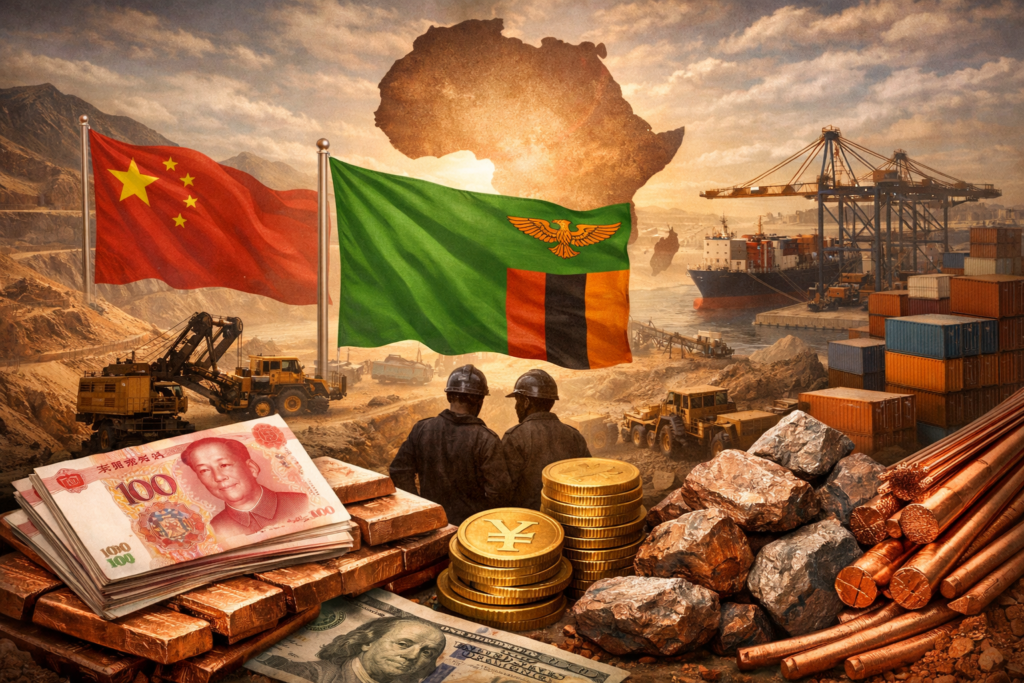
Image Credentials: Image Title: China’s Push for Yuan Internationalization Advances as Zambia Adopts Mining Tax Payments Source: (sora.openai) Date: January 2026. Attribution: This image was created using AI-generated imagery (sora.openai) and does not depict a real-world scene.
By Open Chronicle News Desk
LUSAKA/BEIJING – China’s long-term strategy to elevate the renminbi (yuan) as a global alternative to the U.S. dollar has quietly marked a significant milestone in Africa. Earlier this month, Zambia became the first nation on the continent to officially allow mining companies to pay their taxes in yuan, a move that underscores Beijing’s growing influence over the global copper supply chain.
The policy, which went into effect on January 2, 2026, allows mining firms to use the yuan for statutory payments. While the Zambian government maintains that the U.S. dollar will remain the nation’s primary reserve currency and anchor for external debt, the introduction of a second settlement channel is seen as a pragmatic response to the “commercial gravity” of a copper industry increasingly dominated by Chinese investment.
Zambia became the first African nation to formally accept the Chinese Yuan (Renminbi) for payment of mining taxes and royalties. This is a major milestone in Zambia's economic relationship with the People's Republic of China.
Here is an explanation of why this happened and what… pic.twitter.com/PAgIWsEHsw
— Jito Kayumba (@JitoKayumba) January 3, 2026
A Strategic Settlement Tool
Zambia’s copper exports are the lifeblood of its economy, and China is its largest buyer. By accepting the yuan for taxes, Lusaka aims to reduce “conversion frictions” and alleviate the periodic spikes in dollar demand that occur when large tax payments are due.
“The yuan option is a targeted operational reform,” noted analysts at the Zambia Institute for Policy Analysis and Research (ZIPAR). “It’s less about global currency politics and more about improving efficiency in a trade corridor that is already heavily China-facing.”
Despite this framing, the move is being watched closely in Washington. As the Trump administration intensifies its scrutiny of Chinese infrastructure and mining projects across the developing world, Zambia’s decision adds another layer of complexity to the Transatlantic–Chinese rivalry for critical minerals.
The 15th Five-Year Plan and the “Financial Powerhouse.”
The timing of Zambia’s shift coincides with Beijing’s preparations for its 15th Five-Year Plan (2026–2030), which is expected to be unveiled in March. Sources indicate the plan will prioritize “current account liberalization” to boost global demand for the yuan.
Leading economists, including Ding Shuang of Standard Chartered, suggest that China is entering a more proactive phase of building a yuan-based ecosystem for international trade and financing. The goal is to make the currency not just usable for trade, but a credible option for international reserves, helping to shield China and its partners from external shocks linked to the dollar system.
Regional Ripple Effects?
Zambia’s adoption of the yuan could serve as a pilot program for other resource-rich African nations. With the yuan’s value appearing more stable against the Zambian kwacha compared to the dollar over certain periods between 2020 and 2025, the “settlement toolkit” approach may prove alluring to neighbors like the Democratic Republic of Congo or Zimbabwe.
As China transitions into this new growth paradigm, the quiet adoption of its currency in the heart of Africa’s copper belt serves as a potent reminder that the “internationalization” of the yuan is no longer just a theoretical ambition—it is becoming a day-to-day reality in global commodities.