
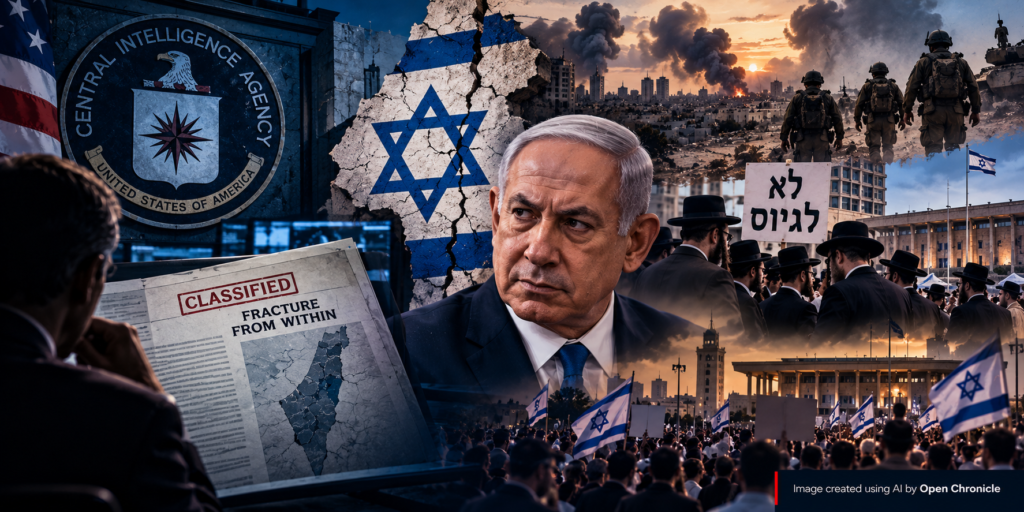
A classified CIA assessment reportedly warns that mounting political, economic, military and social pressures inside Israel could create conditions for severe internal conflict, including scenarios involving civil war or state collapse, as the country approaches its October 27 election.
By Open Chronicle with agencies
A classified assessment produced within the CIA has reportedly raised concerns that deepening divisions within Israeli society could place the country at risk of a profound internal crisis.
According to reporting by Drop Site News, which said it was briefed on the assessment by two US sources, CIA analysts examined a combination of political instability, economic pressure, military strain and social divisions that could potentially converge as Israel approaches its October 27 election.
The assessment reportedly considers extreme scenarios including civil war or what was described as “total collapse.”
Those conclusions represent analytical scenarios rather than predictions that either outcome will occur. The underlying classified document has not been publicly released, meaning its full methodology, evidence and qualifications cannot independently be examined.
“Fracture From Within”
The assessment, reportedly titled “Fracture From Within,” was compiled in August by the CIA’s Red Cell, an analytical unit established to challenge conventional assumptions within the US intelligence community and examine alternative interpretations of major strategic developments.
According to Drop Site News, two US sources described the contents of the classified assessment.
One source said the analysts responsible for the report were specialists on Israel and argued that its conclusions should be taken seriously given the political divisions surrounding the coming election.
The reported assessment focuses not on an external military threat to Israel, but on pressures developing within Israeli society itself.
Several Pressures Are Reportedly Converging
Among the factors identified are economic difficulties, exceptionally high levels of military expenditure and the psychological consequences of prolonged conflict.
The assessment reportedly argues that these pressures cannot necessarily be considered independently because several are developing simultaneously.
Years of military operations and repeated mobilization have placed significant demands on Israeli forces, reservists, families and the wider economy.
At the same time, Israel remains politically divided as Prime Minister Benjamin Netanyahu seeks to retain power ahead of the October election.
The combination of electoral uncertainty and longer term social tensions forms a central part of the scenario reportedly examined by the CIA analysts.
Ultra Orthodox Military Exemptions Become a Major Fault Line
One of the most significant divisions identified in the assessment concerns Israel’s ultra Orthodox population and the long running controversy surrounding military service.
Israel maintains mandatory military service for much of its population, but ultra Orthodox men have historically benefited from broad exemptions connected to religious study.
Ultra Orthodox leaders argue that compulsory military service threatens their religious way of life and interferes with the obligation to study the Torah.
The issue has become increasingly contentious after years in which Israeli reservists have repeatedly been called away from their jobs and families for military service.
According to the account of the CIA assessment, resentment over these exemptions has become an increasingly important source of political and social tension.
Military Pressure Is Feeding Domestic Tensions
The reported intelligence assessment also highlights the relationship between Israel’s military commitments and its domestic stability.
Repeated mobilizations place pressure not only on the armed forces but also on households, employers and public finances.
For reservists and their families, prolonged periods of military service can mean repeated disruption to employment and family life.
That burden has intensified debate over who should be required to serve and who should be exempt.
The result is a dispute that extends beyond military manpower and increasingly touches fundamental questions about citizenship, religious identity and the distribution of responsibilities within Israeli society.
Economic Strain Adds Another Layer
Economic conditions are another element reportedly examined by the CIA analysts.
High military expenditure associated with prolonged conflict has placed additional pressure on government finances while broader uncertainty affects businesses, workers and households.
The assessment reportedly considers these economic pressures alongside political instability rather than treating them as an isolated problem.
That distinction is important because the warning described by the US sources concerns the possible interaction of several pressures at once.
Economic strain alone would not necessarily threaten the stability of the state. Combined with political polarization, military exhaustion and social divisions, however, analysts reportedly believe it could deepen existing fractures.
Psychological Consequences of Prolonged Conflict
The reported assessment also points to the psychological effects of years of violence and warfare.
Israeli society has experienced repeated military mobilizations, attacks, casualties and prolonged uncertainty.
According to the account of the classified report, widespread psychological trauma represents another potential source of strain within the country.
The long term consequences could extend beyond individual mental health, affecting families, workplaces, military readiness and confidence in political institutions.
Netanyahu Faces a Critical Election
The warning comes at a particularly sensitive political moment.
Israel is scheduled to hold elections on October 27, with Netanyahu seeking to retain power amid deep divisions over the country’s political direction.
The election could become a focal point for many of the tensions described in the reported CIA assessment.
Questions surrounding military service, economic pressures, security policy and the future direction of the state have become intertwined with the struggle for political power.
The intelligence assessment reportedly considers the election period particularly significant because existing divisions could intensify during an already polarized political contest.
A Warning, Not a Prediction
The most dramatic language associated with the reported assessment concerns the possibility of civil war or state collapse.
Such scenarios should be interpreted cautiously.
Red Cell analysis is specifically designed to challenge conventional assumptions and explore possibilities that other intelligence assessments might overlook. Examining a severe scenario does not mean intelligence officials believe that scenario is inevitable or even the most likely outcome.
The document itself also remains classified and unavailable for independent examination.
What has emerged publicly is therefore an account of the assessment provided by sources familiar with its contents rather than the complete intelligence analysis.
Nevertheless, the reported warning suggests that at least some US intelligence analysts are examining Israel’s internal cohesion as a strategic issue in its own right.
Israel’s Internal Stability Becomes a Strategic Question
For decades, assessments of Israel’s security have largely focused on external military threats, regional adversaries and terrorism.
The reported CIA analysis points toward a different question: whether accumulated pressures within Israeli society could eventually become as strategically important as threats beyond its borders.
Military exhaustion, disputes over conscription, economic pressures, political polarization and psychological trauma are individually significant.
The concern reportedly raised by the assessment is what might happen if those forces increasingly reinforce one another.
As Israel moves toward the October 27 election, that question could become an increasingly important part of how Washington evaluates the stability of one of its most important Middle Eastern allies.