
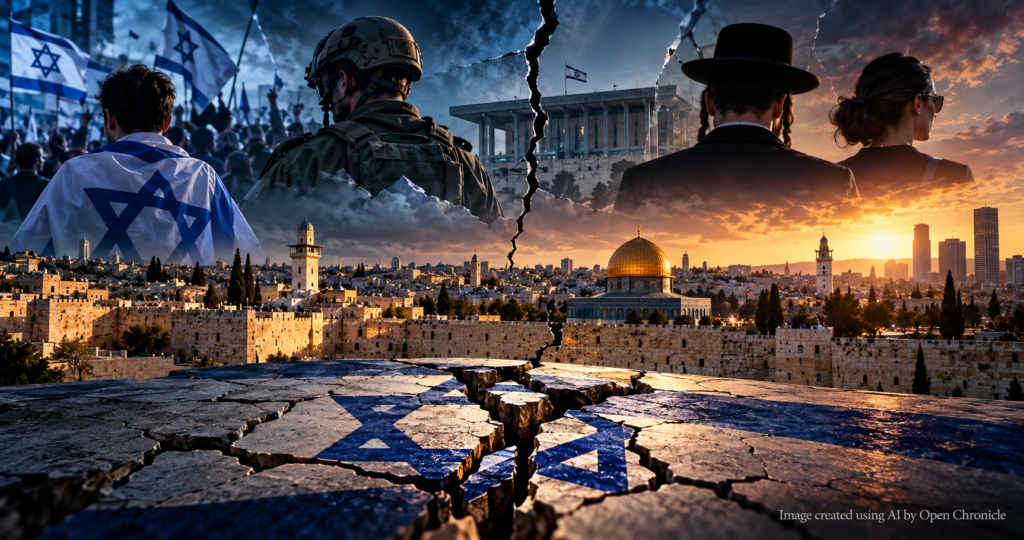
States rarely become unstable because of a single crisis. The greater danger emerges when political polarization, institutional distrust, economic pressure, military strain and social divisions begin reinforcing one another.
By Open Chronicle Explained
Countries survive crises all the time.
Governments fall.
Economies enter recessions.
Wars impose enormous costs.
Citizens protest.
Political parties become bitterly divided.
Institutions lose public confidence.
Yet most of these events do not cause states to collapse.
That raises a more difficult question.
What actually makes a state stable — and what happens when the forces holding it together begin to weaken at the same time?
The question has become particularly relevant in Israel.
A classified US intelligence assessment reportedly examined whether political, economic, military and social pressures inside Israel could combine to create a much deeper internal crisis.
According to reporting described by Open Chronicle, the assessment — reportedly produced by the CIA’s Red Cell and titled Fracture From Within — explored severe scenarios including civil conflict and state collapse.
There is an important qualification.
The document itself has not been made public, its complete methodology cannot independently be examined, and scenario analysis is not the same thing as prediction.
But the controversy surrounding the reported assessment points towards a much broader question that applies far beyond Israel.
How does internal stability actually work?
1. What Is State Stability?
State stability does not simply mean the absence of protests or political disagreement.
Healthy political systems can contain enormous disagreement.
Opposition parties challenge governments.
Courts overturn decisions.
Journalists investigate political leaders.
Citizens demonstrate.
Governments lose elections.
All of those things can happen inside a stable state.
Stability instead depends on something deeper:
the ability of institutions and society to absorb conflict without the political system itself breaking down.
A stable state therefore needs mechanisms capable of processing disagreement.
Elections decide who governs.
Courts interpret law.
Parliaments negotiate legislation.
Police enforce rules.
Civil services maintain public administration.
Armed forces defend the state.
Economic institutions keep money and commerce functioning.
Citizens may intensely disagree about policy while continuing to accept these mechanisms.
That distinction is fundamental.
Political conflict is normal.
Systemic conflict begins when disagreement shifts towards the legitimacy of the system itself.
2. The Invisible Architecture Holding a Country Together
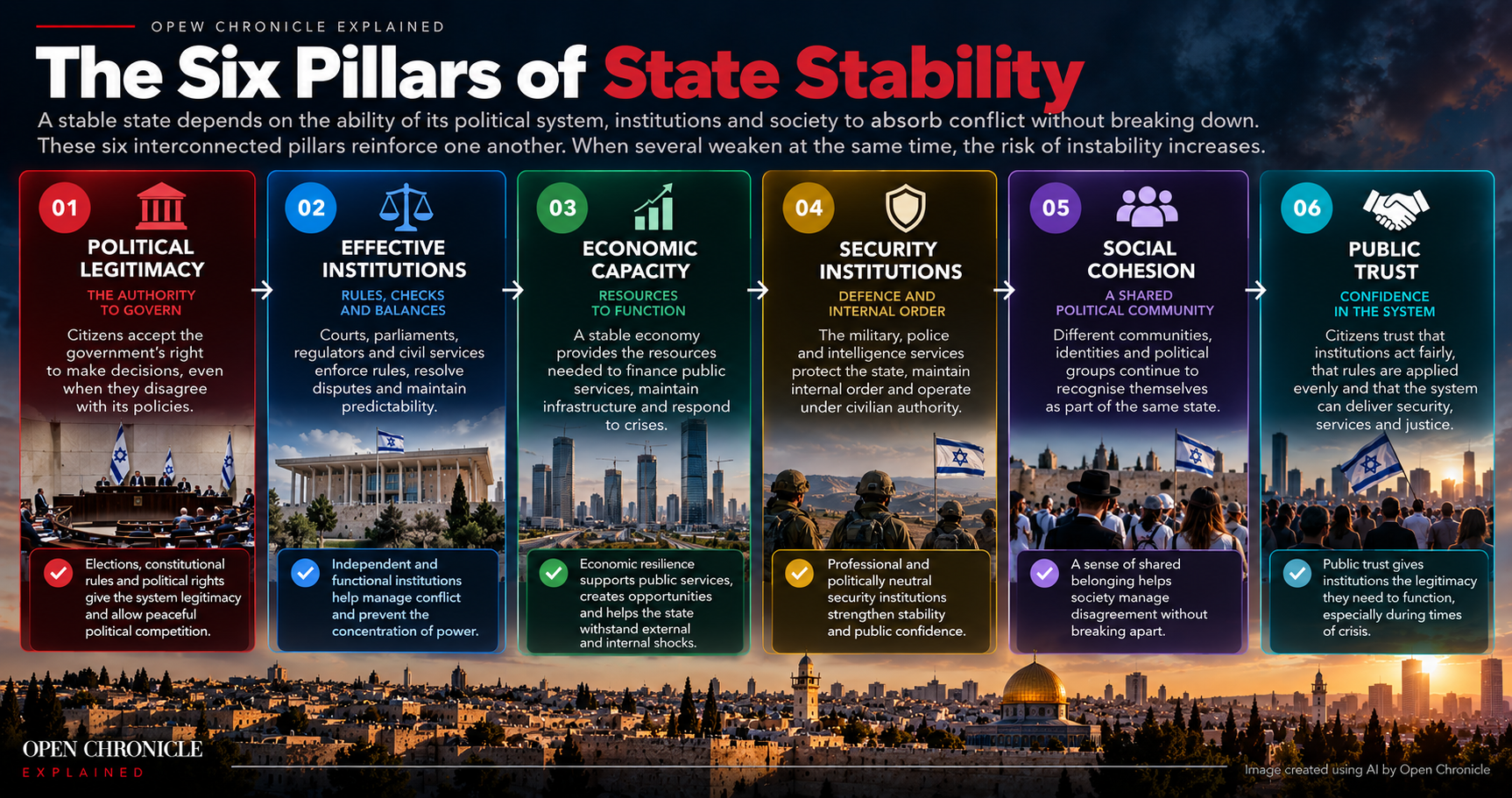
A modern state rests on several interconnected foundations.
They can be simplified into six pillars:
Political legitimacy
↓
Effective institutions
↓
Economic capacity
↓
Security institutions
↓
Social cohesion
↓
Public trust
None operates completely independently.
A government needs economic resources to finance institutions.
Institutions need legitimacy to enforce decisions.
Security forces need political authority.
Citizens need sufficient trust to accept outcomes they dislike.
And societies need enough cohesion to continue functioning despite disagreements.
The strength of a state therefore does not come from one institution.
It comes from a system of relationships.
3. Political Legitimacy: Why Do People Accept Government Authority?
Every political system ultimately confronts a simple question:
Why should people accept decisions they oppose?
Democracies attempt to solve this through elections, constitutional rules, political rights and institutions.
A voter may strongly dislike the government but still accept that the government has legal authority.
That distinction creates stability.
Political legitimacy weakens when significant sections of society stop believing that institutions represent them or that the rules governing political competition are legitimate.
This does not automatically produce state failure.
But it changes the nature of political conflict.
Instead of:
“I oppose this government.”
the argument can become:
“I no longer trust the system producing this government.”
That is a much deeper fracture.
4. Why Institutional Trust Matters
States depend on institutions people rarely think about when everything is working.
Courts.
Parliaments.
Election authorities.
Police.
Central banks.
Civil services.
Military institutions.
Regulators.
Local governments.
These institutions perform different functions, but together they create predictability.
Citizens know roughly what happens when a contract is violated.
Businesses know how taxes are collected.
Political parties know how elections work.
Government agencies know where their authority begins and ends.
When institutional trust falls, every political dispute becomes harder to resolve.
A court decision may be interpreted not as a legal judgment but as a political attack.
A parliamentary vote may be regarded as illegitimate.
An election defeat may be interpreted as evidence that the political system itself has failed.
The institutions designed to resolve disagreements can then become part of the disagreement.
5. Israel Shows Why Institutional Conflict Matters
Israel provides a particularly interesting contemporary example.
It remains a competitive multiparty parliamentary system with powerful state institutions.
At the same time, disputes surrounding the judiciary, government authority and constitutional arrangements have generated intense political conflict.
Unlike many democracies, Israel does not have a single codified constitution.
Instead, a collection of Basic Laws provides much of the country’s constitutional framework.
That makes disagreements over the balance between parliament, government and judiciary especially consequential.
The judicial reform controversy that erupted before the October 7, 2023 attacks exposed profound disagreement about where political authority should ultimately reside.
Supporters of reform argued that unelected judges had accumulated excessive influence over decisions made by elected governments.
Opponents argued that weakening judicial oversight could remove an essential check on executive and parliamentary power.
The disagreement therefore concerned more than individual court decisions.
It concerned the architecture of the state itself.
6. Social Cohesion: The Glue Between Citizens
Institutions alone cannot explain stability.
Societies also require a degree of cohesion.
That does not mean everyone must share the same religion, ideology, ethnicity or political beliefs.
Modern states routinely contain enormous diversity.
Social cohesion instead means that people who disagree still recognise themselves as participants in a common political community.
They may argue intensely about:
- taxation,
- religion,
- immigration,
- territory,
- war,
- education,
- social values,
- or political leadership.
But they continue to believe that their disputes can be managed inside a shared system.
The danger begins when political identities become mutually exclusive.
Politics then stops being:
“Which policy should our country adopt?”
and begins becoming:
“Whose country is this?”
That is a much more difficult question for institutions to resolve.
7. Israel Contains Several Overlapping Social Divides
Israeli society contains numerous political, religious, ethnic and cultural communities.
Among the important divisions are disagreements between:
Religious and secular Israelis
Political right and left
Jewish and Arab citizens
Ultra-Orthodox and non-Haredi Jewish communities
Different interpretations of Israel’s national and constitutional identity
These divisions do not automatically threaten the state.
Israel has managed substantial social diversity throughout its history.
The important question is whether different divisions begin reinforcing one another.
A religious dispute may become an electoral dispute.
An electoral dispute may become a constitutional dispute.
A constitutional dispute may affect confidence in courts.
Military policy may then introduce another dividing line.
This is how separate political problems can become interconnected.
8. Why Military Service Has Become Such an Important Fault Line
Israel’s military-service debate demonstrates this process particularly clearly.
Military service occupies an unusually important place in Israeli society because of the country’s security environment and system of conscription and reserve service.
Ultra-Orthodox, or Haredi, men historically benefited from broad exemptions connected with full-time religious study.
For Haredi communities, Torah study is not simply education.
It lies at the centre of religious life and communal identity.
Many Haredi leaders therefore regard compulsory military service as a threat to their way of life.
But another perspective has become increasingly important.
Years of warfare and repeated reserve mobilisation have imposed substantial burdens on other parts of Israeli society.
Reservists can spend long periods away from:
families
jobs
businesses
education
and normal civilian life.
The resulting debate is therefore no longer simply about military manpower.
It asks:
Who carries the obligations of citizenship?
9. When Burdens Are Perceived as Unequal
Perceived fairness is extremely important for social cohesion.
Imagine a state asking citizens to make extraordinary sacrifices.
Some serve in combat.
Some lose income.
Some businesses operate without key employees.
Families endure repeated absences.
Taxes finance expanding military expenditure.
Under those circumstances, exemptions enjoyed by another group can become politically explosive.
The underlying dispute changes from:
“How should military recruitment work?”
to:
“Are the responsibilities of citizenship being shared fairly?”
That question touches identity, religion, economics and politics simultaneously.
This is exactly the kind of overlap that analysts examining state stability pay attention to.
10. Why War Can Strengthen and Weaken Cohesion
External threats can initially unite societies.
The political phenomenon is sometimes described as a rally-around-the-flag effect.
Political disagreements temporarily become less important.
National identity becomes stronger.
Citizens mobilise around a shared threat.
But prolonged warfare can produce the opposite effect.
Over time, war creates:
casualties
economic costs
military fatigue
family disruption
political disputes
psychological trauma
arguments over strategy
and questions about who is carrying the burden.
A society may therefore move through two different phases:
External threat → greater unity
followed potentially by:
Prolonged conflict → accumulated internal strain
The transition is not inevitable.
But the longer a conflict continues, the greater the number of domestic systems it can affect.
11. Why Military Exhaustion Becomes an Economic Problem
Reservists are not only soldiers.
They are also:
engineers,
teachers,
business owners,
doctors,
programmers,
construction workers,
managers,
students,
parents.
When large numbers of reservists are repeatedly mobilised, military requirements begin interacting with the civilian economy.
Businesses lose workers.
Households lose income or stability.
Government expenditure rises.
Public debt can increase.
Investment decisions may be delayed.
Economic uncertainty grows.
Military strain therefore becomes economic strain.
And economic strain can return to the political system.
This produces another feedback loop:
War
↓
Mobilisation
↓
Higher public expenditure
↓
Workforce disruption
↓
Economic pressure
↓
Political dissatisfaction
↓
Greater difficulty sustaining the war effort
The systems are connected.
12. Why Economic Pressure Alone Usually Does Not Break States
Countries survive recessions.
They survive high debt.
They survive inflation.
They survive expensive wars.
Economic difficulty therefore should not automatically be interpreted as evidence of impending state collapse.
The greater concern arises when economic stress reinforces other fractures.
Consider two countries experiencing the same recession.
In one:
institutions remain trusted,
elections remain accepted,
political violence remains limited,
and citizens believe conditions will eventually improve.
The political system may remain highly resilient.
In another:
institutions are already distrusted,
society is deeply polarised,
government legitimacy is disputed,
and security institutions are under pressure.
The same economic shock can have much greater political consequences.
Context determines resilience.
13. What Is Political Polarization?
Polarization is more than disagreement.
Citizens can disagree strongly while still cooperating.
More dangerous forms of polarization emerge when political identity becomes deeply connected with social identity.
Instead of merely thinking:
The other side has the wrong policy.
people begin thinking:
The other side threatens the country I believe should exist.
Political opponents become existential adversaries.
Compromise then becomes difficult because compromise itself can appear immoral or dangerous.
This produces another destabilising mechanism.
Polarization
↓
Less compromise
↓
Institutional paralysis
↓
Lower trust
↓
Greater polarization
This is a feedback loop.
And feedback loops are central to understanding state instability.
14. The Most Important Concept: Problems Can Compound
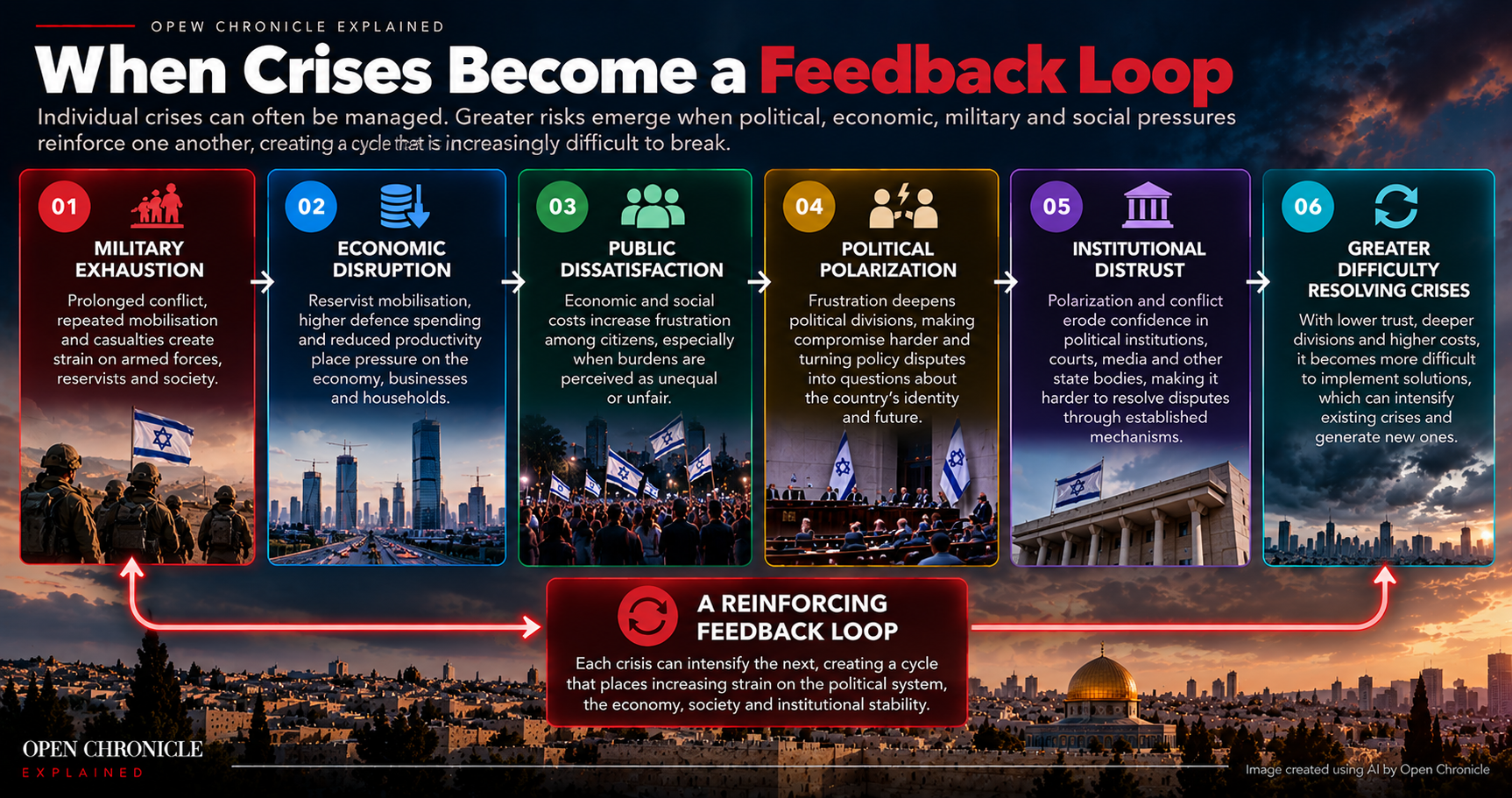
This is perhaps the central lesson behind state-stability analysis.
Individual problems matter.
But their interaction matters more.
Imagine five pressures:
A · Political polarization
B · Institutional distrust
C · Economic strain
D · Military exhaustion
E · Social division
If they remain isolated, institutions may manage them.
But imagine they begin connecting:
Military exhaustion
creates
↓
Economic disruption
which creates
↓
Public dissatisfaction
which increases
↓
Political polarization
which reduces
↓
Institutional trust
which makes it harder to solve
↓
Military and economic problems
The system begins feeding back into itself.
This is called a reinforcing feedback loop.
It explains why analysts often focus less on individual crises than on whether several crises are converging.
15. How Do Analysts Think About State Fragility?
There is no single universal formula.
But analysts frequently examine several broad categories.
Political
Is government authority accepted?
Can political disputes be resolved constitutionally?
Are elections functioning?
Institutional
Do courts, public administration and security institutions continue operating effectively?
Economic
Can the state finance itself and maintain essential services?
Security
Does the government maintain control over organised coercive power and territory?
Social
Do different communities continue recognising a shared political order?
External
Are wars, sanctions, diplomatic isolation or foreign intervention intensifying domestic pressures?
The important word is again:
interaction.
A country can perform poorly in one category while remaining extremely strong in others.
Fragility becomes more serious when weaknesses spread across several systems.
16. What Does “State Collapse” Actually Mean?
The phrase is frequently used far too loosely.
A government losing popularity is not state collapse.
A prime minister losing an election is not state collapse.
Mass demonstrations are not state collapse.
A constitutional crisis is not necessarily state collapse.
Even severe political instability may occur while the state itself remains functional.
Actual state collapse implies something much more profound.
Core institutions lose the ability to perform fundamental functions.
The government may lose effective authority.
Security forces may fragment.
Public administration may stop functioning.
Territorial control may weaken.
Essential services may become impossible to maintain.
The state’s monopoly over legitimate organised force may disintegrate.
That is an extraordinarily high threshold.
17. Civil Conflict Is Also a Much Higher Threshold
Political polarization should not automatically be described as civil war.
Neither should protests, riots or even isolated political violence.
Civil war generally involves sustained organised armed conflict between actors within a state, usually at a scale far beyond ordinary political unrest.
That distinction matters enormously when interpreting intelligence scenario analysis.
An analyst may examine:
What circumstances could theoretically produce civil conflict?
That is not equivalent to saying:
Civil war will occur.
Intelligence organisations deliberately explore low-probability but high-impact scenarios because policymakers need to understand what could happen if existing assumptions prove wrong.
18. What Is a Red Team or Red Cell?
This helps explain the reported CIA assessment.
Red-team analysis is designed to challenge conventional thinking.
Instead of asking only:
What do we think will happen?
analysts may ask:
What if our assumptions are wrong?
or:
What dangerous scenario are we overlooking?
The objective is not necessarily prediction.
It is analytical stress-testing.
Imagine policymakers broadly believe:
Israel’s institutions are sufficiently resilient to absorb domestic conflict.
A red-team exercise might deliberately test the opposite assumption:
What combination of events could overwhelm those institutions?
Analysts can then identify warning indicators.
That makes extreme scenarios useful even when they never occur.
19. Warning Is Not Prediction

This distinction is essential.
Consider a bridge engineer.
The engineer might calculate what would happen if:
traffic doubled,
a structural component failed,
and extreme winds occurred simultaneously.
The engineer is not predicting that all three things will happen.
The engineer is asking whether the bridge would survive if they did.
Strategic scenario analysis works similarly.
Scenario
asks:
What could happen?
Forecast
asks:
What is likely to happen?
Prediction
makes a stronger claim about what will happen.
Confusing these categories can make intelligence reporting appear far more dramatic than the underlying analysis warrants.
20. What Makes a State Resilient?
The opposite of fragility is not the absence of problems.
It is resilience.
A resilient political system can experience major shocks and continue functioning.
Several mechanisms contribute to resilience:
Trusted institutions
Citizens believe disputes can be resolved within the system.
Peaceful political competition
Governments can change without threatening the existence of the state.
Independent institutions
Different centres of authority can constrain one another.
Economic capacity
The government can finance essential services and respond to crises.
Professional security institutions
Military and police forces remain tied to constitutional authority.
Social networks
Communities continue interacting despite political differences.
Political compromise
Opponents remain capable of negotiation.
Resilience therefore does not require unity.
It requires the ability to manage division.
21. Why Elections Can Both Release and Increase Pressure
Elections provide democracies with a mechanism for resolving political conflict.
Citizens can replace governments without overthrowing the political system.
That makes elections an extraordinary stabilising technology.
But highly polarised elections can also temporarily intensify political tension.
Campaigns emphasise differences.
Political rhetoric becomes sharper.
Different visions of national identity compete directly.
Groups fear losing political power.
The critical question is what happens after the result.
Can winners exercise authority without attempting to eliminate political competition?
Can losers accept defeat while continuing to oppose the government?
Can institutions resolve disputes about the process?
If the answer remains yes, elections can ultimately release political pressure.
22. Israel’s October 2026 Election Is Therefore Important — But Not Determinative
Israel’s October 27 election arrives after years of extraordinary political and military pressure.
Questions surrounding:
military service,
religion,
judicial authority,
security,
economic burdens,
the consequences of prolonged warfare,
and the country’s political direction
are converging in the electoral arena.
That makes the election an important test of political institutions.
But an election by itself does not determine whether a state is stable.
The deeper question concerns what happens to the conflicts surrounding it.
Do institutions continue mediating them?
Do political actors continue accepting constitutional mechanisms?
Can compromises be constructed?
Do different communities continue accepting participation in the same political system?
Those are the questions that determine resilience.
23. The Stability Equation
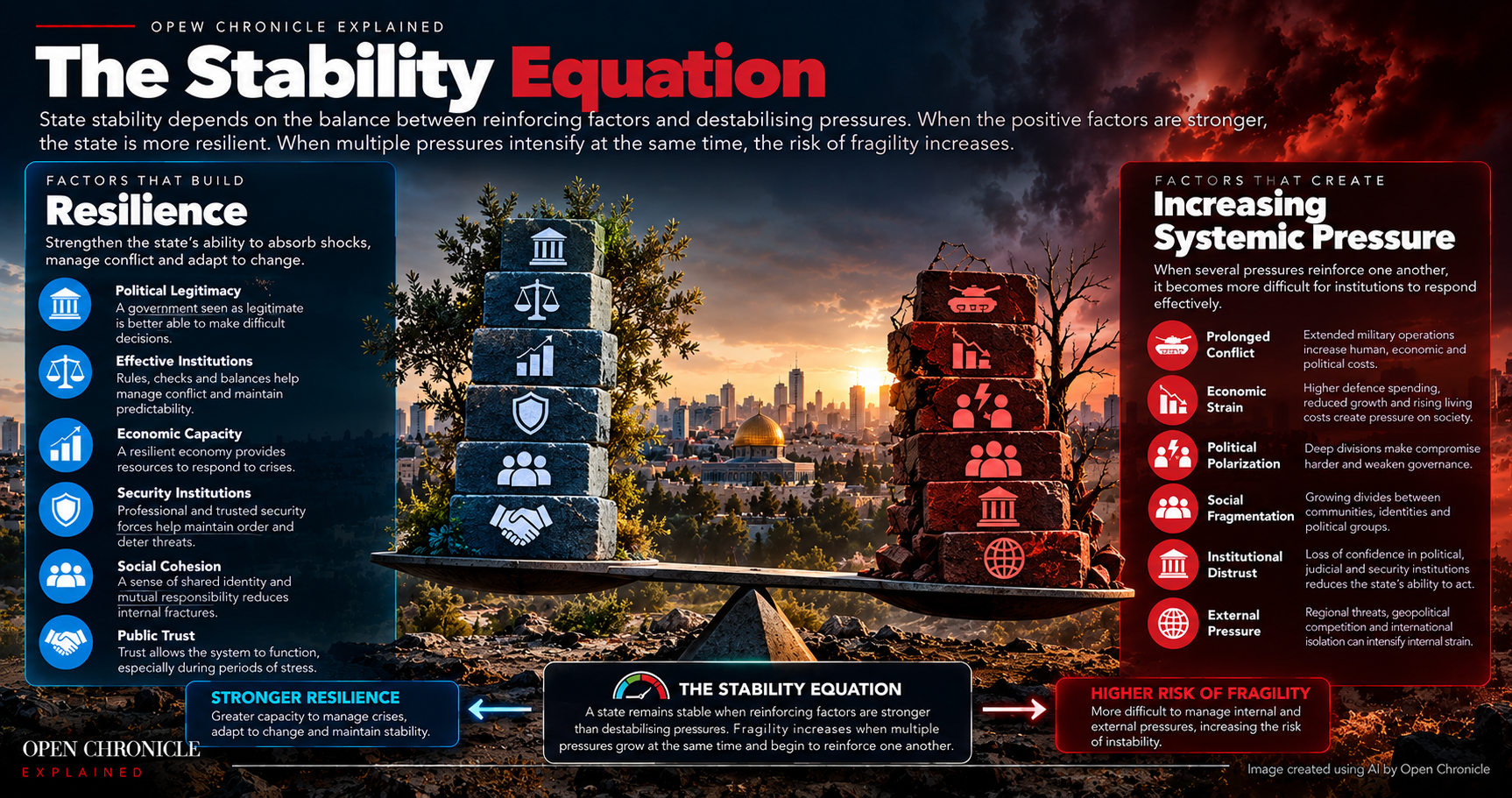
There is no mathematical equation capable of predicting state collapse.
But the underlying logic can be represented conceptually:
Strong Institutions
Political Legitimacy
Economic Capacity
Security Cohesion
Social Trust
=
RESILIENCE
Now reverse the process:
Political Polarization
Institutional Distrust
Economic Stress
Military Exhaustion
Social Fragmentation
=
INCREASING SYSTEMIC PRESSURE
Increasing systemic pressure does not equal collapse.
It means the system must absorb more stress.
The crucial variable is whether institutions retain enough capacity and legitimacy to do so.
What?
State stability is the ability of a political system and its institutions to continue functioning while absorbing political, economic, military and social shocks.
Stability does not mean the absence of disagreement.
It means disagreement does not destroy the mechanisms used to manage it.
How?
States remain stable through interacting systems:
Institutions
↓
manage
Political conflict
↓
supported by
Economic capacity
↓
protected by
Security institutions
↓
legitimised through
Public trust and political participation
When several of these mechanisms weaken simultaneously, pressures can begin reinforcing one another.
Why?
Because modern states are systems.
Military problems can become economic problems.
Economic problems can become political problems.
Political problems can undermine institutions.
Institutional distrust can deepen social polarization.
Social polarization can make political compromise harder.
The danger therefore rarely comes from one problem alone.
It comes from feedback loops between problems.
When Internal Fractures Become Strategic
The most important lesson from the debate surrounding Israel is not that the country is destined for collapse.
There is no public evidence supporting such a conclusion.
The reported CIA assessment itself should not be interpreted that way.
The deeper lesson is that national security does not exist only at borders.
A country can possess powerful armed forces, advanced intelligence services and sophisticated weapons while simultaneously confronting pressures within its own political and social system.
External security asks:
Can the state defend itself from its adversaries?
Internal resilience asks:
Can the state continue functioning when its own society is under extraordinary pressure?
Strong states need both.
Israel’s current tensions demonstrate why.
The country’s military capabilities remain formidable.
Its institutions continue functioning.
Its economy continues operating.
Its political system continues preparing for competitive elections.
Yet substantial disagreements over religion, military service, constitutional authority, political identity and the distribution of wartime burdens are real.
Those facts can coexist.
A state can be powerful and internally divided.
A democracy can be resilient and deeply polarised.
An intelligence service can examine catastrophic scenarios without predicting catastrophe.
Understanding the difference between those statements is exactly why state stability needs to be explained rather than sensationalised.
Because countries usually do not fracture when citizens disagree.
They become vulnerable when the institutions designed to manage disagreement can no longer prevent one crisis from feeding another.
Related Reporting
CIA Assessment Warns Israel’s Internal Fractures Could Threaten State Stability
Open Chronicle’s October 6, 2026 report examines a reportedly classified CIA Red Cell assessment considering how political instability, military pressure, economic strain and social divisions could interact inside Israel ahead of the October 27 election.
The reported assessment explores severe scenarios rather than predicting that they will occur.
CIA Assessment Warns Israel’s Internal Fractures Could Threaten State Stability
Open Chronicle’s October 6, 2026 report examines a reportedly classified
CIA Red Cell assessment considering how political instability, military
pressure, economic strain and social divisions could interact inside
Israel ahead of the October 27 election.
The reported assessment explores severe scenarios rather than predicting
that they will occur.
Sources and Further Reading
Institutional research and comparative material for understanding
political stability, democratic resilience, social cohesion and the
pressures affecting Israeli society.
CIA Assessment Warns Israel’s Internal Fractures Could Threaten State Stability
Open Chronicle reporting on the reportedly classified CIA Red Cell
assessment that provides the contemporary context for this explainer.
The Israeli Democracy Index 2025
Research examining institutional trust, political divisions, social
cohesion and public attitudes toward Israeli democracy.
State of Israeli Democracy
Continuing 2026 measurements of public attitudes toward democracy,
political representation and institutional performance.
Annual Assessment of the Jewish People 2026
Research examining social cohesion and changing political and religious
divisions within Israeli society.
Global State of Democracy — Israel
Comparative information concerning Israeli democratic institutions,
political polarization and institutional developments.
Freedom in the World 2026 — Israel
Assessment of political rights, civil liberties and institutional
developments.
Open Chronicle Explained uses Israel as a contemporary
case study to explain the general concepts of state stability, resilience
and fragility. References to the reported CIA assessment are based on
public reporting about a classified document that has not itself been
released. Extreme scenarios examined in intelligence analysis should not
be interpreted as predictions. Open Chronicle Explained distinguishes
throughout between documented pressures, analytical scenarios and
conclusions about future outcomes.
Understanding the systems behind the headlines.
Explore Open Chronicle Explained →