
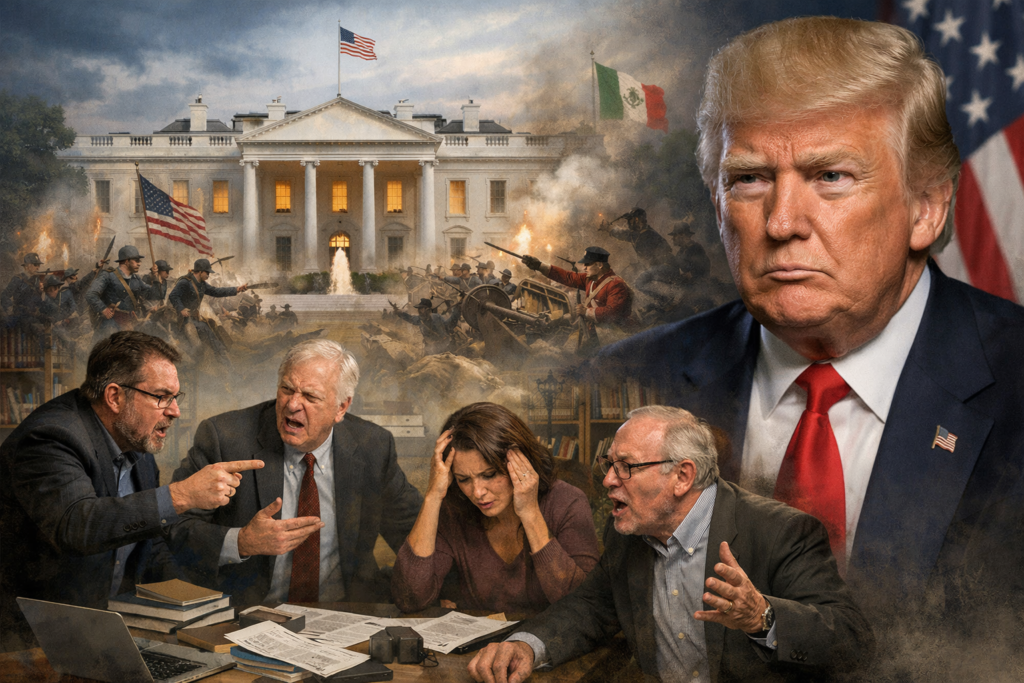
Image Credentials: Image Title: Historians Accuse Trump Administration of Distorting Mexican-American War History Source: (sora.openai) Date: February 2026. Attribution: This image was created using AI-generated imagery (sora.openai) and does not depict a real-world scene. Source: (sora.openai) Date: February 2026. Attribution: This image was created using AI-generated imagery (sora.openai) and does not depict a real-world scene.
By Open Chronicle Staff
WASHINGTON, D.C. — A recent White House statement commemorating the Mexican-American War has ignited a firestorm of criticism from historians and international analysts, who accuse the Trump administration of “whitewashing” and “distorting” historical facts to justify a more aggressive “America First” policy in Latin America.
The controversy centers on a February 2 declaration describing the 1846–1848 conflict as a “legendary victory” that “expanded the promise of American independence.” Critics argue the text uses a selective, imperialist lens to draw direct parallels between the expansionist “Manifest Destiny” of the 19th century and the administration’s current interventions in Mexico, Venezuela, and beyond.
A “Legendary” or “Unjust” Victory?
The White House statement celebrates the war for securing the American Southwest and reaffirming U.S. sovereignty. However, historians point out that the statement conspicuously omits the central role that the expansion of slavery played in the conflict, a factor that abolitionists of the era warned was the war’s primary driver.
“The Trump administration is embracing this as a positive of U.S. history and framing it, historically incorrectly, as if it were a defensive measure to stop Mexico from invading,” said Alexander Aviña, a professor of Latin American history at Arizona State University. He noted that the declaration ignores the displacement of hundreds of thousands of Indigenous peoples and the violence required to reach the Pacific.
The narrative stands in stark contrast to the views of historical figures like Ulysses S. Grant, who later called the war “one of the most unjust ever waged by a stronger nation against a weaker one.”
Sovereignty and Sarcasm
In Mexico City, President Claudia Sheinbaum responded to the White House statement with a mix of irony and resolve. When questioned during her morning press conference, she laughed, noting that Mexico must continue to “defend its sovereignty.”
The relationship between the two leaders has been characterized by a delicate balance of diplomacy and sarcasm. Sheinbaum has previously mocked the U.S. President’s rhetorical flourishes, such as his suggestion to rename the Gulf of Mexico the “Gulf of America.”
The Ideological Edit
The statement is part of a broader push by the administration to “restore truth and sanity to American history.” This initiative has already led to the rewriting of historical displays at the Smithsonian Institution and the removal of government data related to climate change, the destruction of Indigenous cultures, and the “ugly” aspects of American slavery.
For analysts, the latest White House memo is less about the 19th century and more about the 21st. “This serves to rhetorically affirm that the United States is justified in imposing its policy across the American continent,” Aviña concluded. As the administration weighs military action against Mexican cartels and maintains its grip on regional politics, the debate over history has become a primary battlefield for the future of the hemisphere.