
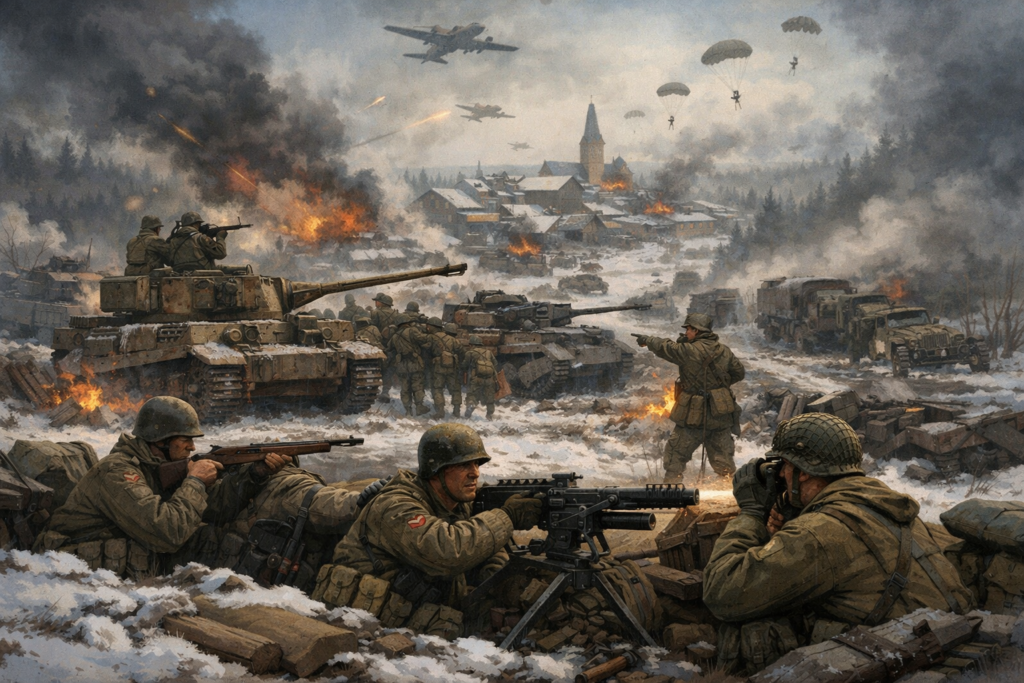
Image Credentials: Image Title: The Bastogne Bottleneck: German Tactical Failures and Lost Opportunities Source: (sora.openai) Date: February 2026. Attribution: This image was created using AI-generated imagery (sora.openai) and does not depict a real-world scene.
Open Chronicle History
Vol. 33 | Issue 06 | Tactical Analysis: The Bastogne Enigma
By the Open Chronicle History Desk
The defense of Bastogne is immortalized as a triumph of American “grit,” but for the German Wehrmacht, it was a series of tactical blunders that ultimately derailed the entire Ardennes Offensive. While General McAuliffe’s famous “Nuts!” response provided the morale, a specific set of German tactical choices and missed opportunities provided the opening for the 101st Airborne to hold out.
The Fatal Decision to Bypass
The primary German failure was a conflict between speed and security. The original plan for the Fifth Panzer Army was to bypass Bastogne and race toward the Meuse River.
-
The Error: General von Lüttwitz initially left only a single division (the 26th Volksgrenadier) to mask the city while the 2nd Panzer and Panzer-Lehr Divisions moved west.
-
The Consequence: By the time the Germans realized Bastogne’s road network was essential for their logistical “tail,” the 101st Airborne and 10th Armored CCB had established a formidable 360-degree perimeter. A concentrated strike with all three divisions on December 20th likely would have crushed the Americans before they could dig in.
Failure to Coordinate Artillery and Air
Despite having the town surrounded, the Germans never achieved a “Schwerpunkt” (point of main effort) with their heavy weaponry.
-
Artillery Fragmentation: Instead of a concentrated “creeping barrage” to soften the perimeter, German artillery fire was sporadic and often directed at the town center rather than the frontline foxholes. This allowed American defenders to shift their own limited artillery to whichever sector was being probed.
-
The Luftwaffe’s Absence: The offensive was timed for bad weather to ground Allied planes, but this also meant the Luftwaffe couldn’t provide close air support. When the weather finally cleared on December 23rd, it was the Allies who dominated the skies, dropping supplies to the 101st and napalm on German armor.
Missing the Multi-Pronged Assault
Historical analysis suggests the Germans “nibbled” at the edges rather than “biting” the core.
-
Sequential vs. Simultaneous: German attacks were often sequential, attacking the north, being repelled, then attacking the south. Military analysts argue that if the Germans had launched simultaneous multi-regimental attacks at three or four different points, they would have overwhelmed the thin American lines, which were essentially “robbing Peter to pay Paul” by moving troops around the perimeter to meet each new threat.
Psychological Warfare and the Surrender Ultimatum
The Germans attempted to use the “surrender or be annihilated” tactic on December 22nd. While this was standard doctrine, it failed because:
-
Poor Intelligence: The Germans overestimated the 101st’s desperation. They believed the Americans were out of ammunition and food. While supplies were low, the arrival of the C-47 resupply drops on December 23rd completely neutralized the German leverage.
What Could Have Been: Alternative German Tactics
| Tactic | Potential Outcome |
| Combined Arms Siege | Committing the 2nd Panzer Division to the city immediately, rather than bypassing it, would have likely broken the defense in 48 hours. |
| Total Interdiction | Prioritizing the destruction of the Assenois road (the path Patton eventually used) with heavy mining and anti-tank screens could have delayed the relief of the city by days. |
| Night Infiltration | Using specialized “Brandeburg” units for night-time sabotage of American command posts inside the town could have shattered the 101st’s coordination. |
Bibliography
-
Beevor, Antony. Ardennes 1944: Hitler’s Last Gamble. London: Viking, 2015.
-
Caddick-Adams, Peter. Snow and Steel: The Battle of the Bulge, 1944-45. New York: Oxford University Press, 2014.
-
Cole, Hugh M. The Ardennes: The Official History of the Battle of the Bulge. Washington, D.C.: Office of the Chief of Military History, 1965.
-
Mitchell, Ralph M. The 101st Airborne Division’s Defense of Bastogne. Fort Leavenworth: Combat Studies Institute, 1986.