
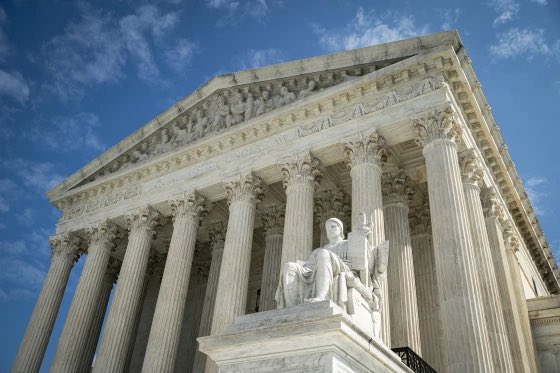
Image: from Mike Netter X@nettermike
By Open Chronicle Staff February 4, 2026
WASHINGTON — In a pivotal ruling ahead of the 2026 midterm elections, the U.S. Supreme Court on Wednesday declined to block a new congressional map in California, handing a major victory to Democrats in their bid to reclaim control of the U.S. House of Representatives.
The court’s one-sentence order, issued without public dissent, allows the state to implement a redistricting plan that is expected to favor Democrats in at least five additional congressional seats. The decision follows a high-stakes legal battle initiated by the California Republican Party, which argued that the map unconstitutionally used race as a primary factor in drawing district boundaries.
MASSIVE: The U.S. Supreme Court has just allowed California’s new congressional map, one that favors Democrats heavily, to take effect AHEAD of the November midterm elections.
CONGRATS @CAgovernor
Republicans started this 🤣 pic.twitter.com/arkbZRqW0n
— Brian Krassenstein (@krassenstein) February 4, 2026
A Tit-for-Tat Redistricting War
The California map was explicitly designed by the state’s Democratic-led legislature as a countermeasure to a similar redistricting effort in Texas. In December, the Supreme Court allowed a new Texas map to proceed, which is estimated to flip five Democratic-held seats to Republicans.
“Donald Trump said he was ‘entitled’ to five more congressional seats in Texas. He started this redistricting war. He lost, and he’ll lose again in November,” California Governor Gavin Newsom stated on social media following the ruling.
The battle highlights the fallout of a 2019 Supreme Court decision that declared partisan gerrymandering to be a “political question” beyond the reach of federal courts. By declining to intervene in California after allowing the Texas map to stand, the court appears to have cemented a new era of mid-decade redistricting driven by pure partisan advantage.
Oralè Resisters
Congratulations another win!
Five more Blue House Seats
The Supreme Court’s allows
California voter approved New Redistricting map to use in
November! By unanimous vote! #Prop50 #CaVoteMap #YesOn50 #USDemocracy #50501Socal #VotoLatino #GavinNewsom #California… pic.twitter.com/DlxhwegD8L— Ruben Garcia (@goRubenRuben) February 4, 2026
High Stakes for the Trump Agenda
With Republicans currently holding a narrow majority in both chambers of Congress, the upcoming midterms are seen as a referendum on President Donald Trump’s second-term legislative goals. If Democrats manage to flip the House, the administration faces the prospect of gridlock and a wave of congressional investigations.
Challengers in California had claimed the map violated the 14th and 15th Amendments by using “race as a predominant factor” to favor Latino voters. However, a lower federal court previously ruled that the evidence of racial motivation was “exceptionally weak,” while the evidence of “partisan motivations” was overwhelming.
Justice Samuel Alito, in a concurring opinion in the earlier Texas case, noted that the impetus for both states’ maps was “partisan advantage pure and simple.”
As California—the nation’s most populous state with 52 House seats—prepares to head to the polls under the new boundaries, the ruling sets the stage for a fierce and potentially decisive battle for the gavel this November.