
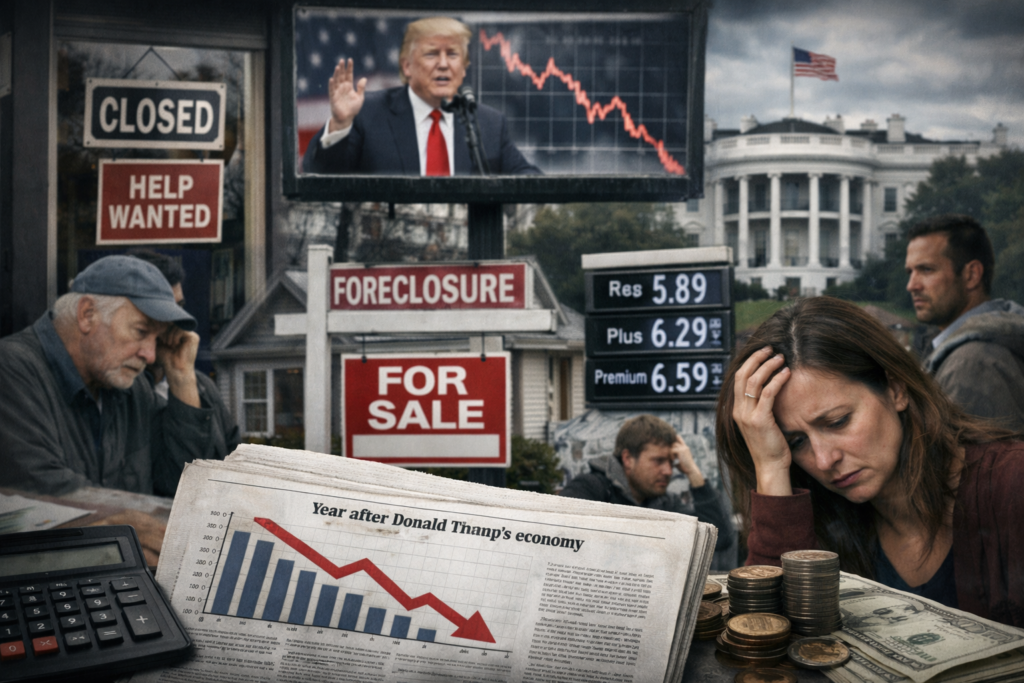
Image Credentials: Image Title: Persistent Economic Gloom Marks First Anniversary of Trump’s Second Term Source: (sora.openai) Date: February 2026. Attribution: This image was created using AI-generated imagery (sora.openai) and does not depict a real-world scene.
By Open Chronicle Staff
February 4, 2026
WASHINGTON — One year after Donald Trump’s return to the White House, a new report from the Pew Research Center reveals that the “economic boom” promised on the campaign trail has yet to materialize in the eyes of most Americans. Despite the administration’s aggressive policy shifts, public sentiment regarding the U.S. economy remains overwhelmingly negative, a trend that has now persisted for six consecutive years.
The survey, conducted between January 20 and 26, 2026, among over 8,500 adults, paints a picture of a nation deeply concerned with the rising costs of necessities. As the 2026 midterm elections approach, these findings suggest a growing vulnerability for the Republican Party’s economic platform.
Cost of Living Crisis
The primary driver of the public’s pessimism is the “affordability gap.” While the administration points to stock market resilience, the average American remains laser-focused on their personal balance sheets.
| Economic Concern | Percentage “Very Concerned” |
| Cost of Health Care | 71% |
| Price of Food & Consumer Goods | 66% |
| Cost of Housing | 62% |
| Price of Electricity | 51% |
While 45% of Americans are worried about job availability, it is the daily expense of living—not the threat of unemployment—that dominates the national anxiety. In contrast, only 20% of respondents expressed significant concern about the stock market.
The Tariff Backlash
A central pillar of the Trump administration’s second-term strategy has been a substantial increase in tariffs. However, the Pew report indicates a sharp disconnect between the White House and the electorate.
By a wide margin, 60% of Americans say they disapprove of the administration’s tariff policies, with 39% “strongly” disapproving. Many respondents expressed fears that these trade barriers are directly contributing to the elevated prices of consumer goods.
Confidence in the President’s leadership has also seen a marked decline. Only 27% of Americans say they support all or most of Trump’s policies—a significant drop from the 35% recorded when he took office last year. This erosion of support is even appearing within the President’s own base; support for his plans among Republicans has dipped from 67% to 56% over the last twelve months.
A Partisan Divide on the Future
While the overall outlook is bleak, a stark partisan divide remains regarding the future. A majority of Republicans (57%) remain optimistic, believing the economy will improve over the next year. Conversely, 62% of Democrats expect conditions to worsen.
Overall, roughly half of the country (52%) believes that Trump’s economic policies have actively made conditions worse since he took office. As the administration enters its second year, the pressure to deliver “Day 1” results is mounting, with the public’s patience seemingly wearing thin.