
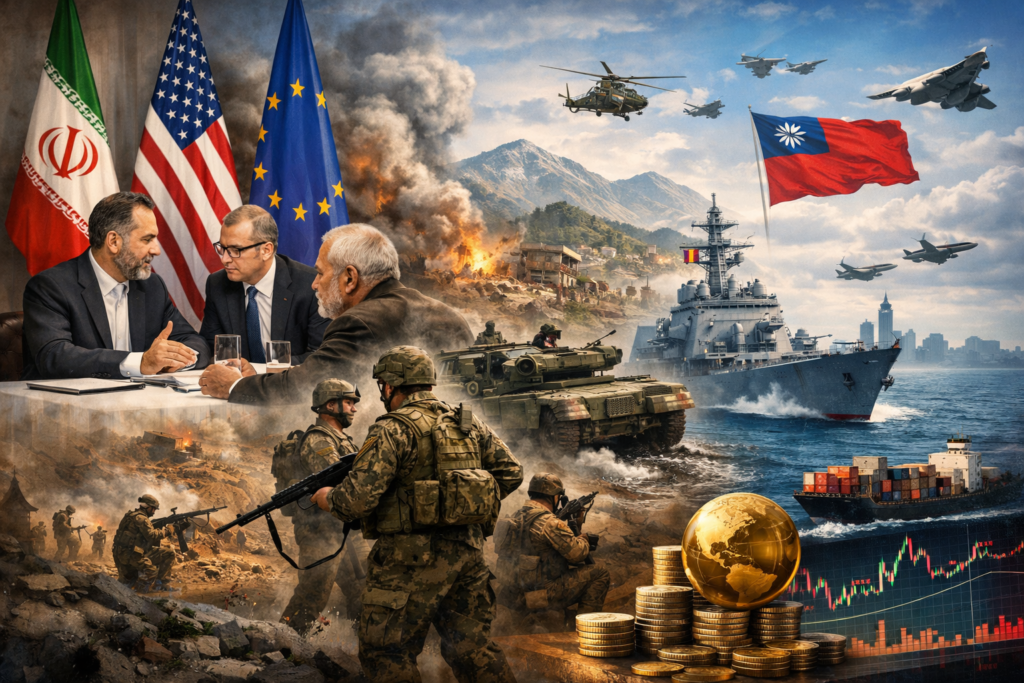
Image Credentials: Image Title: Global News Brief: Key Events and Developments for February 5, 2026 Source: (sora.openai) Date: January 2026. Attribution: This image was created using AI-generated imagery (sora.openai) and does not depict a real-world scene.
Global Briefing: Key Developments Shaping International Politics and the Economy
By Open Chronicle Staff with Agencies
Diplomatic maneuvering, regional conflict management, and economic recalibration are defining the global agenda as the week unfolds. From renewed nuclear talks involving Iran to shifting dynamics in the Caucasus and rising tensions over Taiwan, governments are signaling both caution and resolve in a rapidly evolving geopolitical environment.
US and Iran set to resume nuclear talks in Oman
The White House has confirmed that negotiations centered on Iran’s nuclear program will take place on Friday in Muscat, Oman. The talks, long surrounded by uncertainty, come after mixed signals from Tehran raised doubts over whether discussions would proceed. According to Iranian Foreign Minister Abbas Araghchi, negotiations are expected to begin around 10 a.m. local time.
US officials indicated that Washington rejected Iranian requests to alter the format or venue of the talks, emphasizing that the Muscat meeting was non-negotiable. The decision to proceed underscores the stakes involved, as both sides face mounting regional and international pressure to prevent further escalation over Iran’s nuclear activities.
Türkiye backs the peace momentum between Azerbaijan and Armenia
Turkish President Recep Tayyip Erdogan praised recent steps taken by Azerbaijan and Armenia toward establishing lasting peace, calling them “extremely valuable.” Speaking via video message during the Zayed Award for Human Fraternity 2026 program, Erdogan highlighted the symbolic and practical importance of reconciliation in the Caucasus.
He congratulated Azerbaijani President Ilham Aliyev and Armenian Prime Minister Nikol Pashinyan, expressing hope that their agreement, reached last August, would open a new chapter for regional stability. Ankara’s endorsement reflects its broader interest in a secure South Caucasus, where unresolved conflicts have long posed risks to trade routes and regional cooperation.
Xi urges caution on Taiwan during call with Trump
Chinese President Xi Jinping warned US President Donald Trump to handle arms sales to Taiwan with “prudence,” reiterating Beijing’s position that it will not allow the island’s separation from China. During a phone call between the two leaders, Xi emphasized Taiwan as the most sensitive issue in China-US relations and called for mutual respect and peaceful coexistence.
The exchange comes amid heightened tensions following Washington’s approval of a record $11.1 billion arms package for Taiwan in December. While Xi expressed a desire to stabilize bilateral ties and build trust in 2026, his remarks signaled that Taiwan remains a red line in Beijing’s foreign policy.
Conflicts, security, and political pressure worldwide
Across multiple regions, security concerns continue to dominate headlines. Gaza’s Health Ministry reported the transfer of dozens of Palestinian bodies and human remains following their release by Israel, highlighting the lingering humanitarian toll of the conflict. Syrian authorities uncovered a new mass grave in Damascus linked to massacres committed under the former Assad regime, underscoring the unresolved legacy of the civil war.
In the United States, tensions remain high in Minnesota following recent deaths linked to federal immigration enforcement, while revelations about Jeffrey Epstein have resurfaced amid newly released Justice Department documents. Meanwhile, European lawmakers have called for an investigation into TikTok over alleged interference with politically sensitive content.
Economic realignments and strategic resources
On the economic front, the United States and Argentina reached an agreement to strengthen cooperation on critical minerals, reflecting growing competition over resources essential for clean energy and advanced technologies. Argentina’s government framed the deal as a pathway to expanding exports and deepening its strategic partnership with Washington.
In Europe, eurozone inflation fell to 1.7 percent in January, driven largely by declining energy prices. While services inflation remains elevated, the overall slowdown offers some relief to policymakers navigating weak growth and persistent cost pressures.
A world balancing diplomacy and disruption
Taken together, these developments illustrate a global landscape defined by cautious diplomacy amid persistent instability. Whether through negotiations in Oman, peace initiatives in the Caucasus, or economic partnerships focused on strategic materials, states are seeking leverage without tipping into open confrontation. Yet unresolved conflicts, great power rivalry, and economic uncertainty continue to test the limits of cooperation in an increasingly fragmented world.