
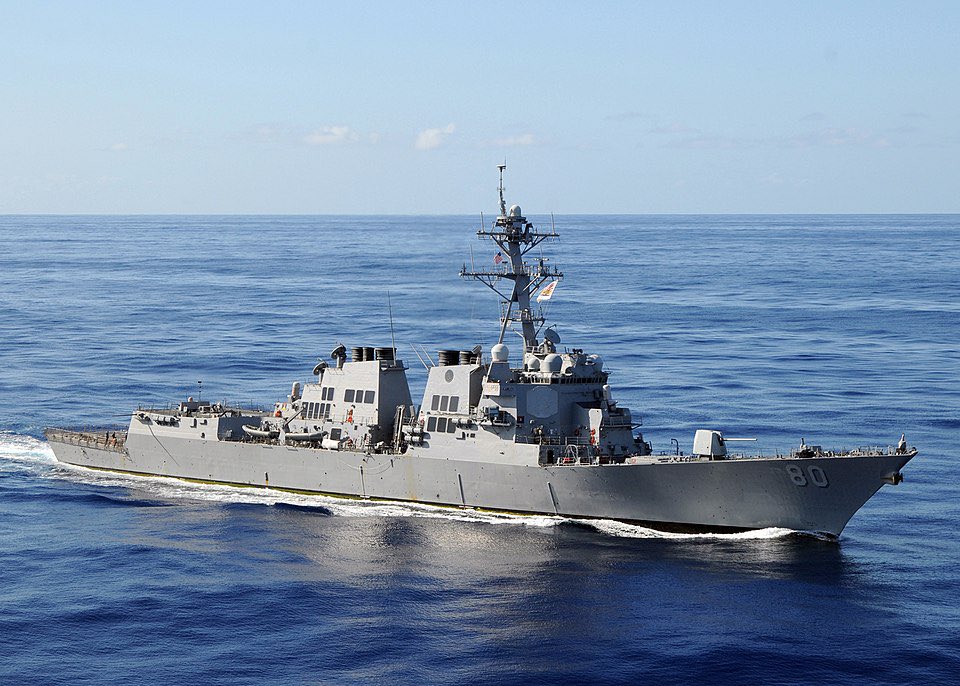
Image: from Open Source Intel X@Osint613
WASHINGTON/DUBAI – The U.S. Maritime Administration (MARAD) issued a high-level emergency advisory on Monday, instructing all American-flagged commercial vessels to stay “as far as possible” from Iranian territorial waters. The warning, effective until August 2026, marks a significant escalation in maritime security protocols following a series of aggressive encounters in the Persian Gulf and the Strait of Hormuz.
The Trigger: A “Near-Seizure” in the Strait
The move follows a high-stakes incident on February 3, involving the M/V Stena Imperative, a U.S.-flagged tanker under contract with the Department of Defense. According to U.S. Central Command (CENTCOM), two Islamic Revolutionary Guard Corps (IRGC) fast-attack boats and a Mohajer drone approached the tanker at high speeds, ordering the captain to stop engines for boarding.
The situation was only de-escalated when the USS McFaul, an Arleigh Burke-class destroyer, arrived on the scene with overhead support from U.S. Air Force jets to escort the vessel to safety. This incident occurred just hours after an F-35C from the USS Abraham Lincoln strike group shot down an Iranian Shahed drone that had “aggressively approached” the aircraft carrier in the Arabian Sea.
New Rules of Engagement for Sailors
The MARAD Advisory (2026-001) provides specific, unprecedented instructions for ship masters transiting the region:
-
The “Oman Route”: Eastbound vessels are urged to hug the territorial waters of Oman to maximize distance from Iran’s coastline.
-
Refusal of Entry: Masters are advised to verbally decline any Iranian requests to board, citing international law and the Law of the Sea Convention, provided it does not compromise the immediate safety of the crew.
-
No Forcible Resistance: In a sobering directive, the advisory states that if Iranian forces do successfully board a vessel, the crew should not offer forcible resistance, as this could lead to a lethal escalation or a broader regional conflict.
-
AIS Discipline: Ships are told to keep their Automatic Identification System (AIS) transponders on at all times, as Iran has frequently used “silent” transponders as a pretext for seizing vessels on smuggling charges.
Geopolitical Context: Diplomacy Under Fire
The maritime friction stands in stark contrast to the diplomatic efforts currently underway in Muscat, Oman. Indirect talks between the Trump administration and Tehran reportedly began on February 6, with both sides signaling a desire to avoid a full-scale war.
However, the “pressure campaign” continues on both sides. President Trump recently signed an executive order imposing a 25% tariff on any country purchasing Iranian goods, while senior IRGC officials have warned that the U.S. should “prepare coffins” for its troops if Washington initiates military strikes.
For the global energy market, the advisory is a chilling reminder of the fragility of the Strait of Hormuz, a chokepoint through which one-fifth of the world’s oil supply passes daily.