
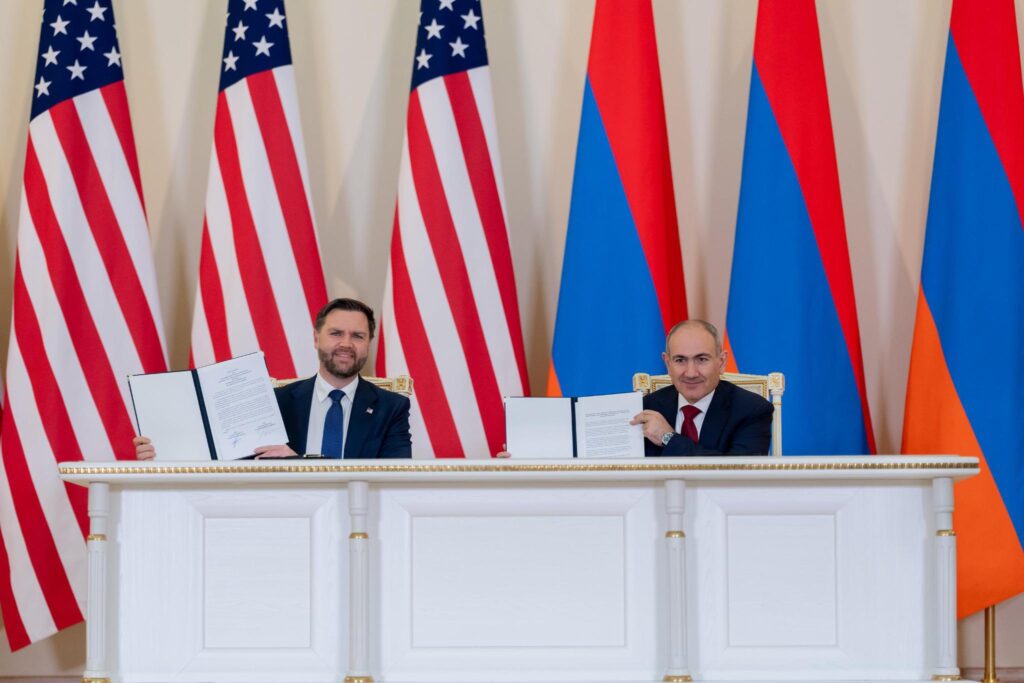
Image: from Vice President JD Vance X@VP
YEREVAN – In a move that signals a tectonic shift in South Caucasus geopolitics, U.S. Vice President JD Vance and Armenian Prime Minister Nikol Pashinyan have formalized a landmark agreement on peaceful nuclear cooperation and a breakthrough defense sale.
The visit, marking the first time a sitting U.S. Vice President has set foot in Armenia, underscores Washington’s aggressive push to decouple the former Soviet republic from its traditional reliance on Moscow.
A $9 Billion Nuclear Future
The cornerstone of the visit was the signing of the “Joint Statement on the Completion of Negotiations on an Agreement for Peaceful Nuclear Cooperation.” This framework paves the way for the deployment of American Small Modular Reactor (SMR) technology in Armenia, intended to replace the aging, Soviet-era Metsamor nuclear plant.
Vice President Vance announced that the pact would underpin up to $9 billion in planned U.S. engagement in Armenia’s energy sector.
-
Phase One: An initial $5 billion investment tranche to kickstart infrastructure and technology transfer.
-
Phase Two: An additional $4 billion allocated for long-term fuel and maintenance contracts.
“This is a classic win-win,” Vance stated during a joint press conference. “We are exporting world-class American technology to secure Armenia’s energy independence while creating high-tech jobs back home.”
📸Vice President Vance and @SLOTUS in Yerevan, Armenia, where VP Vance and Prime Minister Nikol Pashinyan signed a historic civil nuclear agreement. pic.twitter.com/ggLWck4soV
— Vice President JD Vance (@VP) February 9, 2026
Breaking the Russian Defense Monopoly
In a move described as “modest but symbolic,” Prime Minister Pashinyan confirmed Armenia’s first-ever purchase of U.S. military hardware: an $11 million deal for V-BAT reconnaissance drones.
While the dollar amount is small compared to regional spending, the strategic implications are vast. The V-BAT, a vertical take-off and landing (VTOL) UAV, represents a shift away from Russian procurement. Pashinyan noted that the purchase follows three years of joint “Eagle Partner” military exercises, signaling that Armenia is now ready to integrate NATO-standard technology into its defense architecture.
The “Trump Route” (TRIPP)
Central to the discussions was the Trump Route for International Peace and Prosperity (TRIPP). This proposed 43-kilometer transit corridor through Armenia’s Syunik region is designed to link Azerbaijan to its Nakhchivan exclave.
Vance described TRIPP as a “transformative” project that would bypass Russian and Iranian influence, positioning Armenia as a central hub for east-west trade. Under current proposals, the United States would take a 74% controlling stake in the company developing the corridor for the first 49 years, ensuring Western oversight of the strategic artery.
Regional Repercussions
The visit comes at a time of “divorce” between Armenia and the Russia-led CSTO alliance. By offering nuclear sovereignty and advanced tactical drones, the Trump administration is effectively betting on Armenia as a new democratic partner in a region once considered Russia’s “backyard.”
However, the visit was not without tension. Protesters gathered in Yerevan to demand stronger U.S. action regarding Armenian prisoners held in Baku and the protection of Christian heritage in Nagorno-Karabakh, reminding the delegation that for many Armenians, “peace” remains a fragile and costly ambition.